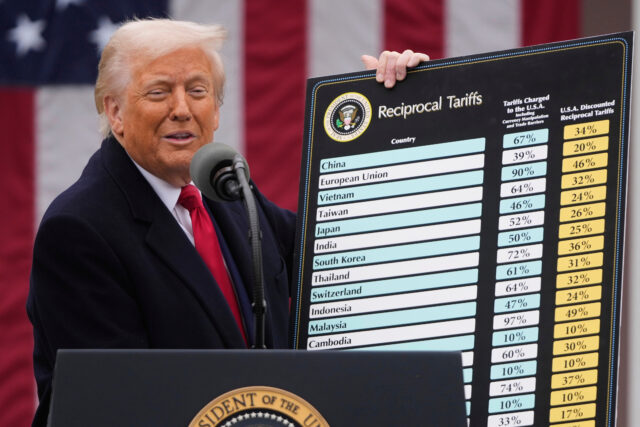
WASHINGTON — The fate of much of Donald Trump’s sweeping tariff programme hangs in the balance as the Supreme Court of the United States prepares to decide whether the former president improperly invoked the 1977 International Emergency Economic Powers Act (IEEPA) to impose broad import levies.
Lower courts have already ruled that Trump “exceeded his authority” by relying on IEEPA to justify his sweeping “reciprocal” duties targeting U.S. trading partners—and separate levies aimed at China, Canada and Mexico. The January‑April 2025 tariff campaign relied on emergency powers to impose import taxes without the usual congressional tariff authorisations.
Should the Supreme Court uphold those rulings, Trump would face a constrained set of options. He could attempt to rely on alternate statutes — such as the Trade Act of 1974 — which allow import duties but with stricter limits (such as a 15 % cap and 150‑day duration). He could seek fresh congressional legislation to grant new authority for broad tariffs. Or he could restructure his approach, scaling back tariffs to fit more established legal frameworks.
In the meantime, market observers are already preparing for fallout if the tariffs are struck down. A large number of companies that paid the higher duties could move to seek refunds. As Bloomberg notes: “Wall Street is betting on tariff refunds if the Supreme Court rules against Trump.”

From Trump’s perspective, the stakes are high. The tariff campaign had formed a central element of his trade‑policy strategy and leveraged revenue from import duties as part of broader fiscal and geopolitical manoeuvres. A reversal could not only undercut that strategy but also raise questions about executive‑branch reach in trade and national‑security matters.
Yet even with a negative ruling, the tariffs would not instantly disappear: the specifics of relief, refund eligibility and legal enforcement would still require further judicial and administrative action. The Supreme Court decision may serve more as a guidepost than a switch‑flip for immediate change.
As Bloomberg observes, “The future of much of President Donald Trump’s tariff campaign rests in the hands of the U.S. Supreme Court, which will decide whether he can use an emergency law that had previously never been wielded to impose import taxes.”
With the hearing ahead, trade lawyers, affected importers and global partners of the United States await the court’s decision — knowing that whichever way the ruling goes, the ripple effects may reshape U.S. trade policy and executive‑branch authority for years to come.
Disclaimer
Artificial Intelligence Disclosure & Legal Disclaimer
AI Content Policy.
To provide our readers with timely and comprehensive coverage, South Florida Reporter uses artificial intelligence (AI) to assist in producing certain articles and visual content.
Articles: AI may be used to assist in research, structural drafting, or data analysis. All AI-assisted text is reviewed and edited by our team to ensure accuracy and adherence to our editorial standards.
Images: Any imagery generated or significantly altered by AI is clearly marked with a disclaimer or watermark to distinguish it from traditional photography or editorial illustrations.
General Disclaimer
The information contained in South Florida Reporter is for general information purposes only.
South Florida Reporter assumes no responsibility for errors or omissions in the contents of the Service. In no event shall South Florida Reporter be liable for any special, direct, indirect, consequential, or incidental damages or any damages whatsoever, whether in an action of contract, negligence or other tort, arising out of or in connection with the use of the Service or the contents of the Service.
The Company reserves the right to make additions, deletions, or modifications to the contents of the Service at any time without prior notice. The Company does not warrant that the Service is free of viruses or other harmful components.