

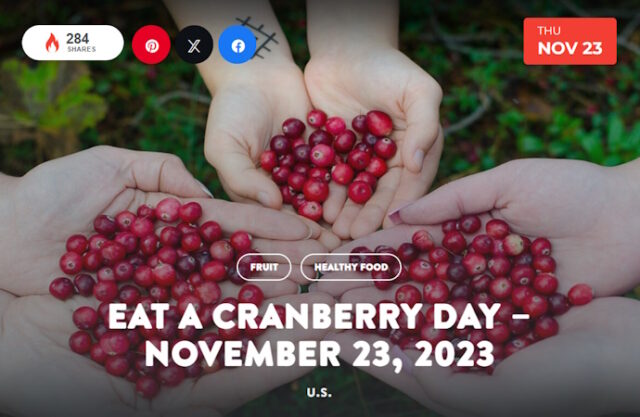
Another seasonal holiday staple graces the table each year and National Cranberry Relish Day makes sure you’re prepared. On November 23rd make sure you’re stocked and ready. Get tasting the many recipes out there and pick your favorite one!
- 1647 – Missionary John Elliot names the fruit ‘cranberry,’ derived from the German ‘kraanbere’ and English ‘craneberry.’
- 1683 – American settlers make the first-ever cranberry juice.
- 1796 – The first acknowledgment of a cranberry sauce recipe can be found in the 1796 cookbook American Cookery by Amelia Simmons, which calls for serving roast turkey with “boiled onions and cranberry sauce,” according to The Washington Post.
- 1816 – Veteran Henry Hall mass cultivates cranberries for the first time in Dennis, Massachusetts.
- 1868 – In 1868 a standard 100 lb. barrel of cranberries sold for $0.58 in Philadelphia, PA.
- 1880s – a New Jersey grower named John “Peg Leg” Webb discovered that cranberries bounce.
- 1900s – Believed to have originated in the New England States during the early 1900s, cranberry relish is a traditional part of many families’ Thanksgiving dinners.
- 1912 – Canned cranberry sauce got its start in 1912 when cranberry growers Marcus L. Urann and Elizabeth Lee started working together to create a jellied sauce, which was concocted by boiling the bruised berries from the bog (say that 3 times fast).
- 1941 – Cranberry sauce in a can became a Thanksgiving staple across the country by 1941.
- 1959 – Thanks to this significant health scare, Americans have a cranberry-less Thanksgiving for the first time in a long while.
- 1959 or 1971 – Each Thanksgiving, Susan Stamberg provides National Public Radio listeners with her mother-in-law’s recipe for cranberry relish sauce. She has been doing this since 1971. What’s unusual about the special recipe, known as Mama Stamberg’s Cranberry Relish, is that horseradish is one of its principal ingredients. Craig Claiborne originally published the recipe in his food column in 1959.
- 1980 – John Lennon confirmed in a 1980 interview that he repeated the words cranberry sauce at the end of the song “Strawberry Fields Forever.”
- 1994 – The Cranberry was made the official state berry of Massachusetts.
- 2015 – Eat A Cranberry Day is first mentioned and celebrated on the World Wide Web.
- If you strung all the cranberries produced in North America last year, they would stretch from Boston to Los Angeles more than 565 times.
- Legend has it that Pilgrims served cranberries, along with wild turkey and succotash, at the first Thanksgiving in Plymouth, Massachusetts.
- There are several theories as to the origin of the name ‘cranberry.’ One is that the open flowers look like the head of a crane; another is that cranes like these sour berries.
- Americans consume 400 million pounds of cranberries each year. 20 percent are eaten during Thanksgiving week.
- The cranberry is one of three fruits native to North America. The other two are the Concord grape and the blueberry.
- There are approximately 333 cranberries in a pound, 3,333 cranberries in one gallon of juice, and 33,333 cranberries in a 100-pound barrel.
- Cranberry juice contains a chemical that blocks pathogens that cause tooth decay
- 90% of all cranberries are wet harvested. The bog is flooded then a great big eggbeater knocks the berries off the vine. They float up to the top of the water where they are scooped up.
- Cranberries can be stored in the refrigerator for up to one month, or in the freezer for up to nine months.
- Massachusetts-based Ocean Spray, the largest producer of cranberry products in the U.S., produces about 79 million cans of jellied cranberry sauce each year, 85 percent of which are sold during the Thanksgiving and Christmas holidays.
- Jellied cranberry sauce from a can (the log) is most preferred by consumers totaling 75% of overall cranberry sauce sales.
- It takes about 200 cranberries to make one can of cranberry sauce.
- Why does it wiggle? Because cranberries have a high pectin content, which causes the fruit to “gel.” Pectin is a key ingredient added when making jellies or jams.
- There’s a reason the cans are upside down. The rounded edge, which is typically at the bottom of canned goods, is at the top of cranberry sauce. According to an Ocean Spray representative: “The rounded end of the can is filled with an air bubble vacuum, which makes it easier to get the sauce out.”
- In their rawest, purest form, cranberries are great for oral and dental hygiene.
- Cranberries are 90% water.
Sources:

Disclaimer
Artificial Intelligence Disclosure & Legal Disclaimer
AI Content Policy.
To provide our readers with timely and comprehensive coverage, South Florida Reporter uses artificial intelligence (AI) to assist in producing certain articles and visual content.
Articles: AI may be used to assist in research, structural drafting, or data analysis. All AI-assisted text is reviewed and edited by our team to ensure accuracy and adherence to our editorial standards.
Images: Any imagery generated or significantly altered by AI is clearly marked with a disclaimer or watermark to distinguish it from traditional photography or editorial illustrations.
General Disclaimer
The information contained in South Florida Reporter is for general information purposes only.
South Florida Reporter assumes no responsibility for errors or omissions in the contents of the Service. In no event shall South Florida Reporter be liable for any special, direct, indirect, consequential, or incidental damages or any damages whatsoever, whether in an action of contract, negligence or other tort, arising out of or in connection with the use of the Service or the contents of the Service.
The Company reserves the right to make additions, deletions, or modifications to the contents of the Service at any time without prior notice. The Company does not warrant that the Service is free of viruses or other harmful components.









 is most preferred by consumers totaling 75% of overall cranberry sauce sales.)