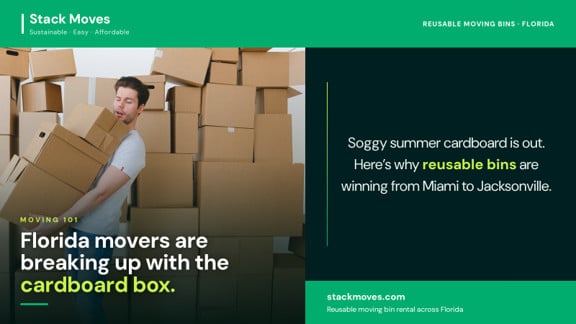
If you’ve ever moved in Florida during the summer, you probably know the feeling. You tape up a stack of cardboard boxes in the morning, load them onto a dolly, and by the time they have sat in a humid garage or the back of a truck for a few hours, the bottoms have gone soft and the corners are sweating. Somewhere between the old place and the new one, a box gives out, and a lamp or a set of dishes pays the price.
It is a small annoyance most of us have accepted as part of the deal. Moving is chaos, boxes are cheap, and cheap things fail. But a growing number of Florida households — from Miami and Fort Lauderdale to Orlando, Tampa, and Jacksonville — are starting to question whether the cardboard box — a piece of packing technology that has barely changed in a century — is really the smartest way to haul everything they own across town.
The quiet cost of the cardboard box
The numbers behind America’s moving habit are bigger than most people realize. Roughly 900 million cardboard boxes are used and discarded during U.S. residential moves every year, and only about 60 percent of the cardboard actually gets recycled as it should. The rest ends up in landfills or soggy at the curb after an afternoon storm.
There is a climate footprint too. Manufacturing a single cardboard box — pulping the fiber, running the mills, trucking the finished product to a store near you — emits roughly the same amount of carbon as burning a fifth of a gallon of gasoline. Multiply that across an entire moving season in a fast-growing state like Florida, where people are constantly arriving, upgrading, and relocating, and the throwaway box starts to look less like a bargain and more like a habit worth breaking.

Then there is the practical reality of our climate. Cardboard and humidity are natural enemies. Boxes that were sturdy in an air-conditioned bedroom lose their backbone fast in a driveway that hits 95 degrees, and a surprise downpour can turn a neatly packed stack into a pulpy mess. For a state that spends half the year in high humidity and hurricane watches, a packing material that weakens when it gets wet is a genuinely poor fit.
A rental model borrowed from smarter industries
The alternative gaining traction is refreshingly simple: instead of buying boxes you will throw away, you rent bins you return. Companies built around this idea deliver stacks of durable, reusable plastic containers to your door, let you pack at your own pace, and then come back to collect them once you are settled. No flattening, no tape, no last-minute run to the store for “just five more boxes.”
Stack Moves is one of the companies leaning into that model, and its residential moving service is a useful window into how the approach works in practice. Customers pick a bundle sized to their home — anywhere from a studio to a five-bedroom house — and the bins arrive pre-assembled and sanitized. You pack, you move, and the company handles pickup afterward. The bins themselves are rigid, weatherproof, and stackable, which matters when your belongings are riding out a bumpy drive on I-95 or sitting in a garage overnight.
The environmental math is where the model really separates itself. According to the company’s own sustainability breakdown, each reusable bin is built to withstand 500-plus moves before retirement, meaning a single crate effectively replaces hundreds of one-and-done cardboard boxes over its lifetime. The company estimates the reusable approach cuts packaging-related carbon emissions by roughly 80 percent compared with single-use cardboard. Whether or not you track your household’s carbon footprint, that is a meaningful reduction hiding inside an ordinary errand.
Does it actually make sense for a Florida move?
The honest answer is: it depends on your move, and that is worth being clear-eyed about. Reusable bin rental tends to shine for local and regional moves — the kind where a company can drop bins off and pick them up within a reasonable service radius. Stack Moves, for example, publishes its coverage area openly, and its locations list shows service across the state’s major metros — Miami-Dade, Broward, and Palm Beach in the south, plus Orlando, Tampa, Jacksonville, and the Naples–Fort Myers stretch on the Gulf coast. For a cross-country move where you are driving your own belongings a thousand miles, the return logistics get trickier, and traditional boxes may still win.
Cost is the other honest variable. Rental bins are not free, and for a bare-bones move where you can scavenge free boxes from a grocery store, cardboard will be cheaper on paper. But that comparison often misses the hidden costs of the cardboard route: the tape, the time spent sourcing and assembling boxes, the gas burned driving around to collect them, and the occasional replacement of whatever broke when a box failed. When people price it all out, the gap narrows considerably — and for a lot of busy households, the time saved is worth more than the difference.
For anyone trying to figure out what a reusable move would actually require, a little planning goes a long way. Most services offer a sizing tool to estimate how many bins a given home needs; Stack Moves has a moving box calculator that maps home size to a recommended bundle, which takes some of the guesswork out of the decision before you commit.
A small change with a long tail
None of this requires a grand statement about sustainability. Most people who switch to reusable bins do it because it is easier and cleaner, and the environmental benefit is a bonus they feel good about rather than the reason they signed up. That is usually how durable habits form — not through guilt, but through convenience that happens to point in a better direction.
Florida is one of the most mobile states in the country. People move here, move within it, and move out of it constantly, and every one of those moves has historically meant another pile of boxes headed for the curb. The shift toward reusable packaging is still early, and it will not fit every situation. But the next time you are staring down a move in the summer heat, it is worth remembering that the sweaty, sagging cardboard box is a choice — and, increasingly, not the only one.
Disclaimer
Artificial Intelligence Disclosure & Legal Disclaimer
AI Content Policy.
To provide our readers with timely and comprehensive coverage, South Florida Reporter uses artificial intelligence (AI) to assist in producing certain articles and visual content.
Articles: AI may be used to assist in research, structural drafting, or data analysis. All AI-assisted text is reviewed and edited by our team to ensure accuracy and adherence to our editorial standards.
Images: Any imagery generated or significantly altered by AI is clearly marked with a disclaimer or watermark to distinguish it from traditional photography or editorial illustrations.
General Disclaimer
The information contained in South Florida Reporter is for general information purposes only.
South Florida Reporter assumes no responsibility for errors or omissions in the contents of the Service. In no event shall South Florida Reporter be liable for any special, direct, indirect, consequential, or incidental damages or any damages whatsoever, whether in an action of contract, negligence or other tort, arising out of or in connection with the use of the Service or the contents of the Service.
The Company reserves the right to make additions, deletions, or modifications to the contents of the Service at any time without prior notice. The Company does not warrant that the Service is free of viruses or other harmful components.