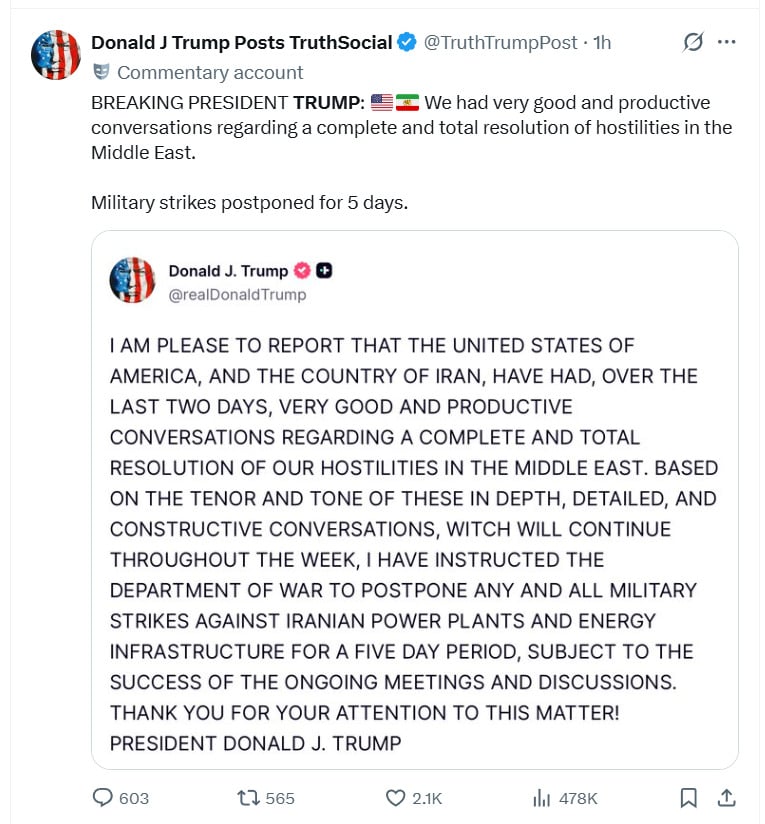
The brief reprieve in Middle Eastern tensions took an immediate and confusing turn on Monday. Hours after President Donald Trump announced a five-day postponement of planned military strikes against Iran’s power infrastructure, citing “very good and productive” conversations, Tehran issued a swift and absolute denial, stating that no such negotiations have occurred.
This dramatic contradiction between Washington and Tehran casts a deep shadow over what was briefly perceived as a diplomatic breakthrough. The geopolitical chessboard has been thrown into disarray, leaving international observers and regional powers scrambling to discern the true state of affairs between the two arch-rivals.
The Administration’s Narrative
The day began with a wave of cautious optimism. In a statement released via social media and a formal White House briefing, the President announced he was pausing the massive kinetic operation he had threatened only 48 hours earlier. That ultimatum had given Iran until this morning to unconditionally reopen the Strait of Hormuz, which it had closed following a series of maritime skirmishes and retaliatory attacks that began in late February. The President had previously vowed “total and complete obliteration” of Iran’s energy grid, starting with its primary generation facilities, if the ultimatum was not met.

The Trump administration characterized the sudden pivot as a response to private, high-level diplomatic outreach. “We have received very productive communication from representatives in the Islamic Republic, suggesting a willingness to de-escalate,” a National Security Council official stated. The President himself emphasized the constructive tone of these alleged discussions, stating, “We’ve had very good and productive conversations over the last 48 hours. I think we have a real opportunity here to solve this. Because of this progress, I am halting all imminent military plans for five days.”
Following this, the Department of Defense confirmed that it had received orders to stand down on all planned airstrikes and cyberattacks against Iranian power generation and transmission sites until the end of the week. This pause was explicitly linked to the assumption that this “fruitful” dialogue would continue.
The Iranian Denial
The optimism was almost immediately punctured. Within two hours of the President’s statement, Iran’s official state news agency, IRNA, released a blunt and unequivocal rejection of the narrative. “The assertions made by the President of the United States regarding ‘productive talks’ are sheer fabrications,” an official statement from the Iranian Ministry of Foreign Affairs declared. “There have been no negotiations, direct or indirect, between the Islamic Republic of Iran and the current United States administration. Our position remains unchanged: the closure of the Strait of Hormuz is a sovereign security measure, and we will not negotiate under threat or coercion.”
The statement further characterized the U.S. narrative as a desperate attempt to avoid a catastrophic regional conflict while appearing to maintain the upper hand. Some senior figures in the Islamic Revolutionary Guard Corps (IRGC) went further, describing the postponement of the strikes as a “strategic retreat” by Washington, forced by Tehran’s firm and visible warnings of reciprocal devastation. Iran has repeatedly threatened that any strike on its grid would trigger immediate, crippling retaliation against critical energy and water infrastructure across the Gulf, targeting both U.S. military bases and allied nations.
The Cost of Uncertainty
The stark disconnect between the two sides has plunged the international community into a diplomatic twilight zone. The initial five-day pause was predicated on a bilateral willingness to talk; it is now unclear whether a genuine channel exists, or if the entire narrative was constructed for domestic or strategic messaging by either side.
Regional allies, including Israel, Saudi Arabia, and the United Arab Emirates, are closely monitoring the confusion, having been prepared for an immediate U.S. military campaign. The humanitarian stakes remain immense. Legal scholars and humanitarian organizations have warned that a strike on Iran’s electrical grid—composed of over 110 facilities—would cause a “cascade of catastrophe,” crippling hospitals, water treatment plants, and food supply chains, and impacting the 90 million civilians who would bear the brunt of the blackouts.
Regional and Economic Reactions
Despite the confusion, the direct military de-escalation for the next five days had a cooling effect on world markets. Oil prices, which had peaked above $100 per barrel during the 48-hour ultimatum, fell sharply as the immediate risk of a full regional war subsided. Brent crude traded down by more than 14% on Monday, settling near $96 per barrel. However, energy analysts note that this is a fragile stabilization, dependent entirely on the perceived likelihood of a full conflict being permanently averted by the week’s end. If the diplomatic confusion leads to an immediate renewal of threats, the market volatility is expected to return with intensity.
For now, the world waits to see if this five-day window will be filled by genuine de-escalation, a frantic backchannel to correct the narrative, or merely a brief pause before a deeper conflict resumes.
Current Cost of Gasoline
As of March 23, 2026, the national average for gasoline in the United States is $3.91 per gallon. This price reflects a roughly 33% increase over the last three weeks, driven primarily by the instability in the Middle East and the closure of the Strait of Hormuz. Analysts suggest that if the current diplomatic pause fails and conflict resumes, a national average exceeding $4.00 is highly likely.
Sources and Links
- Axios: Trump says he’s pausing Iran energy strikes for 5 days amid talks
- Michigan Public (NPR): U.S. will hold off striking Iran’s power plants for 5 days after ‘productive’ talks
- The Hindu: Iran-Israel war LIVE: Trump says postponing Iran power plant strikes for five days
- Euractiv: Trump suspends threat to ‘obliterate’ Iran’s power plants pending further talks
- Press TV (Iran): Tehran denies any dialogue with Washington as “fabrication”
- The Washington Post: These car brands could suffer the most with soaring gas prices
- Trading Economics: Gasoline – Price – Chart – Historical Data
Disclaimer
Artificial Intelligence Disclosure & Legal Disclaimer
AI Content Policy.
To provide our readers with timely and comprehensive coverage, South Florida Reporter uses artificial intelligence (AI) to assist in producing certain articles and visual content.
Articles: AI may be used to assist in research, structural drafting, or data analysis. All AI-assisted text is reviewed and edited by our team to ensure accuracy and adherence to our editorial standards.
Images: Any imagery generated or significantly altered by AI is clearly marked with a disclaimer or watermark to distinguish it from traditional photography or editorial illustrations.
General Disclaimer
The information contained in South Florida Reporter is for general information purposes only.
South Florida Reporter assumes no responsibility for errors or omissions in the contents of the Service. In no event shall South Florida Reporter be liable for any special, direct, indirect, consequential, or incidental damages or any damages whatsoever, whether in an action of contract, negligence or other tort, arising out of or in connection with the use of the Service or the contents of the Service.
The Company reserves the right to make additions, deletions, or modifications to the contents of the Service at any time without prior notice. The Company does not warrant that the Service is free of viruses or other harmful components.