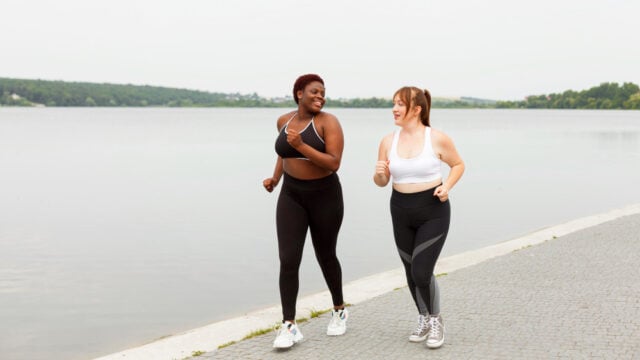
- Why we’re talking about this: Walking is great for your health—but small changes can make it an even more effective workout.
- What to do: Increase intensity with hills, intervals, or short strength exercises instead of simply walking farther.
- Looking ahead: Challenging your walking routine can help build strength, endurance, and long-term fitness.
Walking is one of the best things you can do for your health—but once it becomes routine, it may be time to make it more challenging. If you’re ready to level up, try turning your daily stroll into more of a workout. Whether you increase distance or add effort, even small adjustments can have a major impact on your fitness and overall health.
1. Get 10,000+ Steps a Day
There’s a reason why reaching 10,000 steps daily is a common target on fitness trackers. These steps help manage weight and keep your heart healthy.
If you’re a beginner, start by gradually increasing your daily step count until you reach 10,000. After mastering this, try challenging yourself to reach 15,000-25,000 steps each day.
Here are some ways to amp up the intensity of your walks:

- Try a hilly route.
- Wear two- to three-pound ankle and hand weights.
- Incorporate toning exercises every few minutes, such as jumping jacks, walking lunges, squats, or squat jumps. Adding these moves in intervals can help you build muscle, improve heart health, and increase endurance.
2. Walk 30 Minutes Daily
“Walking for at least 30 minutes per day, five days a week, helps maintain a healthy weight,” Amy Rothberg, MD, an endocrinologist and clinical professor of internal medicine at the University of Michigan, told HEALTH. And you don’t have to log all 30 minutes in a single session. “You can do your 30 minutes in 10-minute bouts throughout the day.”
Walking in small bursts may even be more beneficial than a continuous 30-minute walk. Short, vigorous activities can boost your fitness level, while low-intensity exercises like brisk walking help burn stored fat.
Walking in short intervals may also provide confidence boosts to keep you motivated. “Whether it’s parking farther away or walking to meet a colleague, you get a sense of accomplishment,” said Rothberg. “It’s these little successes that end up establishing good habits.”
35 Amazing Scientific Health Benefits of Running (+10 Tips for Beginners)
3. Add Jogging Intervals
“Adding running intervals to your walks can help you burn more calories,” Jeff Galloway, a running coach, told HEALTH. “Plus, easing into running like that allows you to build up your distance while avoiding injury.”
- Begin by jogging for 5-10 seconds per minute for 10 minutes.
- Then, gradually increase to 30 minutes.
- Once you reach this goal, extend your jogging periods until you jog for 30 seconds per minute for 30 minutes.
“Eventually, you can build up to short walk breaks,” said Galloway. “For example, walk for 30 seconds, then run for 60 seconds. That method can help you train for a 5K or even longer race.”
Tips for Runners:
“If you’re a regular runner with a 10-minute mile average, alternate 90 seconds of running with 30 seconds of walking,” said Galloway. “If you average a 12-minute mile, try alternating 60 seconds of running and 30 seconds of walking.”
How Else Can You Elevate Your Walking Workout?
These other techniques can help make your walking routine more interesting:
- Switch up your pace.
- Walk on an incline at the gym or add elevation changes, like hills or stairs, to your route.
- Walk outdoors.
- Ask a friend to join you.
- Listen to music.
- Try a walking meditation.
- Track your progress
Tip: Join a walking group!
Research suggests walking with groups may improve quality of life and lower the risk of depression.
What Does Walking Do for Your Health?
Walking is a simple way to add movement to your routine. Studies suggest that walking at a steady pace may reduce certain health risks, similar to running.
“Walking is one of the best tools for weight maintenance,” Rothberg said. “It’s aerobic, it engages some of the biggest muscles, and it’s feasible for most people.”
Walking can:
- Decrease risk of heart disease, diabetes, and certain cancers
- Lower low-density lipoprotein (LDL) cholesterol levels
- Improve metabolic health (how the body burns energy from food and drinks)
- Boost energy
- Lower blood pressure
- Improve sleep
- Decrease the risk of mental health conditions
- Lower blood sugar levels
Remember: The best walking routine is one you enjoy and will do consistently. Trying new exercises can help you determine what works for you.
Disclaimer
Artificial Intelligence Disclosure & Legal Disclaimer
AI Content Policy.
To provide our readers with timely and comprehensive coverage, South Florida Reporter uses artificial intelligence (AI) to assist in producing certain articles and visual content.
Articles: AI may be used to assist in research, structural drafting, or data analysis. All AI-assisted text is reviewed and edited by our team to ensure accuracy and adherence to our editorial standards.
Images: Any imagery generated or significantly altered by AI is clearly marked with a disclaimer or watermark to distinguish it from traditional photography or editorial illustrations.
General Disclaimer
The information contained in South Florida Reporter is for general information purposes only.
South Florida Reporter assumes no responsibility for errors or omissions in the contents of the Service. In no event shall South Florida Reporter be liable for any special, direct, indirect, consequential, or incidental damages or any damages whatsoever, whether in an action of contract, negligence or other tort, arising out of or in connection with the use of the Service or the contents of the Service.
The Company reserves the right to make additions, deletions, or modifications to the contents of the Service at any time without prior notice. The Company does not warrant that the Service is free of viruses or other harmful components.