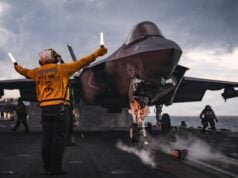
Tensions between the United States and Iran escalated sharply on Saturday after a dangerous exchange across Gulf waters. Iranian forces fired ballistic missiles directly at two American warships patrolling regional waters. According to U.S. Central Command, both vessels successfully evaded the incoming missiles. No American military personnel suffered injuries during the barrage. The Pentagon responded quickly and decisively. American forces launched strikes against three crude oil carriers linked to Tehran’s Islamic Revolutionary Guard Corps.
“Let the message to the IRGC be clear: If you shoot at two of our ships, we will impose an even higher economic cost —taking out three of yours. We will not hesitate to defend American forces, and if necessary, destroy Iran’s limited and exposed oil fleet.” — Adm. Brad Cooper,… pic.twitter.com/UGGcSGsUtd
— U.S. Central Command (@CENTCOM) September 5, 2026
Thanks to the precision and professionalism of American service members, the M/T Kylo sank in the Gulf of Oman today and joined Iran’s navy at the bottom of the sea. pic.twitter.com/OwSDMl8SSQ
— U.S. Central Command (@CENTCOM) September 6, 2026

IRIB claims Iran targeted three vessels in the Strait of Hormuz and three American ships. Tehran says the strike is retaliation for U.S. attacks on three Iranian tankers. pic.twitter.com/jeFAGZZvKk
— Open Source Intel (@Osint613) September 5, 2026
U.S. officials made their stance clear from the start. Admiral Brad Cooper, the CENTCOM commander, issued a blunt public warning following the counterstrike. He stated that targeting two American ships would cost Iran three of its own. Cooper also warned that the U.S. would not hesitate to destroy Iran’s exposed tanker fleet. Washington described the targeted vessels as key funding sources for the IRGC and its regional proxies.
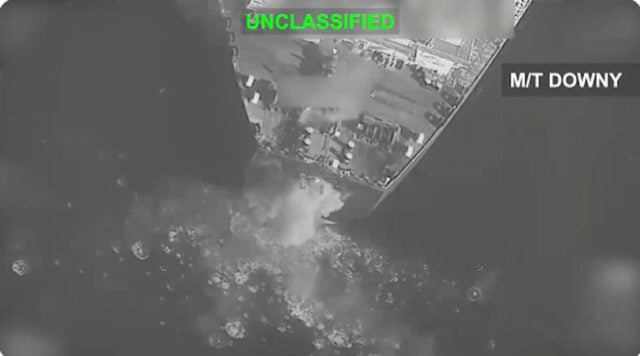
The American military detailed exactly how the counterstrikes unfolded across regional waterways. Forces permanently disabled the tanker M/T Downy off the coast of Kharg Island. That location serves as a primary export terminal for Iranian oil shipments. A second vessel, the M/T Stark 1, was disabled near the port of Jask. Further out, the U.S. targeted a third tanker, the M/T Kylo, in the Gulf of Oman. American forces ordered the crew of the Kylo to abandon ship before opening fire. Multiple precision strikes left the vessel completely inoperable and burning.
Tehran offered a drastically different narrative and condemned the operation. Iran’s Foreign Ministry called the American strikes an unlawful act of economic warfare. Iranian state media claimed the Revolutionary Guard retaliated by targeting three American vessels and additional tankers. Military spokespeople in Tehran warned that future attacks on U.S. warships would become far more severe. Iranian leaders maintain that foreign naval forces have no legitimate place in their coastal waters.
This dramatic flare-up has rattled global energy markets and commercial shipping lanes. Nearly one-fifth of the world’s petroleum supply normally navigates through the narrow Strait of Hormuz. Commercial vessel traffic has dropped sharply because insurance costs and security risks have skyrocketed. Oil traders worry that further clashes could halt crude deliveries entirely. A prolonged maritime shutdown would trigger severe price spikes across global economies.
The weekend exchange marks a dangerous turning point in the months-long confrontation. By striking commercial tankers, Washington has shifted tactics to target Iran’s primary economic lifeline. Meanwhile, Tehran has shown an increased willingness to fire directly at frontline American naval assets. Neither government appears eager to back down or offer diplomatic concessions right now. Both sides seem locked into a cycle of rapid retaliation. With critical shipping routes caught in the middle, the danger of wider conflict remains exceptionally high.
International observers continue urging both nations to show restraint before the situation spirals out of control. For now, commercial ships must navigate heavily contested waters under the shadow of war. Every single patrol in the Gulf carries the risk of igniting an even larger clash. The coming days will show whether deterrence holds or tensions boil over completely.
Sources
Disclaimer
Artificial Intelligence Disclosure & Legal Disclaimer
AI Content Policy.
To provide our readers with timely and comprehensive coverage, South Florida Reporter uses artificial intelligence (AI) to assist in producing certain articles and visual content.
Articles: AI may be used to assist in research, structural drafting, or data analysis. All AI-assisted text is reviewed and edited by our team to ensure accuracy and adherence to our editorial standards.
Images: Any imagery generated or significantly altered by AI is clearly marked with a disclaimer or watermark to distinguish it from traditional photography or editorial illustrations.
General Disclaimer
The information contained in South Florida Reporter is for general information purposes only.
South Florida Reporter assumes no responsibility for errors or omissions in the contents of the Service. In no event shall South Florida Reporter be liable for any special, direct, indirect, consequential, or incidental damages or any damages whatsoever, whether in an action of contract, negligence or other tort, arising out of or in connection with the use of the Service or the contents of the Service.
The Company reserves the right to make additions, deletions, or modifications to the contents of the Service at any time without prior notice. The Company does not warrant that the Service is free of viruses or other harmful components.