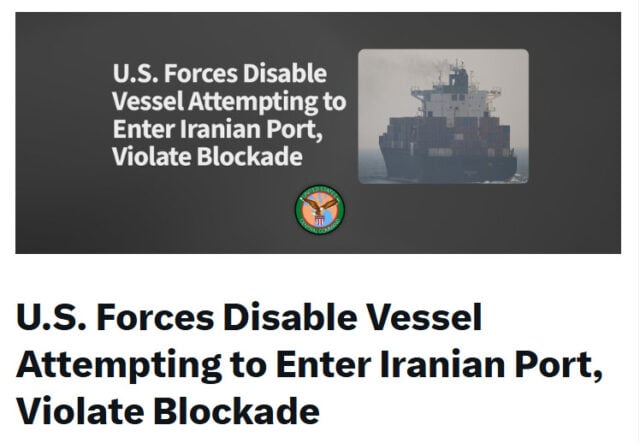
WASHINGTON — In a dramatic escalation of maritime tensions that have pushed the Middle East to the brink of a broader regional war, President Donald Trump announced Sunday that the United States Navy has forcibly seized an Iranian-flagged cargo ship in the Gulf of Oman. The vessel, identified as the Touska, was intercepted by the guided-missile destroyer USS Spruance after it allegedly ignored multiple warnings to halt and attempted to bypass a U.S.-led naval blockade of Iranian ports.
— U.S. Central Command (@CENTCOM) April 19, 2026
U.S. Navy Sailors conduct a live-fire exercise aboard Arleigh Burke-class
guided-missile destroyer USS Frank E. Petersen Jr. (DDG 121) on Jan. 23, 2026.
 Frank E. Petersen Jr. is underway conducting routine operations in the U.S.
7th Fleet area of operations. Units assigned to 7th Fleet conduct regular
Indo-Pacific patrols to deter aggression, strengthen alliances and partnerships,
and advance peace through strength.
(U.S. Navy photo by Mass Communication Specialist 2nd Class Christian Kibler)
The announcement, delivered via the President’s Truth Social platform and later confirmed by Pentagon officials, marks the first physical seizure of an Iranian commercial vessel since the “all or none” blockade policy was implemented earlier this month. In a characteristically blunt series of posts, President Trump described the operation as a necessary response to Iranian “aggression” and “total violations” of a fragile, Pakistan-brokered ceasefire.
“The Iranian crew refused to listen, so our Navy ship stopped them right in their tracks by blowing a hole in the engineroom,” Trump wrote on Sunday afternoon. “Right now, U.S. Marines have custody of the vessel… seeing what’s on board!”

The Interception of the Touska
According to U.S. Central Command (CENTCOM) and eyewitness reports from the region, the confrontation occurred early Sunday morning as the Touska—a massive vessel described by the President as nearly 900 feet long—was navigating the waters of the Gulf of Oman, approaching the strategic Strait of Hormuz.
The USS Spruance (DDG-111), an Arleigh Burke-class destroyer that has been a fixture of the U.S. 5th Fleet’s operations in the region, issued several radio warnings and visual signals to the Touska, demanding the ship submit to an inspection. Military officials stated that the Touska was suspected of carrying illicit cargo and was already under U.S. Treasury sanctions for a “prior history of illegal activity.”
When the Touska maintained its course and speed, the Spruance was authorized to use “disablement fire.” Presidential statements and subsequent military briefings confirmed that the destroyer targeted the Touska’s propulsion systems, successfully disabling the vessel without causing it to sink. Shortly thereafter, a fast-rope team of U.S. Marines boarded the ship from MH-60R Sea Hawk helicopters to take control of the bridge and engine room.
The crew of the Touska is currently being held for questioning. While no casualties were immediately reported among the crew or the boarding party, the damage to the Touska is said to be significant, rendering it unable to move under its own power. It is currently being towed to an undisclosed port for further search and investigation.
A Region Under Siege
The seizure of the Touska is the latest flashpoint in an eight-week conflict that has devastated parts of Iran and Lebanon and sent shockwaves through global energy markets. The current war, which erupted in early 2025 following a series of escalations between Israel, Hezbollah, and Iran, has already claimed the lives of at least 3,000 people in Iran and nearly 2,300 in Lebanon.
The United States, while not officially a primary combatant in the ground war, has significantly ramped up its naval presence under President Trump’s “Peace Through Strength” doctrine. The U.S. blockade, which restricts any vessels from entering or leaving Iranian ports without American clearance, was instituted after Iran was accused of mining the Strait of Hormuz and targeting international tankers.
“Iran decided to fire bullets yesterday in the Strait of Hormuz—A Total Violation of our Ceasefire Agreement!” Trump posted, referencing an incident on Saturday where Iranian forces allegedly fired on the CMA CGM Everglade, a French-flagged container ship, as well as several British-flagged vessels.
The International Maritime Organization (IMO) confirmed that the Everglade sustained minor damage north of Kumzar, Oman. These incidents effectively shredded a 10-day truce that many had hoped would lead to a permanent resolution.
The Breakdown of Diplomacy
The seizure comes at a particularly delicate moment for international diplomacy. Just days ago, there was hope that a second round of high-level talks in Islamabad, Pakistan, would provide a breakthrough. President Trump had signaled that Vice President JD Vance, along with special envoy Steve Witkoff and senior advisor Jared Kushner, were prepared to travel to Pakistan to meet with Iranian counterparts.
However, following the Touska incident and the renewed firing in the Strait, the prospects for these talks have darkened. Iran’s state-run news agency, IRNA, reported on Sunday that the Iranian government has declined to participate in the scheduled Monday evening sessions. IRNA cited Washington’s “excessive demands, unrealistic expectations, and the ongoing naval blockade” as insurmountable barriers.
Iranian President Masoud Pezeshkian, in a phone conversation with the Prime Minister of Pakistan, reportedly characterized the U.S. blockade as “provocative and illegal,” accusing the Trump administration of “bullying” behavior that undermines the very ceasefire it claims to protect.
Despite the rejection from Tehran, President Trump has remained defiant, issuing a stark ultimatum to the Iranian leadership. “We’re offering a very fair and reasonable DEAL, and I hope they take it,” he wrote. “Because, if they don’t, the United States is going to knock out every single Power Plant, and every single Bridge, in Iran.”
Economic and Strategic Fallout
The global economy is already reeling from the effective closure of the Strait of Hormuz, through which approximately 20% of the world’s oil supply passes. The price of Brent crude has spiked to levels not seen in years, prompting fears of a global recession.
While Iran recently claimed it had “reopened” the strait to commercial traffic, the U.S. naval blockade ensures that only ships approved by Washington can pass without risk of interception. This “all or none” policy is designed to drain Iran’s economic resources and force the regime to the negotiating table on U.S. terms, which include the total dismantling of its remaining nuclear infrastructure and an end to its support for regional proxies like Hezbollah and the Houthis.
Critics of the administration’s strategy, including some former diplomats, have questioned whether the current negotiating team—led by Witkoff and Kushner—has the necessary experience to navigate such a complex crisis. A recent analysis suggested that previous rounds of talks in Geneva were “ill-prepared,” potentially leading to the very misunderstandings that sparked the February and March strikes on Iranian soil.
The USS Spruance (DDG-111) has emerged as a central player in this maritime standoff. Having previously survived multiple drone and missile attacks from Houthi rebels in late 2024, the destroyer is a highly decorated vessel with a crew seasoned in high-intensity combat operations.
Equipped with the latest Aegis Baseline 9 combat system and the Optical Dazzling Interdictor, Navy (ODIN) laser system, the Spruance is uniquely capable of handling the swarm tactics and electronic warfare often employed by the Iranian Revolutionary Guard Corps (IRGC). Its successful interception of the Touska without the loss of life is being hailed by the Pentagon as a “masterclass in precision maritime interdiction.”
Looking Ahead
As of Sunday evening, the situation remains fluid. U.S. Marines continue to search the Touska, with some officials hinting that the ship may have been carrying more than just commercial goods—potentially weapons or dual-use technologies destined for regional proxies.
The international community is watching with bated breath. France and the United Kingdom, whose ships were targeted by Iranian fire on Saturday, have expressed support for the U.S. action while simultaneously urging all parties to return to the negotiating table.
For the Trump administration, the seizure of the Touska is a clear signal that the naval blockade is not merely a symbolic gesture, but an enforced reality. Whether this move provides the leverage needed to secure a “Grand Bargain” in Islamabad or serves as the final spark for a total regional conflagration remains the defining question of 2026.
Sources and Links
- WGLT: U.S. seizes Iranian cargo ship in Strait of Hormuz, Trump says
- Las Vegas Sun: The Latest: Trump says US Navy seizes Iranian-flagged cargo ship
- The Jerusalem Post: Iranian ship seized by US Navy after attempting to pass through Strait of Hormuz
- Bloomberg Government: Trump Says US Seized Iranian Ship, Blew Hole in Its Engine Room
- Time: Trump Accuses Iran of ‘Total Violation’ as Strait of Hormuz Remains Shut
- PBS NewsHour: Trump says U.S. officials will hold more talks with Iran in Pakistan
- Military.com: Iran Reopens Strait of Hormuz, but Trump Says Blockade on Iranian Ships and Ports Will Stay in Force
- Arms Control Association: Analysis: U.S. Negotiators Were Ill-Prepared for Serious Nuclear Talks With Iran
- DVIDS: USS Spruance (DDG 111) Unit Information
- Hindustan Times: Trump says Iranian-flagged vessel intercepted over trying to breach blockade
Disclaimer
Artificial Intelligence Disclosure & Legal Disclaimer
AI Content Policy.
To provide our readers with timely and comprehensive coverage, South Florida Reporter uses artificial intelligence (AI) to assist in producing certain articles and visual content.
Articles: AI may be used to assist in research, structural drafting, or data analysis. All AI-assisted text is reviewed and edited by our team to ensure accuracy and adherence to our editorial standards.
Images: Any imagery generated or significantly altered by AI is clearly marked with a disclaimer or watermark to distinguish it from traditional photography or editorial illustrations.
General Disclaimer
The information contained in South Florida Reporter is for general information purposes only.
South Florida Reporter assumes no responsibility for errors or omissions in the contents of the Service. In no event shall South Florida Reporter be liable for any special, direct, indirect, consequential, or incidental damages or any damages whatsoever, whether in an action of contract, negligence or other tort, arising out of or in connection with the use of the Service or the contents of the Service.
The Company reserves the right to make additions, deletions, or modifications to the contents of the Service at any time without prior notice. The Company does not warrant that the Service is free of viruses or other harmful components.