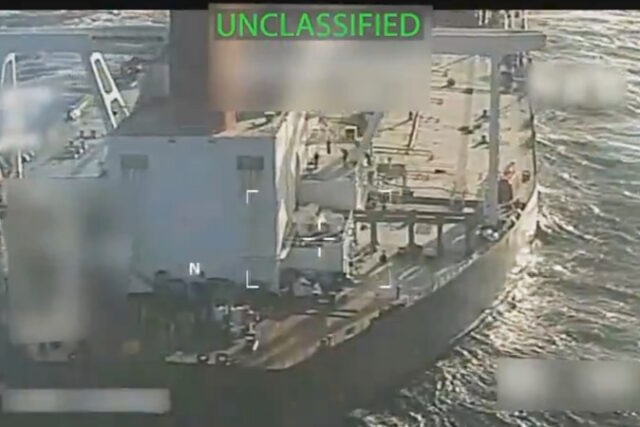
The global oil market, which had been trending toward a five-year low in late 2025, is facing a fresh wave of volatility as the United States ramps up maritime enforcement. On December 21, 2025, reports surfaced that the U.S. Coast Guard is in active pursuit of a third oil tanker in international waters near Venezuela. This move marks an aggressive expansion of the Trump administration’s “total and complete blockade” of sanctioned exports, a strategy designed to choke the financial lifelines of the Maduro regime.
The Hunt for the “Bella 1”
The vessel currently under pursuit has been identified as the Bella 1, a crude carrier suspected of belonging to the “dark fleet”—a network of aging, uninsured ships used to bypass international sanctions. This follows the high-profile seizures of the Skipper and the Centuries earlier this month.
U.S. Secretary of State Marco Rubio and Homeland Security Secretary Kristi Noem have signaled that these operations are just the beginning. With shipping data suggesting over 30 sanctioned vessels are currently operating near Venezuela, Washington appears to be using physical interdiction as a primary tool to deter what it labels “narco-terrorism” funding.
Price Predictions: Geopolitical Risk vs. The 2026 Glut
While U.S. actions have injected a “risk premium” into the market, analysts are divided on whether this will lead to a sustained price spike.

- Short-Term Bullish Pressure: Historically, the displacement of one million barrels of oil per day can translate to a $5 to $10 increase per barrel. Analysts at Goldwyn Global Strategies suggest that a total blockade of Venezuela—which currently exports roughly 765,000 barrels per day—could push prices up by $5 to $8 if the supply isn’t immediately replaced by OPEC+ spare capacity.
- The “Super-Glut” Ceiling: Despite the blockade, Westpac and the IEA maintain a bearish long-term outlook. Global supply is expected to rise by 3 million barrels per day in 2025, far outstripping tepid demand growth. This “developing super-glut” acts as a ceiling; even with the tanker seizures, WTI is struggling to stay above $57, and many analysts predict it could still test the $55 floor early next year if a Russia-Ukraine peace deal materializes.
The “Dark Fleet” Deterrent
The true impact on prices may be psychological. Experts from Vortexa note that physical seizures are a “different category of risk” compared to paper-based sanctions. By threatening the loss of the hull itself, the U.S. is making the “dark fleet” trade prohibitively expensive. This forces buyers, primarily Chinese “teapot” refiners, to demand even steeper discounts for Venezuelan Merey crude, which is already trading at $15 below ICE Brent.
While the blockade adds friction, the sheer volume of oil “on the water”—currently 24% above historical averages—suggests that, for now, the world is well-cushioned against these targeted disruptions.
Sources
- Investing.com: Oil prices rise as US pursues third Venezuelan oil tanker
- Times of India: Trump’s blockade of Venezuela’s oil tankers: Impact on global crude
- ING Think: The Commodities Feed: Trump’s Venezuelan oil tanker blockade
- CSIS Analysis: Why Did the United States Seize a Venezuelan Oil Shipment?
- Atlantic Council: What Trump’s Venezuela oil blockade means for Maduro and the world
Disclaimer
Artificial Intelligence Disclosure & Legal Disclaimer
AI Content Policy.
To provide our readers with timely and comprehensive coverage, South Florida Reporter uses artificial intelligence (AI) to assist in producing certain articles and visual content.
Articles: AI may be used to assist in research, structural drafting, or data analysis. All AI-assisted text is reviewed and edited by our team to ensure accuracy and adherence to our editorial standards.
Images: Any imagery generated or significantly altered by AI is clearly marked with a disclaimer or watermark to distinguish it from traditional photography or editorial illustrations.
General Disclaimer
The information contained in South Florida Reporter is for general information purposes only.
South Florida Reporter assumes no responsibility for errors or omissions in the contents of the Service. In no event shall South Florida Reporter be liable for any special, direct, indirect, consequential, or incidental damages or any damages whatsoever, whether in an action of contract, negligence or other tort, arising out of or in connection with the use of the Service or the contents of the Service.
The Company reserves the right to make additions, deletions, or modifications to the contents of the Service at any time without prior notice. The Company does not warrant that the Service is free of viruses or other harmful components.