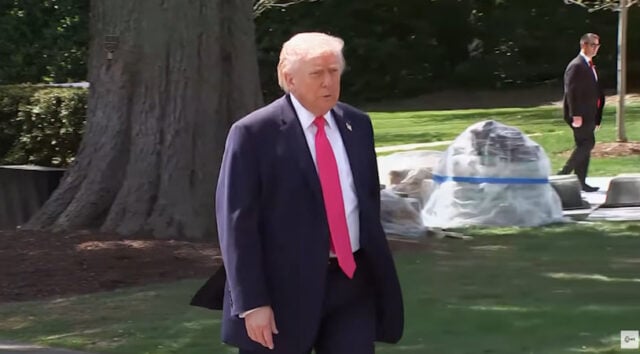
Standing before the churning rotors of Marine One on a crisp April morning, President Donald Trump delivered a sweeping, combative, and characteristically optimistic address to the nation’s media. As he prepared to depart for a series of high-energy rallies and economic roundtables in Las Vegas and Arizona, the President touched upon everything from the “illegal tolls” in the Middle East to his personal grievances with the Vatican.
The backdrop of this departure was a nation at a crossroads. With the 2026 midterm elections looming and a complex military engagement with Iran entering a critical diplomatic phase, Trump used the South Lawn as a stage to frame his administration’s narrative: a relentless fight for the American worker and a “tough-as-nails” approach to global peace.
The Economic Push: Gas, Tips, and the “Big Beautiful Bill”
The primary purpose of Trump’s trip to the Southwest is to revitalize an economic message that has been complicated by the geopolitical realities of 2026. In Las Vegas, the President is scheduled to meet with a diverse group of service workers—including barbers, casino pit supervisors, and police officers—to tout the successes of his signature tax legislation, the “One Big Beautiful Bill Act.”

Central to this message is the popular “No Tax on Tips” and “No Tax on Overtime” provisions. Trump leaned into these policies during his remarks, claiming that the average American’s tax refund is up by approximately $340 this year. However, he was quickly confronted with the reality that many residents in Nevada and Arizona feel these savings are being devoured by the pump.
“I gotta spend over $100 for a full tank of gas? It’s crazy,” one Las Vegas resident told local news, a sentiment the President acknowledged but reframed as a temporary necessity of war.
Trump admitted that gas prices, which have spiked to an average of $5.00 per gallon in many Western cities, might go “a little bit higher” before the November elections. He blamed the spike on the “Iranian blockade” and the ongoing naval operations in the Strait of Hormuz. His solution remains a long-term play: “Energy costs will come down significantly when we finish the job and Iran understands they cannot play games with the world’s energy supply,” he told the press pool.
Diplomacy by Deadline: The Israel-Lebanon Ceasefire
In a major foreign policy announcement, Trump confirmed that a 10-day ceasefire between Israel and Lebanon is set to begin at 5:00 p.m. ET today. This deal, brokered through intense communication with Israeli Prime Minister Benjamin Netanyahu and Lebanese President Joseph Aoun, represents a desperate attempt to de-escalate a conflict that has seen over 2,000 casualties in Lebanon in recent weeks.
The President described the deal as the “first meaningful talks” between the two nations since the early 1980s. He has dispatched a heavy-hitting diplomatic team to solidify the peace, including:
- Vice President JD Vance
- Secretary of State Marco Rubio
- Special Envoy Steve Witkoff
- Jared Kushner
While Trump voiced supreme confidence that “both sides want to see peace,” analysts warn that the fragility of the deal rests on Hezbollah’s willingness to comply. For the President, however, the ceasefire is a testament to his “Art of the Deal” philosophy applied to the world’s most volatile theater.
The Tehran Standoff and the Islamabad Summit
Parallel to the Levantine ceasefire is the ongoing negotiation with Iran. Trump confirmed that Vice President Vance is currently in Islamabad, Pakistan, for face-to-face peace talks with Iranian officials. The stakes could not be higher. The United States is currently maintaining a naval blockade of the Strait of Hormuz—a channel responsible for 20% of the world’s oil supply.
Trump’s rhetoric remained a blend of carrot and stick. He described the latest Iranian 10-point proposal as a “workable basis,” yet simultaneously threatened to “blast Iran into oblivion” if they did not immediately cease their pursuit of nuclear capabilities and stop laying mines in international waters.
“No one who pays an illegal toll will have safe passage on the high seas,” Trump asserted, referring to Iranian efforts to tax or block commercial shipping. The President framed the current U.S. military action as a mission to restore global maritime security, though the domestic political pressure of $5 gas remains his primary vulnerability.
A Holy Row: The Feud with Pope Leo XIV
Perhaps the most unexpected turn in the President’s remarks was a sharp escalation of his public feud with Pope Leo XIV, the first U.S.-born pontiff. The Pope has recently emerged as a vocal critic of the administration’s military operations in Iran and its previous actions in Venezuela.
Trump did not hold back, labeling the Holy Father “weak on crime” and “terrible for foreign policy.” He alleged that Leo XIV was only elected because the Catholic Church believed an American Pope would be the best way to “deal with” a Trump presidency.
The Path Forward
As the President boarded Marine One, the narrative for the coming week was clear. Trump is gambling that his base’s enthusiasm for tax breaks and “America First” strength will outweigh the immediate pain of inflation and high fuel costs. By linking the economy directly to the resolution of the “Iran War,” he is asking the American public for patience and a mandate to finish what he started.
From the desert sands of Las Vegas to the diplomatic halls of Islamabad, the Trump administration is operating on multiple fronts, attempting to rewrite the rules of 21st-century engagement through a combination of economic populism and high-stakes brinkmanship.
Sources Used and Links
- PBS News: Trump suggests high oil prices are a positive after bragging about low gas prices last month
- PBS News: Pakistani army chief tries to keep dialogue open between U.S. and Iran
- The Washington Post: Trump announces 10-day Israel-Lebanon ceasefire to “achieve lasting peace” (Referencing syndicated reporting on the announcement)
- The Associated Press: Fact-checking Trump’s State of the Union claims on the economy, immigration and crime
- The Associated Press: Wall Street hits record as S&P 500 continues 2-week rally, boosted by hopes for Iran war’s end
- The Guardian: Middle East crisis live: Netanyahu confirms Israel has agreed to 10-day ceasefire with Lebanon
- The Guardian: Pope says ‘world is being ravaged by a handful of tyrants’ amid feud with Trump’s White House
- Los Angeles Times: Business – Los Angeles Times: Trump tax cuts and Iran war economic impact
- TheStreet: Trump has a blunt message on gas prices for the rest of 2026
- Al Jazeera: No date set for US-Iran talks, as Pakistan pushes to keep diplomacy alive
- TIME: Israel and Lebanon Agree to 10-Day Ceasefire, Trump Announces
- CBS News: Live Updates: Trump says Israel, Lebanon agree to ceasefire as Iran keeps Strait of Hormuz gridlocked
- NPR/WGLT: Pope Leo takes aim at ‘handful of tyrants’ spending billions on war
- YouTube: Donald Trump says gas prices could be higher by November after Iran blockade
Disclaimer
Artificial Intelligence Disclosure & Legal Disclaimer
AI Content Policy.
To provide our readers with timely and comprehensive coverage, South Florida Reporter uses artificial intelligence (AI) to assist in producing certain articles and visual content.
Articles: AI may be used to assist in research, structural drafting, or data analysis. All AI-assisted text is reviewed and edited by our team to ensure accuracy and adherence to our editorial standards.
Images: Any imagery generated or significantly altered by AI is clearly marked with a disclaimer or watermark to distinguish it from traditional photography or editorial illustrations.
General Disclaimer
The information contained in South Florida Reporter is for general information purposes only.
South Florida Reporter assumes no responsibility for errors or omissions in the contents of the Service. In no event shall South Florida Reporter be liable for any special, direct, indirect, consequential, or incidental damages or any damages whatsoever, whether in an action of contract, negligence or other tort, arising out of or in connection with the use of the Service or the contents of the Service.
The Company reserves the right to make additions, deletions, or modifications to the contents of the Service at any time without prior notice. The Company does not warrant that the Service is free of viruses or other harmful components.