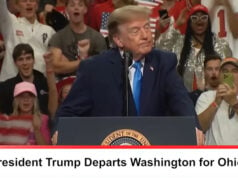
WASHINGTON — In a volatile television appearance that ended with an abrupt walkout, President Donald Trump aggressively defended his administration’s active three-month-old war with Iran, dismissed the financial pain of everyday Americans suffering from soaring grocery prices, and doubled down on a controversial, legally imperiled $1.8 billion victim payment fund.
[Watch the NBC Meet The Press Interview]
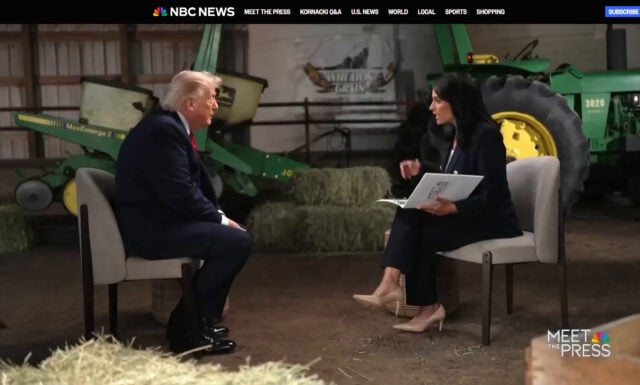
The interview, taped Friday in a rustic barn in Chippewa Falls, Wisconsin, ahead of an event with local farmers, aired Sunday morning on NBC’s Meet the Press. It quickly devolved into a highly contentious, adversarial showdown between the president and moderator Kristen Welker. After roughly four minutes of intense pushback regarding his foreign policy consistency, economic priorities, and repeated false claims about the electoral system, Trump cut the conversation short, stood up, and walked off the set.
“Let’s call it quits because I’ve had enough,” Trump told Welker before exiting. “Thank you, darling. Have a good time.”

The dramatic media breakdown highlights the immense and compounding domestic pressures facing the White House as the military conflict in the Middle East begins to severely warp the American economy at home, creating deep fissures within the Republican party ahead of critical upcoming midterm elections.
The Iran War: ‘This is Not an Endless War’
The interview’s primary focus was the ongoing military conflict with Iran, which began on February 28 when the United States joined Israel in launching massive airstrikes against Iranian nuclear and military installations. The escalation followed months of regional friction, culminating in the death of Iran’s former Supreme Leader in an allied bombing run.
Welker immediately pressed the president on whether launching a major military campaign directly violated his central 2024 campaign promise to start “no new wars” and bring about an immediate era of global stability. Trump flatly dismissed the premise, arguing that his rhetoric as a candidate had been widely misinterpreted.
“First of all, I didn’t guarantee no war. Why would I have built the strongest military in the world?” Trump said during the broadcast. He insisted that his non-interventionist campaign positions did not tie his hands as commander-in-chief when dealing with existential global threats. “I don’t like these endless wars. This is not an endless war. We’ve been doing this for three months.”
Trump maintained that his military actions were a necessary global intervention designed to permanently neutralize Iran’s nuclear ambitions. “I’m doing the world a service, and I’m doing our country a service,” he claimed.
Despite his aggressive rhetoric, Trump sent highly mixed and contradictory signals regarding the true state of Iran’s nuclear capability. At one point, he boasted that U.S. strikes over the past year had already “obliterated” Iran’s nuclear development facilities. Yet, moments later, he admitted that Washington is currently “very close” to signing a comprehensive peace deal with Tehran, though he is holding out for significantly more stringent terms than those agreed to by his negotiators.
According to Trump, the two nations are at a standoff over specific phrasing regarding how Iran can acquire nuclear material. While Iranian negotiators have reportedly conceded that they will not actively develop a weapon, Trump is demanding a sweeping clause that prohibits them from buying or transferring pre-existing nuclear assets from third-party nations.
“They’ve conceded the fact that they will not have nuclear weapons,” Trump explained. “We had a clause in there that they will not develop nuclear weapons. And everybody was very happy with it except me. And I said, ‘Well, what happens if they, not develop, but they go out and purchase, they acquire? I want to put the word, if they buy, purchase or acquire… You know, you’ve got to have that in there, too, because that’s not developing.’”
Trump threatened that if a diplomatic agreement is finalized, the U.S. military will physically retrieve and destroy Iran’s existing stockpiles of highly enriched uranium. If talks collapse, however, Trump warned that the U.S. would unleash a devastating phase of military action. “If we don’t make a deal, then we’re going to take them out militarily very harshly,” Trump said. “And we’ll wait till we do that before we go, in which case we’ll have safety either way.”
Grocery Prices and the Economic Toll at Home
The true flashpoint of the interview came when Welker pivoted from foreign policy mechanics to the grinding domestic economic fallout triggered by the conflict. Since the outbreak of hostilities on February 28, the U.S. military has been locked in a secondary battle to secure international shipping lanes. Iran has successfully disrupted commercial traffic through the vital Strait of Hormuz—a crucial global bottleneck for oil, natural gas, and key agricultural inputs like fertilizer.
The maritime blockade has sent global energy markets into a tailspin, causing retail gasoline and commercial transportation costs to skyrocket across the United States. Consequently, these operational hikes have cascaded down to American supermarkets, driving grocery and food prices to historic highs.
When Welker pressed Trump on the direct financial suffering of working-class families who are struggling to pay for basic household groceries due to his military campaign, the president offered a stark, uncompromising response. He told Welker that he considers the financial anxieties of everyday Americans “not even a little bit” when he is actively negotiating global security parameters with Tehran.
The cold dismissiveness of the remark drew immediate condemnation from political opponents and highlighted a growing vulnerability for the administration. Earlier in the week, the U.S. House of Representatives delivered a direct legislative rebuke to the White House, passing a war powers resolution in a tight 215–208 vote aimed at forcing a halt to U.S. military action against Iran. While Trump is widely expected to veto the measure to preserve his executive commander-in-chief authority, the bipartisan defection of several key Republicans signaled deep anxiety over the war’s mounting economic toll on voters.
When pushed for a timeline on when the economic blockade might ease, Trump remained stubbornly noncommittal. He acknowledged that the strategic Strait of Hormuz could easily remain heavily restricted or closed entirely through the upcoming Labor Day holiday on September 7. Still, he tried to project an air of ultimate optimism, stating, “I think this will resolve itself fairly quickly.”
Trump also confirmed that Iran’s newly elevated Supreme Leader, Mojtaba Khamenei—who ascended to power after his father was killed in the initial February airstrikes—is personally engaged in the ongoing peace talks. Trump praised the younger Khamenei’s “bravery” and confirmed intelligence reports that the Iranian leader was seriously injured during a recent military strike. “They say he’s giving approval because that’s the way it has been for a long, long time,” Trump noted.
The $1.8 Billion Legal Fund Controversy
The interview grew progressively more volatile as Welker steered the conversation toward a deeply controversial domestic policy initiative: the administration’s planned, but now frozen, $1.8 billion compensation fund.
The fund was originally conceived as part of a sweeping Department of Justice agreement to settle a prolonged lawsuit brought by Trump against the Internal Revenue Service. Under the terms of the initial proposal, the massive taxpayer-funded pot was designed to financially compensate close political allies, aides, and supporters of the president who claimed they had been the targets of politically motivated federal prosecutions and tax audits during previous administrations.
However, the initiative sparked an immediate firestorm on Capitol Hill and in the federal courts. Facing intense legal challenges from watchdog groups and substantial public pushback from a faction of Republican senators who questioned the legality and ethics of using public funds for political payouts, federal officials ultimately backed away from the plan, leaving the fund effectively scrapped.
When Welker asked if he had permanently abandoned the project given its widespread bipartisan opposition, Trump grew highly defensive, insisting that he still firmly believes the compensation fund should be established.
“If it was up to me, I’d pay them the kind of money that they deserve,” Trump said, defending his allies as victims of a weaponized justice system. “If they get it approved, that’s great. If they don’t get it approved, I’d be disappointed.”
Sudden Escalation and the Walkout
The final minutes of the interview dissolved into a rapid-fire exchange of accusations. Visibly frustrated by Welker’s persistence regarding the compensation fund and the economic data surrounding grocery inflation, Trump pivoted to unverified claims of systemic voter fraud. Without providing evidence, the president asserted that the ongoing, heavily delayed vote count from Tuesday’s California primary election was inherently “rigged” against conservative candidates.
When Welker repeatedly interrupted to point out that state election officials were following standard, legally mandated processing protocols for mail-in ballots and that top federal prosecutors had found no evidence of widespread irregularities, Trump’s patience expired.
Refusing to engage further with the host’s live fact-checking regarding the election and the events of January 6, the president cut Welker off mid-sentence, brought the interview to an immediate halt, and walked out of the Chippewa Falls barn.
The abrupt ending left the White House scrambling to manage the fallout from a broadcast that managed to simultaneously highlight a grinding foreign war, defense of a derailed political payout fund, and a blunt acknowledgment that consumer grocery prices are secondary to foreign policy objectives. Following the broadcast, an NBC News spokesperson declined to comment further on the interaction, and the White House press office did not immediately return requests for comment regarding the president’s sudden departure.
Sources and Links
- The Washington Post: Iran launched missiles and drones toward Strait of Hormuz, U.S. military says
- The Washington Post: Trump walks out of ‘Meet the Press’ interview when challenged over false claims
- Associated Press (via CityNews): Trump dismisses idea that Iran betrays his ‘no new wars’ campaign message
- The Times of Israel: Trump says he’s ‘very close’ to Iran deal but seeks stricter nuclear terms; hails ‘bravery’ of ‘badly injured’ Mojtaba Khamenei
- Associated Press: House approves war powers resolution to halt military action against Iran, in a rebuke of Trump
- The Los Angeles Times: President Trump storms off NBC interview after claiming California election was ‘rigged’
- NBC News: Trump says he does not consider American financial situations in Iran talks
Disclaimer
Artificial Intelligence Disclosure & Legal Disclaimer
AI Content Policy.
To provide our readers with timely and comprehensive coverage, South Florida Reporter uses artificial intelligence (AI) to assist in producing certain articles and visual content.
Articles: AI may be used to assist in research, structural drafting, or data analysis. All AI-assisted text is reviewed and edited by our team to ensure accuracy and adherence to our editorial standards.
Images: Any imagery generated or significantly altered by AI is clearly marked with a disclaimer or watermark to distinguish it from traditional photography or editorial illustrations.
General Disclaimer
The information contained in South Florida Reporter is for general information purposes only.
South Florida Reporter assumes no responsibility for errors or omissions in the contents of the Service. In no event shall South Florida Reporter be liable for any special, direct, indirect, consequential, or incidental damages or any damages whatsoever, whether in an action of contract, negligence or other tort, arising out of or in connection with the use of the Service or the contents of the Service.
The Company reserves the right to make additions, deletions, or modifications to the contents of the Service at any time without prior notice. The Company does not warrant that the Service is free of viruses or other harmful components.