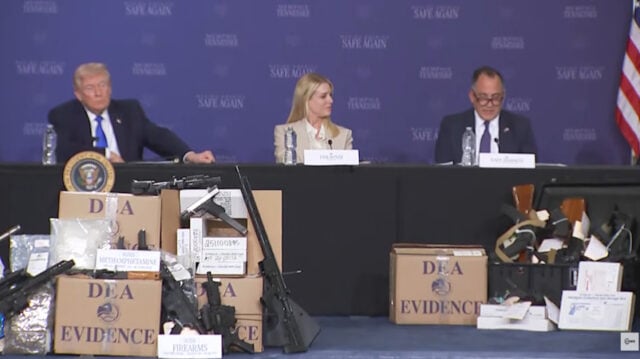
MEMPHIS, Tenn. — On Monday afternoon, the tarmac of a Tennessee Air National Guard Base in Memphis served as the backdrop for a sweeping declaration of domestic and foreign policy, anchored by a focus on municipal law enforcement. President Donald Trump traveled to the Mid-South to participate in a high-profile roundtable discussion with the Memphis Safe Task Force, a sprawling coalition of 31 federal, state, and local agencies established by his administration. Flanked by prominent figures including Tennessee Governor Bill Lee, Secretary of War Pete Hegseth, and Attorney General Pam Bondi, the President used the occasion to underscore what the White House characterizes as a dramatic turnaround in one of the nation’s most historically violent cities.
The visit, carefully choreographed to highlight the administration’s law-and-order agenda ahead of the November midterm elections, wove together a tapestry of policy initiatives. At its center was a significant upgrade to the military benefits provided to National Guard personnel deployed in domestic capacities. However, the wide-ranging address quickly transcended the boundaries of local policing, sprawling into rigid demands for federal election laws, unexpected optimism regarding diplomatic negotiations with the Islamic Republic of Iran, and even a nostalgic nod to mid-century American pop culture.
For a city that has long grappled with the dual burdens of systemic economic disenfranchisement and soaring violent crime rates, the presidential visit represented a focal point of intense national scrutiny. Supporters pointed to remarkable statistical declines in homicide and violent offenses as undeniable proof of the task force’s efficacy. Conversely, detractors, including local Democratic representatives and civil rights advocates, characterized the heavy-handed federal intervention as a superficial remedy that ignores root causes while exacerbating anxieties within immigrant and minority communities.

The National Guard Benefit Upgrade
The centerpiece of Monday’s roundtable was President Trump’s announcement regarding the compensation and operational status of National Guard troops currently patrolling American cities. Since September 2025, when the administration declared a sweeping federal intervention to address municipal crime, National Guard units have been a highly visible presence in Memphis, operating in a supportive capacity to local police and federal marshals.
“The secretary of war just signed a directive to ensure that all National Guard members serving on this task force, as well as in D.C., New Orleans, and our border security missions, will receive the same benefits as active duty troops,” President Trump declared to the assembled officers and press corps. “Because you deserve it.”
The policy shift represents a massive financial and logistical commitment by the federal government. Traditionally, National Guard members operating under standard domestic deployment orders receive part-time compensation and limited, subsidized healthcare options. By elevating their status to mirror that of active-duty military personnel, these troops will now be entitled to full-time pay scales, comprehensive subsidized housing allowances, no-cost healthcare coverage through the military health system, expansive tuition assistance programs, and accrual of time toward federal military retirement plans.
White House officials privately indicated that the move is intended to boost morale and retention among Guard units that have faced unprecedented operational tempos over the past two years. From securing the southern border against cartel activity to conducting saturation patrols in major metropolitan areas, the Guard has increasingly been utilized as a versatile instrument of federal domestic policy. While the Pentagon has yet to formally detail the budgetary impact of this upgrade, defense analysts suggest it will cost hundreds of millions of dollars annually.
Furthermore, this decision has profound implications for the families of deployed service members. By granting active-duty benefits, spouses and dependents will gain expanded access to the military’s medical networks, alleviating immense financial burdens associated with civilian healthcare deductibles. Housing allowances, calculated by local cost-of-living metrics, will inject federal funds directly into the local economies where these guardsmen are stationed. Advocates for military families lauded the move, noting that the repeated activation of Guard units over the past decade has caused significant strain on civilian employment and family stability. By reclassifying their service, the administration is acknowledging the National Guard’s professionalization as a primary instrument of continuous federal operations rather than a secondary emergency reserve force.
Analyzing the Memphis Safe Task Force Data
The justification for this sustained military presence lies in the staggering data presented by the Memphis Safe Task Force. Prior to the federal intervention, Memphis held the grim distinction of having the highest rate of violent crime per capita in the United States. Local authorities were frequently overwhelmed by a combination of gang violence, narcotics trafficking, and a heavily backlogged judicial system.
According to statistics provided by the White House and corroborated by federal law enforcement agencies, the landscape has shifted dramatically since the arrival of the National Guard and the establishment of the unified command structure. Since the operation began in the fall of 2025, the overall crime rate in Memphis has plummeted by an astonishing 34 percent.
The sheer volume of law enforcement activity underscores the aggressive nature of the saturation strategy. Officials reported that the task force has executed upwards of 7,400 arrests in the span of roughly six months. Furthermore, tactical operations have resulted in the seizure of more than 1,200 illegal firearms, removing a massive amount of lethal hardware from the streets. Law enforcement officials have traced many of these weapons back to organized trafficking rings spanning multiple state lines, highlighting the interstate nature of the violence that had gripped the city.
Perhaps the most resonant statistic shared on Monday was the impact on the city’s homicide rate. In 2025, Memphis recorded its first year with fewer than 200 murders since 2019. This represented a 40 percent drop compared to the previous calendar year, a decline that administration officials proudly point to as vindication of their unyielding approach. “Under President Trump’s leadership, federal and state officials are working together successfully to remove criminals from the streets and make Memphis safe again,” White House Spokesperson Liz Huston noted in a statement leading up to the event.
Governor Bill Lee echoed this sentiment during the roundtable, praising the synergy between state troopers, local police, and federal agents. His administration has been a staunch ally of the federal initiative, arguing that the extraordinary measures were necessary to break the cycle of violence that had paralyzed economic growth and eroded community trust in the Mid-South region. The task force’s architecture, weaving together 31 distinct agencies including the U.S. Marshals Service, the FBI, the DEA, and local precincts, has allowed for unprecedented intelligence sharing and operational fluidity.
Local Backlash and the Judicial Strain
However, the narrative of absolute victory is heavily contested by local community leaders and Democratic lawmakers who argue the federal occupation has come at a severe cost to civil liberties and long-term stability. Representative Steve Cohen, the Democratic congressman whose district encompasses Memphis, issued a scathing rebuke of the administration’s strategy, framing it as a militarized bandage over deep socioeconomic wounds.
Cohen argued that deploying the National Guard does not solve the city’s endemic problems. He emphasized that the crime confronting Memphis is the direct result of centuries of racial discrimination, generational poverty, and systematic underinvestment in education and social services. To illustrate his point, Cohen pointed to the recent closure of the Minority Business Development Center in Memphis—a facility he helped establish 13 years ago to spur job growth—which was forced to shut its doors following budget cuts enacted by the Trump administration’s Commerce Department.
Grassroots organizations have also raised alarms about the collateral damage from the task force’s operations, particularly regarding immigration enforcement. While the administration claims it is targeting violent cartels and the “worst of the worst,” reports suggest that the sweeping administrative warrants have caught many non-violent undocumented immigrants in the dragnet. Community advocates report a chilling effect in predominantly Hispanic neighborhoods, where residents are reportedly skipping work, keeping children home from school, and avoiding public spaces out of fear of arbitrary detention by ICE agents embedded within the task force.
The logistical strain on Memphis’s legal ecosystem is another critical consequence of the federal intervention. Public defenders are reporting unmanageable caseloads, with some attorneys representing dozens of clients simultaneously. This influx prevents adequate time for case review, negotiation, or trial preparation, raising constitutional concerns regarding the right to effective legal counsel. Furthermore, the physical infrastructure of the Shelby County court system is visibly deteriorating under the pressure. The aging criminal courthouses lack the technological upgrades and space to process the thousands of administrative and criminal warrants issued by the task force. Reports indicate that traffic courts, normally a routine municipal function, have been completely overwhelmed, resulting in long lines that snake out of municipal buildings and force citizens to miss entire days of work simply to contest minor infractions. This systemic backlog essentially acts as a hidden tax on the city’s working-class residents, compounding the economic anxieties that already plague the region.
The Legislative Standoff: DHS Funding and Electoral Reform
Despite the localized friction, President Trump used the Memphis platform to pivot to a broader legislative battle currently paralyzing Capitol Hill. With the Department of Homeland Security (DHS) facing a looming funding deadline, the President issued a stark ultimatum to Congressional Republicans: hold the line and refuse any appropriations deals with Democrats unless they concede to sweeping electoral reforms.
Specifically, Trump demanded that the Save America Act be included in the DHS funding package. The controversial legislation mandates strict voter identification protocols nationwide, including the requirement of photographic identification and documentary proof of United States citizenship in order to cast a ballot in federal elections.
“So I’m tying homeland security into voter identification with picture and proof of citizenship in order to vote,” Trump explained to the audience. “And those two items are the most important thing having to do with homeland security, so it should be part of the homeland security bill.”
Recognizing the impending Congressional recess for the spring holidays, the President urged Republican senators to remain in Washington and endure a potential partial government shutdown if necessary. “You don’t have to do a fast vote,” he implored. “Don’t worry about Easter or going home, in fact, make this one for Jesus, okay?”
The Save America Act has been a cornerstone of conservative legislative priorities. Proponents argue it is a necessary safeguard to prevent fraudulent voting and ensure that only verified citizens participate in the democratic process. Opponents vehemently argue that the law is designed to disenfranchise marginalized communities, the elderly, and low-income voters who may lack immediate access to such documentation or the financial means to procure it. By chaining this highly partisan electoral reform to the funding of the DHS—an agency tasked with everything from border patrol and cybersecurity to disaster response—the President is engaging in high-stakes brinkmanship. The DHS relies on continuous funding to maintain critical infrastructure protections. A shutdown would force hundreds of thousands of essential personnel, including Transportation Security Administration (TSA) agents and Customs and Border Protection officers, to work without pay.
A Pivot to Foreign Policy: Optimism on Iran
In a jarring transition that highlighted the unpredictable nature of his public addresses, President Trump abruptly shifted focus from the streets of Memphis to the geopolitical chessboard of the Middle East. Amidst ongoing tensions and fears of a broader conflict involving the Islamic Republic of Iran, the President delivered a surprisingly optimistic assessment of backchannel diplomatic negotiations.
“We are now having really good discussions,” Trump revealed, claiming that diplomatic engagements had quietly commenced over the preceding 48 hours. “They started last night, a little bit, the night before that. I think they’re very good. They want peace. They’ve agreed they won’t have a nuclear weapon.”
The assertion that Tehran has firmly committed to abandoning its nuclear ambitions and is eager to “settle” disputes with the United States sent immediate ripples through international markets, eliciting a mix of cautious optimism and profound skepticism among foreign policy analysts. The Trump administration has historically pursued a policy of “maximum pressure” against Iran, which Trump reiterated by noting, “We’ve eliminated everything there is to eliminate in Iran, including leaders.”
Offering Tehran “one more opportunity to end its threats” toward the U.S. and its allies, the President dangled the prospect of a historic de-escalation. The juxtaposition of discussing municipal crime in Tennessee and nuclear non-proliferation in the Middle East within the same breath forces both domestic political opponents and foreign adversaries to constantly react to shifting, real-time policy declarations issued far outside traditional diplomatic channels.
A Cultural Detour: Graceland and the Final Word
Following the conclusion of the heavy-laden policy roundtable, the President’s itinerary included a starkly contrasting detour: a private tour of Graceland, the legendary estate of music icon Elvis Presley. Located just a short drive from the military base, the sprawling mansion is among the most visited private homes in the country.
“I’m going to see Graceland after this, I think. Is that right?” Trump asked aloud during the task force meeting, prompting nods of affirmation from his staff. “I love Elvis.”
Graceland, the sprawling 13.8-acre estate Presley purchased in 1957, preserves the legacy of an artist who fundamentally altered the trajectory of American music. For President Trump, the estate represents an intersection of personal fandom and Americana. The tour of the mansion stands in stark juxtaposition to the grim realities of urban crime and international nuclear negotiations discussed mere hours prior. Political analysts often note that such cultural detours are highly effective at humanizing the President to his base, reinforcing a shared nostalgia for a specific era of American cultural dominance.
As Air Force One eventually departed the Mid-South, the reverberations of the Memphis roundtable were already being felt in the halls of the Pentagon, the corridors of Congress, and the global diplomatic community. By aggressively asserting his administration’s law enforcement successes while simultaneously raising the stakes on military compensation, electoral reform, and Middle Eastern peace, President Trump made it unmistakably clear that his administration will continue to be defined by bold, controversial, and uncompromising executive action.
Sources Used and Links
- WSLS – Trump heads to Elvis Presley’s Graceland in Memphis, a detour during Iran war and airport turmoil
- The Presidential Prayer Team – President Trump Visits Memphis for Task Force Roundtable
- Stamford Advocate – Trump says US and Iran are talking. His claim is eliciting market cheers and plenty of skepticism
- The Guardian – Trump tells Republicans to not make any deals with Democrats until strict voter ID law is passed – US politics live
- National Today – Trump Schedules Memphis Roundtable on Monday
- IQ Connect (Rep. Steve Cohen) – Deploying the National Guard Will Not Solve Memphis’ Endemic Problems
- Washington Examiner – WATCH LIVE: Trump participates in Memphis Safe Task Force roundtable
- Washington Examiner – Trump says National Guard members patrolling US cities will get active-duty benefits
Disclaimer
Artificial Intelligence Disclosure & Legal Disclaimer
AI Content Policy.
To provide our readers with timely and comprehensive coverage, South Florida Reporter uses artificial intelligence (AI) to assist in producing certain articles and visual content.
Articles: AI may be used to assist in research, structural drafting, or data analysis. All AI-assisted text is reviewed and edited by our team to ensure accuracy and adherence to our editorial standards.
Images: Any imagery generated or significantly altered by AI is clearly marked with a disclaimer or watermark to distinguish it from traditional photography or editorial illustrations.
General Disclaimer
The information contained in South Florida Reporter is for general information purposes only.
South Florida Reporter assumes no responsibility for errors or omissions in the contents of the Service. In no event shall South Florida Reporter be liable for any special, direct, indirect, consequential, or incidental damages or any damages whatsoever, whether in an action of contract, negligence or other tort, arising out of or in connection with the use of the Service or the contents of the Service.
The Company reserves the right to make additions, deletions, or modifications to the contents of the Service at any time without prior notice. The Company does not warrant that the Service is free of viruses or other harmful components.