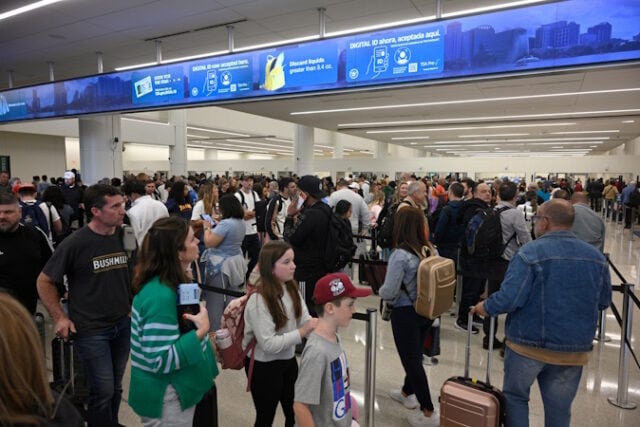
In a dramatic escalation of the ongoing budget battle in Washington, President Donald Trump issued a stern ultimatum on Saturday: if congressional Democrats do not immediately pass a funding bill for the Department of Homeland Security (DHS), he will deploy Immigration and Customs Enforcement (ICE) agents to take over security operations at the nation’s airports. The threat comes as a partial government shutdown enters its 36th day, leaving approximately 50,000 Transportation Security Administration (TSA) officers working without pay and causing a surge in staffing shortages that has brought some of the country’s busiest travel hubs to a crawl.
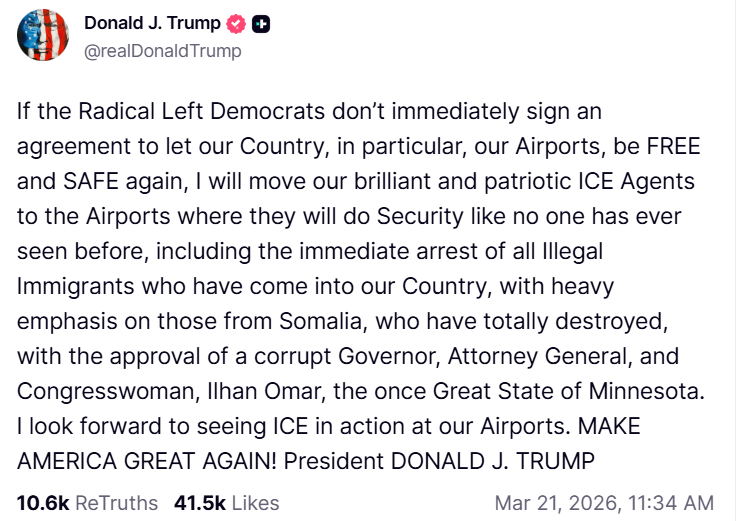
Taking to Truth Social on Saturday morning, the President characterized the move as a necessary step to ensure national safety. “If the Radical Left Democrats don’t immediately sign an agreement to let our Country, in particular, our Airports, be FREE and SAFE again, I will move our brilliant and patriotic ICE Agents to the Airports,” Trump wrote. He further asserted that these agents would conduct “Security like no one has ever seen before,” explicitly mentioning that the deployment would include the “immediate arrest of all Illegal Immigrants” found at travel hubs, with a specific focus on those from Somalia.
A System at the Breaking Point
The President’s proposal arrives at a moment of acute crisis for the nation’s aviation infrastructure. Under the current DHS shutdown—the third in less than six months—TSA officers have been forced to work for weeks without compensation. The financial strain has become untenable for many; union leaders report that officers are receiving eviction notices, struggling to pay utility bills, and taking second jobs to survive.

According to DHS data, more than 300 TSA employees have resigned since the shutdown began. Absenteeism has also skyrocketed, with roughly 10% of the workforce calling out on recent days compared to a typical rate of less than 2%. The result for travelers has been a logistical nightmare. Wait times at checkpoints in major cities like Houston, Atlanta, and New Orleans have stretched into multiple hours, forcing many passengers to miss flights and prompting warnings that smaller regional airports may have to close entirely if staffing levels do not improve.
The Political Impasse
The standoff in the Senate remains deadlocked. On Friday, a Republican-led bill to fund the DHS failed to advance after Democrats blocked the measure for the fifth time. Senate Democratic leader Chuck Schumer has argued that the TSA should be funded through a standalone measure to “end the chaos” without being tied to the administration’s broader immigration enforcement agenda.
“Tomorrow, America will see the matter crystal clear: which senators want to open up TSA, pay TSA workers, and end the chaos at our airports, and which senators are going to block TSA funding yet again,” Schumer stated on the Senate floor. Democrats have also demanded significant policy reforms as part of any long-term funding deal, including requirements for ICE agents to obtain warrants before entering homes and a ban on the use of masks by federal agents.
Republicans, led by Senate Majority Leader John Thune, have countered that Democrats are not negotiating in good faith regarding immigration enforcement. While Thune noted there is “deal space” for a resolution, the administration has remained firm. The White House recently signaled its intent to overhaul DHS operations by firing Secretary Kristi Noem and placing Thomas Homan in charge of high-profile operations in Minneapolis.
Operational and Legal Concerns
The prospect of ICE agents manning security checkpoints has sparked immediate concern from aviation experts and civil rights advocates. Unlike TSA officers, who are specifically trained to screen passengers and baggage for hazardous items and explosives, ICE agents are trained primarily for investigations and immigration enforcement. Critics argue that swapping trained screeners for enforcement agents could compromise the fundamental safety of the “sterile area” of airports.
Furthermore, the President’s directive to prioritize the arrest of undocumented immigrants at airports marks a significant shift in the role of airport security. While a 2025 report by the American Civil Liberties Union (ACLU) revealed that the TSA had already begun sharing passenger lists with ICE, a full-scale deployment of ICE agents into checkpoints would blur the lines between transportation safety and interior immigration enforcement.
The Human Cost of “Metro Surge”
The President’s focus on Somali immigrants in his Saturday post echoes the rhetoric surrounding “Operation Metro Surge,” a massive immigration enforcement effort that began in late 2025. Initially targeting the Twin Cities, the operation was described by the DHS as the largest of its kind in U.S. history. However, the surge has been marred by controversy and violence. In Minneapolis, federal agents fatally shot two American citizens, Renee Good and Alex Pretti, during operations, sparking nationwide protests and legal challenges.
Despite the administration’s claim that such surges are necessary for national security, data from the first year of the operation showed that of the thousands arrested in Minneapolis, only a tiny fraction were actually from Somalia, and none were linked to the social services fraud cases the White House initially cited as the operation’s justification.
The Musk Intervention
Adding another layer of complexity to the weekend’s events, billionaire Elon Musk offered an unconventional solution to the crisis. Early Saturday morning, Musk posted to X (formerly Twitter) that he would be willing to personally pay the salaries of TSA personnel during the impasse.
“I would like to offer to pay the salaries of TSA personnel during this funding impasse that is negatively affecting the lives of so many Americans at airports throughout the country,” Musk wrote. While the legality of a private citizen funding a federal agency’s payroll remains highly questionable, the offer highlighted the desperation of the situation.
Looking Ahead
As the DHS enters another week without funding, the pressure on lawmakers is reaching a fever pitch. TSA workers are scheduled to miss their second full paycheck on March 27. Acting Deputy TSA Administrator Adam Stahl warned earlier this week that “our people are hurting,” and the continued instability is viewed by many as a threat to the integrity of the national travel system.
If President Trump follows through on his threat to move ICE agents into the nation’s terminals, it would represent an unprecedented expansion of federal immigration enforcement into the daily lives of millions of American travelers. For now, the nation’s airports remain a central battlefield in a much larger war over the future of American immigration policy and the limits of executive power.
Sources and Links
- WUSA9: Trump threatens to send ICE to airports as unpaid TSA officers quit, wait times surge and union warns of security risks
- CBS News: Trump threatens to use ICE agents for airport security as delays worsen amid DHS shutdown
- The Guardian: Trump threatens to send ICE agents to US airports unless DHS deal reached
- WKZO: Trump threatens to put ICE agents in airports over funding impasse
- Times of San Diego: ICE agents could provide security at San Diego Airport under Trump proposal
- Human Rights First: ICE Air Expands Deportation and Domestic Transfer Flights to Record Levels
- American Oversight: American Oversight Sues Trump Administration Over Secretive TSA–ICE Data Sharing
Disclaimer
Artificial Intelligence Disclosure & Legal Disclaimer
AI Content Policy.
To provide our readers with timely and comprehensive coverage, South Florida Reporter uses artificial intelligence (AI) to assist in producing certain articles and visual content.
Articles: AI may be used to assist in research, structural drafting, or data analysis. All AI-assisted text is reviewed and edited by our team to ensure accuracy and adherence to our editorial standards.
Images: Any imagery generated or significantly altered by AI is clearly marked with a disclaimer or watermark to distinguish it from traditional photography or editorial illustrations.
General Disclaimer
The information contained in South Florida Reporter is for general information purposes only.
South Florida Reporter assumes no responsibility for errors or omissions in the contents of the Service. In no event shall South Florida Reporter be liable for any special, direct, indirect, consequential, or incidental damages or any damages whatsoever, whether in an action of contract, negligence or other tort, arising out of or in connection with the use of the Service or the contents of the Service.
The Company reserves the right to make additions, deletions, or modifications to the contents of the Service at any time without prior notice. The Company does not warrant that the Service is free of viruses or other harmful components.