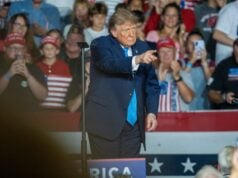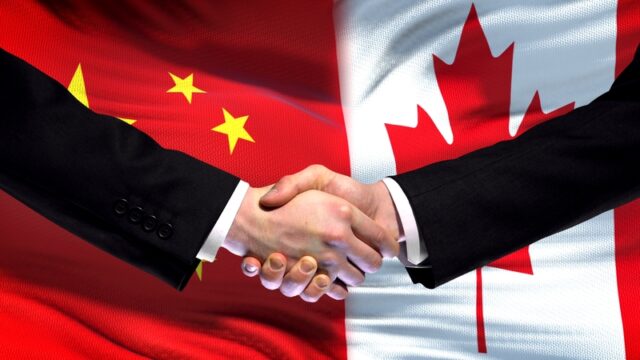
In a move that has sent shockwaves through the North American economic corridor, President Donald Trump on Saturday threatened to impose a “100% Tariff” on all Canadian goods and products. The escalation follows a week of deteriorating relations sparked by Canadian Prime Minister Mark Carney’s recent diplomatic mission to Beijing and his subsequent sharp critiques of U.S. foreign policy at the World Economic Forum in Davos.
Writing on his social media platform, Truth Social, the President accused the Canadian government of attempting to turn the country into a “Drop Off Port” for Chinese goods seeking to circumvent U.S. trade barriers.
“If Governor Carney thinks he is going to make Canada a ‘Drop Off Port’ for China to send goods and products into the United States, he is sorely mistaken,” Trump wrote, intentionally using a dismissive title for the Prime Minister. “China will eat Canada alive, completely devour it, including the destruction of their businesses, social fabric, and general way of life.”
The “New Strategic Partnership”
The catalyst for the current crisis is a landmark trade agreement-in-principle reached between Ottawa and Beijing earlier this month. Under the deal, Canada agreed to ease the 100% surtax it had previously placed on Chinese-made electric vehicles (EVs), allowing up to 49,000 units into the market at a significantly lower 6.1% “most-favored-nation” rate.
In exchange, China promised to slash tariffs on Canadian canola seed—a market worth approximately $4 billion annually—from a staggering 85% down to 15%. The agreement also includes provisions for the resumption of Canadian beef exports, which have been largely locked out of the Chinese market since 2021.

While the Trump administration initially offered a tepidly supportive response to the deal on January 16—with the President stating that signing a trade deal was “what [Carney] should be doing”—the tone shifted violently following the Prime Minister’s appearance at Davos.
A War of Words in Davos
At the World Economic Forum, Prime Minister Carney delivered a speech that many observers interpreted as a direct challenge to the Trump administration’s “America First” doctrine. Carney warned that the “rules-based international order” was cracking and that great powers were increasingly using economic integration as a “weapon of coercion.”
The President responded during his own speech in Switzerland, asserting that “Canada lives because of the United States” and labeling the Prime Minister “ungrateful.” This friction was further exacerbated by Canada’s refusal to support the U.S.-led “Golden Dome” missile defense project over Greenland—a territory the President has repeatedly expressed interest in acquiring.
“Canada is against The Golden Dome being built over Greenland, even though The Golden Dome would protect Canada,” the President posted on Friday. “Instead, they voted in favor of doing business with China.”
Economic Repercussions
If enacted, a 100% tariff on all Canadian imports would be unprecedented in the history of the two nations. Canada remains the top export destination for 36 U.S. states, and the two economies are deeply integrated through the Canada-United States-Mexico Agreement (CUSMA). Analysts warn that such a move would not only devastate the Canadian economy but also trigger massive supply chain disruptions and price hikes for American consumers, particularly in the automotive, energy, and agricultural sectors.
In a video statement released late Saturday, Prime Minister Carney did not address the tariff threat directly but urged Canadians to “focus on what we can control” by supporting domestic products. Meanwhile, Canada’s Trade Minister, Dominic LeBlanc, clarified that there is “no pursuit of a free trade deal with China,” framing the recent agreement as a pragmatic resolution to specific tariff issues rather than a shift in strategic alignment.
Future Outlook
The President’s threat comes as the CUSMA is set for a mandatory review later this year. By calling the existing trade agreement “irrelevant” and revoking Canada’s invitation to his proposed “Board of Peace,” Trump has signaled that the decades-old special relationship between Washington and Ottawa is under its greatest strain in modern history.
For now, the world waits to see if the 100% tariff threat is a literal policy directive or a high-stakes negotiating tactic intended to force Canada to abandon its new ties with Beijing.
Sources & Links
- AP News: Trump threatens Canada with a 100% tariff over its China trade deal
- CBC News: Trump threatens 100% tariffs on all Canadian goods if Canada ‘makes a deal with China’
- The Guardian: Trump threatens Canada with 100% tariff over possible deal with China
- Sky News: Trump threatens Canada with 100% tariff over China trade deal
- Government of Canada: Joint statement of the Canada-China Leaders’ Meeting
Disclaimer
Artificial Intelligence Disclosure & Legal Disclaimer
AI Content Policy.
To provide our readers with timely and comprehensive coverage, South Florida Reporter uses artificial intelligence (AI) to assist in producing certain articles and visual content.
Articles: AI may be used to assist in research, structural drafting, or data analysis. All AI-assisted text is reviewed and edited by our team to ensure accuracy and adherence to our editorial standards.
Images: Any imagery generated or significantly altered by AI is clearly marked with a disclaimer or watermark to distinguish it from traditional photography or editorial illustrations.
General Disclaimer
The information contained in South Florida Reporter is for general information purposes only.
South Florida Reporter assumes no responsibility for errors or omissions in the contents of the Service. In no event shall South Florida Reporter be liable for any special, direct, indirect, consequential, or incidental damages or any damages whatsoever, whether in an action of contract, negligence or other tort, arising out of or in connection with the use of the Service or the contents of the Service.
The Company reserves the right to make additions, deletions, or modifications to the contents of the Service at any time without prior notice. The Company does not warrant that the Service is free of viruses or other harmful components.