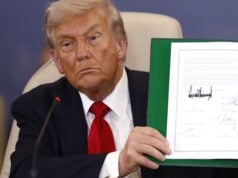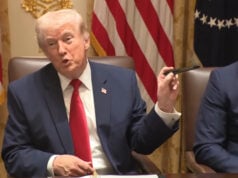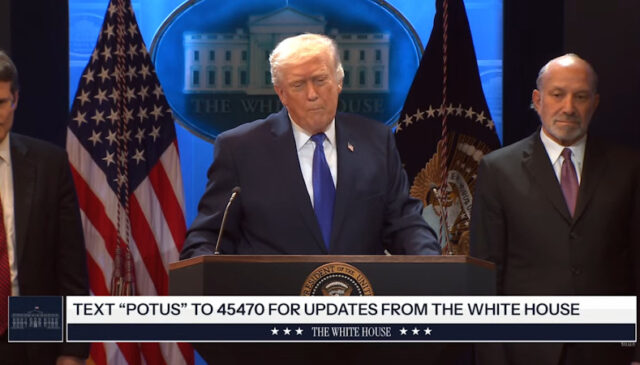
In an afternoon address from the White House briefing room, President Donald Trump delivered a scathing rebuke of the United States Supreme Court, following its landmark decision on Friday, February 20, 2026, to strike down his administration’s sweeping global tariffs. Speaking before a backdrop of newly installed moody blue lighting, the President labeled the ruling a “disgrace to the nation” and “deeply disappointing,” specifically targeting the conservative justices who joined the liberal bloc to dismantle a central pillar of his second-term economic agenda.
The Ruling: A 6-3 Defeat
The Supreme Court’s decision in Learning Resources, Inc. v. Trump (consolidated with V.O.S. Selections v. Trump) upended the administration’s use of the International Emergency Economic Powers Act (IEEPA) of 1977. Since early 2025, the Trump administration had utilized this law to bypass Congress, declaring a national economic emergency to justify broad “reciprocal” tariffs on nearly all imported goods—a move the President famously dubbed “Liberation Day.”
Writing for the 6-3 majority, Chief Justice John Roberts was unequivocal: “The Framers did not vest any part of the taxing power in the Executive Branch.” The Court ruled that while the IEEPA allows the president to regulate commerce during specific foreign-sourced emergencies, it does not grant the unilateral authority to impose broad import taxes, which remains a power reserved strictly for Congress.
Joining Roberts in the majority were the Court’s three liberal members—Justices Sotomayor, Kagan, and Jackson—as well as Trump-appointed Justices Neil Gorsuch and Amy Coney Barrett. The alignment of Gorsuch and Barrett with the liberal wing marked a significant ideological fracture, one that Trump addressed with visible frustration during his press conference.

“I’m ashamed of certain members of the court,” Trump said, without naming Gorsuch or Barrett directly. “Absolutely ashamed, for not having the courage to do what is right for our country.”
Dissent and Potential Chaos
The dissent, led by Justice Brett Kavanaugh and joined by Justices Thomas and Alito, argued that the tariffs were a “traditional and common tool” for regulating importation. However, Kavanaugh’s dissent also contained a warning that became a focal point of the President’s subsequent remarks: the logistical “mess” of issuing refunds.
Estimates from the Tax Foundation suggest the government has collected more than $160 billion in IEEPA-related tariffs since 2025. With the ruling declaring these collections illegal, the case now returns to the U.S. Court of International Trade to determine how, or if, that money should be returned to importers. Trump warned that paying back such a sum would be “almost impossible for our Country to pay.”
The “Backup Plan”
Despite the legal setback, the President remained defiant, insisting that his trade war was far from over. “Other alternatives will now be used to replace the ones that the court incorrectly rejected,” Trump told reporters. “We have alternatives, great alternatives.”
While the President did not detail his next steps, National Economic Council Director Kevin Hassett and other administration officials have previously signaled a pivot to other statutory authorities, such as:
- Section 301 of the Trade Act of 1974: Used to address “unreasonable or discriminatory” trade practices.
- Section 122 of the Trade Act: Allows for temporary surcharges to deal with large balance-of-payments deficits.
- Section 232 of the Trade Expansion Act: Tariffs based on national security, which were notably not struck down by Friday’s ruling.
Economic and Political Fallout
The ruling arrives at a volatile moment for the U.S. economy. While the Committee for a Responsible Federal Budget (CRFB) warned that the loss of tariff revenue could increase projected deficits by $2 trillion over the next decade, many business groups celebrated the decision. The Liberty Justice Center, which represented small businesses in the case, argued that the tariffs had caused “economic uncertainty” and fueled persistent inflation.
Inside the Republican party, the ruling has exposed long-simmering tensions. While many MAGA loyalists echoed the President’s “disgrace” rhetoric, some Republican lawmakers expressed a quiet relief, having spent months defending what critics called “tax increases” on their constituents.
What Happens Next?
The immediate impact of the ruling is a legal suspension of the “Liberation Day” tariff rates, though legal experts expect the administration to move “almost immediately” to reimpose them under the alternative authorities mentioned by Hassett. This sets the stage for a new round of litigation that could stretch well into the 2026 midterm election cycle.
As the press conference concluded, Trump reiterated his favorite campaign refrain: “We will win in the end. We always do.” Whether that victory comes in a courtroom or through a legislative workaround remains to be seen.
Sources and Links
- SCOTUSblog: “Supreme Court strikes down tariffs” (Published Feb 20, 2026).
- PBS NewsHour: “What happens now that the Supreme Court struck down Trump’s tariffs?” (Published Feb 20, 2026).
- Tax Foundation: “Supreme Court Strikes Down President Trump’s Tariffs” (Published Feb 20, 2026).
- CalMatters: “U.S. Supreme Court strikes down Trump’s tariffs. Here’s how they’ve affected California” (Published Feb 20, 2026).
- The Guardian: “Trump illegally used executive power to impose global tariffs, supreme court rules” (Published Feb 20, 2026).
- Committee for a Responsible Federal Budget: “CRFB Reacts to Supreme Court Tariff Ruling” (Published Feb 20, 2026).
- Office of Governor Gavin Newsom: “Governor Newsom calls for immediate tariff refund checks following Supreme Court ruling against Trump” (Published Feb 20, 2026).
- Hindustan Times: “What is Trump’s ‘back-up’ plan after Supreme Court strikes down tariffs – Explained” (Published Feb 20, 2026).
Disclaimer
Artificial Intelligence Disclosure & Legal Disclaimer
AI Content Policy.
To provide our readers with timely and comprehensive coverage, South Florida Reporter uses artificial intelligence (AI) to assist in producing certain articles and visual content.
Articles: AI may be used to assist in research, structural drafting, or data analysis. All AI-assisted text is reviewed and edited by our team to ensure accuracy and adherence to our editorial standards.
Images: Any imagery generated or significantly altered by AI is clearly marked with a disclaimer or watermark to distinguish it from traditional photography or editorial illustrations.
General Disclaimer
The information contained in South Florida Reporter is for general information purposes only.
South Florida Reporter assumes no responsibility for errors or omissions in the contents of the Service. In no event shall South Florida Reporter be liable for any special, direct, indirect, consequential, or incidental damages or any damages whatsoever, whether in an action of contract, negligence or other tort, arising out of or in connection with the use of the Service or the contents of the Service.
The Company reserves the right to make additions, deletions, or modifications to the contents of the Service at any time without prior notice. The Company does not warrant that the Service is free of viruses or other harmful components.