WASHINGTON — In a sharp escalation of “gunboat diplomacy,” President Donald Trump issued a final warning to the Iranian leadership on Thursday, stating that “really bad things” will happen if the Islamic Republic does not commit to a “meaningful” nuclear deal within the next 10 to 15 days.
President Trump Speaking at the Board Of Peace.
Video Courtesy DWS
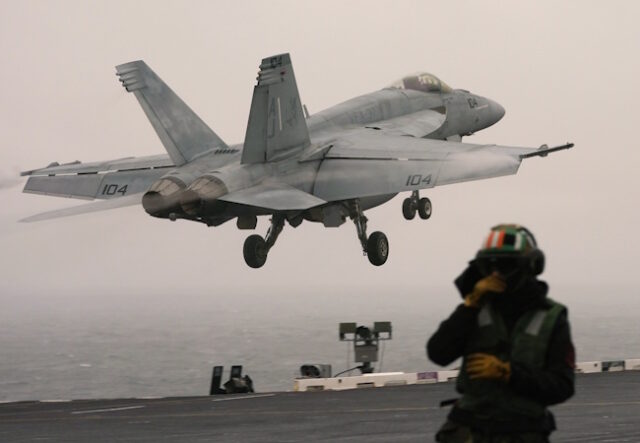
Speaking at the inaugural meeting of the Board of Peace at the U.S. Institute of Peace, the President emphasized that while he would prefer a diplomatic resolution, his patience with Tehran has reached its “maximum.” The remarks come as the United States oversees its largest military buildup in the Middle East since the 2003 invasion of Iraq, with the USS Gerald R. Ford carrier strike group currently steaming toward the region to join existing forces.
The 10-Day Clock
“It’s proven to be, over the years, not easy to make a meaningful deal with Iran, and we have to make a meaningful deal,” President Trump told the board. “Otherwise, bad things happen. You’re going to be finding out over the next, probably 10 days.”

Later, while speaking to reporters aboard Air Force One, the President clarified the timeline, suggesting that 10 to 15 days should be “enough time” for Iran to deliver a written proposal that addresses U.S. concerns.
The administration’s demands are comprehensive. Washington is seeking a total cessation of uranium enrichment—a process Iran claims is for peaceful energy but which the U.S. and Israel insist is a path to a nuclear weapon. Additionally, the U.S. is demanding that Iran scale back its ballistic missile program and sever ties with regional proxy groups, known as the “Axis of Resistance.”
A History of Escalation
The current standoff follows a tumultuous year. In June 2025, a 12-day conflict saw the U.S. and Israel launch targeted strikes on Iranian nuclear facilities, including the underground Fordow enrichment site. While the administration claimed those strikes “decimated” Iran’s nuclear potential, recent intelligence suggests Tehran has continued to enrich uranium to near-weapons-grade levels.
“They can’t have a nuclear weapon,” Trump reiterated Thursday. “You can’t have peace in the Middle East if they have a nuclear weapon. If they join us, that’ll be great. If they don’t join us, that’ll be great too. But it’ll be a very different path.”
The President’s “bad things” rhetoric is a familiar refrain, but analysts note the current context is far more volatile. Beyond the nuclear file, Trump has set “red lines” regarding the Iranian regime’s crackdown on internal anti-government protesters. Last month, a deadly suppression of demonstrations in Tehran and other cities resulted in thousands of deaths, further souring the prospects for a peaceful thaw.
Regional and Global Reaction
Tehran has responded to the ultimatum with its own brand of defiance. In a letter to the UN Security Council, Iranian Ambassador Amir Saeid Iravani stated that while Iran does not seek war, any “military aggression” would be met with a “decisive and proportionate” response. Iran also conducted joint naval drills with Russia in the Gulf of Oman this week, signaling that it is not without allies.
In Europe, the tension is sparking immediate alarm. Polish Prime Minister Donald Tusk urged Polish citizens to leave Iran immediately, warning that the window for evacuation could close within “a few dozen hours.” Germany has already begun moving non-mission-critical personnel out of Iraq as a precaution.
Domestically, the prospect of a new conflict has reignited debate in Congress. Representatives Ro Khanna and Thomas Massie have signaled plans to trigger a War Powers Resolution to block a “war of choice” without congressional approval. Meanwhile, the Council on American-Islamic Relations (CAIR) has called on the administration to seek a “reasonable compromise” rather than pursuing regime change.
The Road Ahead
Despite the looming deadline, there are thin threads of diplomacy remaining. U.S. and Iranian negotiators met indirectly in Geneva earlier this week, mediated by Oman. Iranian Foreign Minister Abbas Araghchi indicated that “guiding principles” had been agreed upon, though White House Press Secretary Karoline Leavitt noted that the two sides remain “very far apart” on key issues.
As the U.S. military buildup is expected to be “complete” by mid-March, the world is watching to see if the 10-day ultimatum leads to a signature or a strike. For the Trump administration, the goal remains singular: the permanent removal of Iran’s nuclear capability.
“We’re either going to get a deal, or it’s going to be unfortunate for them,” Trump concluded.
As the 10-day deadline approaches, the Pentagon has shifted from a posture of regional deterrence to one of immediate strike readiness. Military analysts describe the current concentration of U.S. forces as the most “potent and versatile” assembly of air and sea power in the Middle East since the early 2000s.
Below is a summary of the primary assets currently positioned to respond if negotiations fail.
Primary Naval Strike Forces
The “armada” is anchored by two massive carrier strike groups, allowing the U.S. to launch 24-hour flight operations without relying on terrestrial bases in the Gulf.
- USS Abraham Lincoln (CVN-72): Currently operating in the Arabian Sea off the coast of Oman. Its deck includes the advanced F-35C Lightning II stealth fighters, specifically designed for penetrating sophisticated air defense networks like those protecting Iran’s nuclear sites.
- USS Gerald R. Ford (CVN-78): The world’s newest and largest supercarrier. It transited the Strait of Gibraltar on February 17 and is racing through the Mediterranean toward the Suez Canal. It is expected to be within strike range by the end of the 10-day window.
- Destroyer Screen: A total of 13 Arleigh Burke-class destroyers are dispersed across the Persian Gulf, Red Sea, and Mediterranean. Key vessels like the USS McFaul and USS Mitscher are currently patrolling the Strait of Hormuz, armed with Tomahawk land-attack missiles.
Land-Based Air Power and Logistics
The U.S. Air Force has moved dozens of airframes into “forward-leaning” positions in Jordan, Qatar, and the Indian Ocean.
- Strike Packages: Over 50 additional fighter aircraft, including F-22 Raptors and F-15E Strike Eagles, have been relocated to Muwaffaq Salti Air Base in Jordan.
- Heavy Bombers: B-2 Spirit stealth bombers remain on high alert at Whiteman AFB in the U.S., with support assets already arriving at the forward base on Diego Garcia.
- The “Tanker Bridge”: Flight tracking data has shown a massive surge in KC-46 and KC-135 refueling tankers moving into the region, essential for sustaining long-range missions over the Iranian plateau.
Defensive Shielding
To protect the roughly 40,000 U.S. troops currently stationed in the Middle East from potential Iranian ballistic missile retaliation, the Pentagon has reinforced regional defenses:
- THAAD & Patriot Batteries: Additional Terminal High Altitude Area Defense (THAAD) systems have been deployed to Saudi Arabia and Israel to intercept high-altitude ballistic threats.
- Electronic Warfare: Four specialized electronic warfare planes have been spotted at regional hubs, intended to “blind” Iranian radar and command-and-control networks during any opening salvo.
Sources & Links
- The Times of Israel: US readying for potential weeks-long military campaign against Iran
- Gulf News: Carrier strike group led by USS Gerald R. Ford crosses Strait of Gibraltar
- Wikipedia: United States military buildup in the Middle East during the 2026 crisis
- Aerospace Global News: US military build up in the Middle East: Aircraft and ships
- The Guardian: Trump sends second aircraft carrier to Middle East
- Trump warns Iran of ‘bad things’ if no deal made, sets deadline of 10-15 days – The Times of Israel (Feb 19, 2026)
- Trump news at a glance: president weighs ordering ‘bad things’ against Iran – The Guardian (Feb 19, 2026)
- Trump warns of ‘bad things’ if Iran doesn’t make a deal – PBS NewsHour (Feb 19, 2026)
- Second U.S.-Iran Talks Yield Mixed Results with Middle East on Edge – The Soufan Center (Feb 19, 2026)
- Trump issues ultimatum to Iran to agree nuclear deal – The New Arab (Feb 19, 2026)
- Iran’s Conflict With Israel and the United States – Council on Foreign Relations (Updated Feb 2026)
Disclaimer
Artificial Intelligence Disclosure & Legal Disclaimer
AI Content Policy.
To provide our readers with timely and comprehensive coverage, South Florida Reporter uses artificial intelligence (AI) to assist in producing certain articles and visual content.
Articles: AI may be used to assist in research, structural drafting, or data analysis. All AI-assisted text is reviewed and edited by our team to ensure accuracy and adherence to our editorial standards.
Images: Any imagery generated or significantly altered by AI is clearly marked with a disclaimer or watermark to distinguish it from traditional photography or editorial illustrations.
General Disclaimer
The information contained in South Florida Reporter is for general information purposes only.
South Florida Reporter assumes no responsibility for errors or omissions in the contents of the Service. In no event shall South Florida Reporter be liable for any special, direct, indirect, consequential, or incidental damages or any damages whatsoever, whether in an action of contract, negligence or other tort, arising out of or in connection with the use of the Service or the contents of the Service.
The Company reserves the right to make additions, deletions, or modifications to the contents of the Service at any time without prior notice. The Company does not warrant that the Service is free of viruses or other harmful components.