A Summit Under Heavy Strain
The 36th NATO Heads of State and Government Summit opened in Turkey’s capital, Ankara, under a level of geopolitical duress not seen in decades. As leaders from all 32 member states gathered to iron out defense expenditures and coordinate defensive strategies, the formal agenda was immediately upended by explosive developments across two separate theaters of conflict.
U.S. President Donald Trump arrived at the summit projecting both a fierce critique of transatlantic allies and an assertive posture regarding breaking military developments. Standing alongside global leaders, Trump explicitly linked international defense obligations to active security crises in the Middle East and Eastern Europe. The atmosphere inside the Ankara convention halls quickly shifted from choreographed diplomacy to a high-stakes command center as the United States initiated multi-theater strategic maneuvers.
For NATO’s newly minted Secretary General, Mark Rutte, the summit represented an immediate trial by fire. While European nations sought to focus heavily on long-term defense production metrics and formalized spending projects—boosted by a collective target to commit up to 5% of annual GDP to core defense requirements by 2035—Washington’s attention was visibly split between ongoing operations in the Persian Gulf and structural overhauls to the security architecture of Eastern Europe.

The Demise of the U.S.-Iran Memorandum of Understanding
The most immediate catalyst for tension at the summit was the sudden and violent collapse of the interim peace agreement between the United States and Iran. For weeks, a precarious maritime truce governed by a bilateral Memorandum of Understanding (MoU) had allowed for a fragile stabilization of shipping lanes in the Middle East. Under the terms of that interim deal, a 60-day window had been established to allow commercial vessels to navigate regional waters unimpeded without punitive transit disruptions.
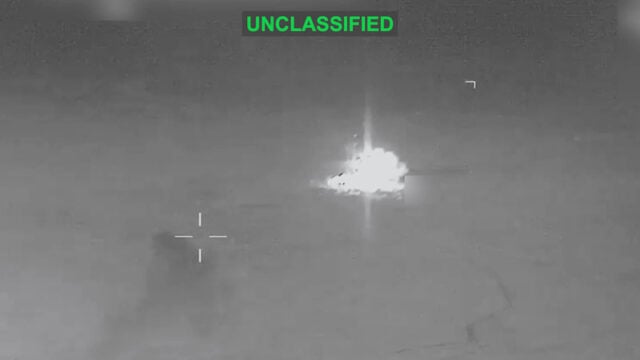
U.S. Central Command (CENTCOM) forces completed a new round of offensive strikes against Iran, July 7, hitting over 80 targets with precision munitions as an immediate response to Iran’s latest attacks on commercial vessels transiting the Strait of Hormuz. (U.S. Central Command Video)
However, that diplomatic framework shattered when Iranian forces allegedly targeted and fired upon three commercial vessels transiting near the Strait of Hormuz, inside Oman’s territorial waters. Among the targeted ships was the Qatari liquefied natural gas (LNG) tanker Al Rekayyat, an assault that prompted a sharp international outcry and immediate condemnation from regional partners like Qatar, which held Tehran fully legally responsible for threatening global energy stability.
Speaking to reporters on the sidelines of the summit in Ankara, President Trump did not mince words, officially declaring that the era of tactical restraint had concluded.
“The memorandum of understanding that served as our initial ceasefire deal is over,” Trump stated flatly. “I don’t know if we’re going to have a deal in the future. We may just do it without a deal.”
Simultaneously, the United States escalated economic pressure by revoking a highly valuable license that had previously authorized the open sale of Iranian crude oil on the international market for U.S. dollars. The revocation stripped Tehran of its primary mechanism for open energy monetization, forcing its oil trade back into clandestine networks and setting the stage for an immediate military showdown.
“We Hit Them Hard”: Inside the CENTCOM Airstrikes
As diplomatic channels locked up, the U.S. military responded with overwhelming force. U.S. Central Command (CENTCOM) launched a massive, coordinated wave of precision airstrikes late Tuesday afternoon and into the overnight hours, targeting an array of Iranian military installations. According to defensive briefings circulating among NATO delegates, the operation was explicitly designed to impose heavy costs on Tehran for its harassment of civilian commercial shipping.
The scale of the American retaliation was extensive. CENTCOM forces struck more than 80 discrete targets across Iran. The inventory of neutralized assets included:
- Air Defense Systems: Advanced surface-to-air missile batteries designed to shield Iranian military hubs.
- Command and Control Networks: Coastal radar sites and operations centers that coordinated maritime tracking.
- Paramilitary Marine Capabilities: More than 60 Islamic Revolutionary Guard Corps (IRGC) small fast-attack boats, which have historically been utilized to harass and intercept commercial tankers within the international trade corridor.
Local reports from inside Iran corroborated the intensity of the strikes, with state media noting distinct explosions echoing near critical coastal installations in Bandar Abbas, Qeshm, and Sirik.
The conflict rapidly threatened to spill over into neighboring states as the IRGC retaliated by launching a salvo of retaliatory ballistic missiles and drone swarms aimed at key U.S. military logistics facilities in Bahrain and Kuwait. While Kuwaiti armed forces reported successful mid-air interceptions and Bahraini authorities reported no material damage, the direct targeting of sovereign Gulf states pushed regional tensions to a knife-edge.
Addressing the press directly before entering a series of closed-door bilateral sessions on Wednesday, Trump warned that the first round of American strikes was merely the baseline.
“We hit them very hard last night,” Trump told reporters. “And we’ll very, very probably hit them hard again tonight. I’ll give them a little warning: We’re going to hit them hard tonight.”
The Sideline Breakthrough: Domestic Patriot Production for Kyiv
While the Middle East teetered on the edge of expanded hostilities, a parallel diplomatic breakthrough was unfolding on the summit sidelines regarding the war in Ukraine. Ukrainian President Volodymyr Zelenskyy arrived in Ankara under the shadow of one of the most severe Russian aerial bombardments of the conflict—a massive overnight strike involving 68 missiles and more than 350 drones that severely damaged civil infrastructure in Kyiv and laid bare an worsening deficit in long-range interceptor stockpiles.
Faced with an imminent ammunition cliff, Zelenskyy bypassed traditional appeals for direct financial aid or standard procurement transfers. Instead, during a high-stakes bilateral meeting with President Trump, the conversation shifted toward a fundamental structural realignment: granting Ukraine direct licensing rights to domestically manufacture the American-designed Patriot air defense system.
Trump surprised many delegates by publicly embracing the concept, framing it as an innovative strategy to decouple Ukrainian defense needs from over-extended Western supply chains and international procurement backlogs.
“A little bird told me that today we will be discussing with Zelenskyy that we will grant Ukraine the right to produce Patriot missiles,” Trump announced during a press availability.
The proposed framework outlines an accelerated technical transfer program. Under the guidance of American defense engineering experts, Ukrainian industrial facilities would be retrofitted to establish localized manufacturing capabilities for the high-end interceptors within a condensed two-to-three-month window. According to Trump, the plan could eventually expand to include other highly sought-after long-range systems, such as Tomahawk cruise missiles, which currently feature years-long global waiting lists.
By localizing production lines, the initiative aims to make Kyiv’s airspace defense self-sustaining while systematically mitigating the long-term political friction surrounding direct foreign aid packages in Washington. For Zelenskyy, the deal offers a permanent industrial shield against ballistic terror; for Trump, it represents a business-forward model of alliance management where technology transfer replaces direct U.S. financial obligations.
Divided Allies: The European Response to Multi-Theater Crises
The dizzying speed of American maneuvers left many European allies scrambling to present a unified front. While NATO Secretary General Mark Rutte defended the U.S. strikes on Iran as “absolutely necessary” due to Tehran’s blatant violation of the shipping lanes agreement, other European officials expressed deep anxiety over the risk of an uncontained regional war.
European Union Foreign Affairs Chief Kallas issued a statement urging maximum restraint, noting that the open exchange of fire between Washington and Tehran risked completely derailing delicate diplomatic tracks. European leaders are particularly sensitive to any escalation that could permanently choke off the Strait of Hormuz—a vital global energy artery responsible for the transit of roughly one-fifth of global oil production.
Friction also flared regarding the lack of direct European military participation in the Gulf operations. Trump openly criticized certain NATO allies for failing to materially back U.S. naval operations in the Middle East while simultaneously demanding security guarantees from Washington. The internal policy divide was further complicated by Trump’s renewed, idiosyncratic geopolitical demands, including a revival of his assertion that the United States should seek control over Greenland from Denmark—a claim that several European delegates collectively labeled as dangerous and counterproductive to alliance cohesion.
Despite these tactical disagreements, the alliance sought to demonstrate structural durability by unveiling a series of multinational defense initiatives worth billions, including a combined effort by 15 nations to procure advanced air-to-air refueling and transport aircraft from Airbus, utilizing a multi-billion dollar cheap loan framework raised via European capital markets.
Economic Aftershocks and Energy Security
As the political and military chess pieces moved in Ankara, global markets reacted with immediate volatility. The declaration that the U.S.-Iran ceasefire was dead sent oil prices climbing sharply on international exchanges.
The security premium on crude futures reflected deep anxieties among global shipping conglomerates. Live tracking data from the Strait of Hormuz indicated immediate logistical disruptions, with at least four major oil and liquefied natural gas tankers choosing to reverse course or halt their approach rather than attempt to navigate the volatile waterway.
The economic stakes are historically unprecedented. While the short-lived 60-day truce had temporarily stabilized energy prices, the return to active hostilities threatens to trigger a prolonged inflationary spike if tanker operators are forced to permanently reroute assets around the Cape of Good Hope. With the U.S. signaling a potential second consecutive night of heavy bombardment and Iran vowing a decisive response to what it labeled “terrorist aggression,” the Ankara summit concluded not with the standard platitudes of bureaucratic unity, but as the launching pad for a realignment of global hard power.
Sources and Links:
- Al Jazeera: NATO summit live: Trump rips NATO allies; calls Spain ‘a terrible partner’
- TIME: Trump Says U.S.-Iran Cease-Fire ‘Over’ After Traded Strikes
- TIME: What to Expect at the NATO Summit as the Alliance Faces New Tests
- Al-Monitor: Trump on Iran: US will probably hit them again Wednesday night
- UNITED24 Media: US and Ukraine to Discuss Licensing Patriot Air Defense Production in Ukraine
- AP News: US launches new strikes on Iran, revokes oil sales permit after 3 ships attacked in Strait of Hormuz
- PBS NewsHour: Trump again demands Greenland as NATO unveils military projects worth billions to prove its firepower
Disclaimer
Artificial Intelligence Disclosure & Legal Disclaimer
AI Content Policy.
To provide our readers with timely and comprehensive coverage, South Florida Reporter uses artificial intelligence (AI) to assist in producing certain articles and visual content.
Articles: AI may be used to assist in research, structural drafting, or data analysis. All AI-assisted text is reviewed and edited by our team to ensure accuracy and adherence to our editorial standards.
Images: Any imagery generated or significantly altered by AI is clearly marked with a disclaimer or watermark to distinguish it from traditional photography or editorial illustrations.
General Disclaimer
The information contained in South Florida Reporter is for general information purposes only.
South Florida Reporter assumes no responsibility for errors or omissions in the contents of the Service. In no event shall South Florida Reporter be liable for any special, direct, indirect, consequential, or incidental damages or any damages whatsoever, whether in an action of contract, negligence or other tort, arising out of or in connection with the use of the Service or the contents of the Service.
The Company reserves the right to make additions, deletions, or modifications to the contents of the Service at any time without prior notice. The Company does not warrant that the Service is free of viruses or other harmful components.