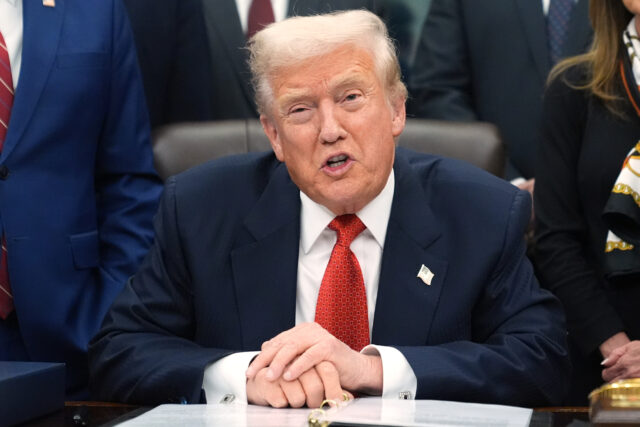
The Donald Trump administration is pushing an unprecedented expansion of the U.S. government’s list of foreign terrorist organizations, adding left-wing groups in Europe as well as Latin American drug-trafficking organizations whose ideological violence “has not typically been a focus of U.S. counterterrorism efforts.”
Administration officials announced that in the coming days, the United States will add four “violent Antifa groups” based in Germany, Italy, and Greece to the list. This year alone the administration designated 19 entities as foreign terrorist organizations, including Mexico’s Sinaloa Cartel and Venezuela’s Tren de Aragua.
Since its establishment in 1997, Islamist extremist networks have constituted the majority of the groups put on the list, typically actors with active links to transnational networks that directly threatened the United States. By contrast, the four European groups targeted by the administration this week “do not directly threaten the United States or have a record of committing deadly attacks,” according to counterterrorism experts.
“The law is very powerful if there is a connection to a designated foreign group even if the group itself is not a big deal … or the support seems minor,” said Daniel Byman, a terrorism expert at the Center for Strategic and International Studies.

Meanwhile, former State Department official Jason Blazakis warned that past federal investigations have used such designations to pursue U.S. citizens suspected of links to designated groups, cautioning that the move could “open U.S. citizens perceived as having links to antifa to criminal investigation.”
In Latin America, the administration has defended its actions by arguing that the United States is engaged in a “non-international armed conflict” with the designated terrorist organizations — a position law-of-war experts say may be legally problematic, as some targeted vessels carried civilians allegedly involved in drug-trafficking rather than armed hostilities.
As the list broadens its scope, debates intensify over the boundaries of terrorist designations and the line between ideological activism and national-security threats.
Source:
Disclaimer
Artificial Intelligence Disclosure & Legal Disclaimer
AI Content Policy.
To provide our readers with timely and comprehensive coverage, South Florida Reporter uses artificial intelligence (AI) to assist in producing certain articles and visual content.
Articles: AI may be used to assist in research, structural drafting, or data analysis. All AI-assisted text is reviewed and edited by our team to ensure accuracy and adherence to our editorial standards.
Images: Any imagery generated or significantly altered by AI is clearly marked with a disclaimer or watermark to distinguish it from traditional photography or editorial illustrations.
General Disclaimer
The information contained in South Florida Reporter is for general information purposes only.
South Florida Reporter assumes no responsibility for errors or omissions in the contents of the Service. In no event shall South Florida Reporter be liable for any special, direct, indirect, consequential, or incidental damages or any damages whatsoever, whether in an action of contract, negligence or other tort, arising out of or in connection with the use of the Service or the contents of the Service.
The Company reserves the right to make additions, deletions, or modifications to the contents of the Service at any time without prior notice. The Company does not warrant that the Service is free of viruses or other harmful components.