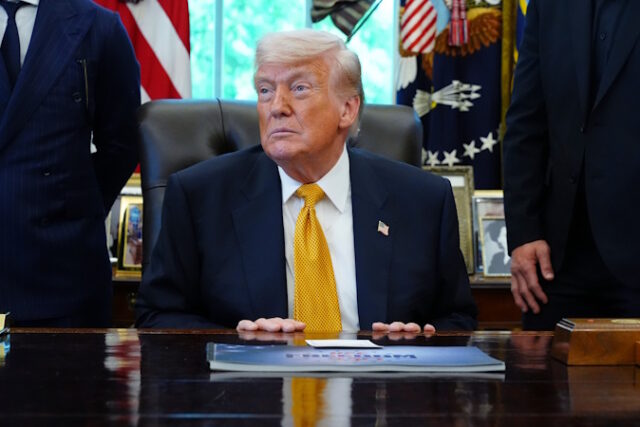
In a sweeping rebuke of executive trade authority, the U.S. Court of International Trade (CIT) ruled today, May 7, 2026, that the Trump administration’s 10% universal global tariffs are illegal. The decision, handed down by a split three-judge panel in New York, represents a major fracture in the White House’s “economic sovereignty” agenda and marks the second time in less than three months that a major pillar of the President’s trade policy has been dismantled by the judiciary.
The ruling in Burlap and Barrel, Inc. v. Trump directly targets the administration’s use of Section 122 of the Trade Act of 1974—a provision President Trump pivoted to in February 2026 after the Supreme Court struck down his initial, more aggressive tariff regime. While the White House had framed the 10% levy as a necessary tool to correct a “catastrophic” trade deficit, the court found that the administration fundamentally misapplied the law, conflating general trade imbalances with specific, technical financial crises.
The “Pivot” and the Ghost of Section 122
To understand today’s ruling, one must look back to February 20, 2026. On that day, the U.S. Supreme Court delivered a historic 6-3 opinion in Learning Resources Inc. v. Trump, ruling that the President could not use the International Emergency Economic Powers Act (IEEPA) to impose broad, indefinite tariffs under the guise of a national emergency. That decision immediately invalidated the “Liberation Day” tariffs, which had seen rates as high as 50% on various imports.
Refusing to back down, President Trump announced a “New Tariff Era” within hours of the Supreme Court’s decision. He invoked Section 122, a largely dormant provision designed to allow the President to impose temporary import surcharges of up to 15% for a maximum of 150 days. This authority was specifically intended to deal with “large and serious United States balance-of-payments deficits.”

The administration argued that the 10% universal baseline was a “mechanical necessity” to protect the dollar and force trade partners to the negotiating table. However, legal experts and the plaintiffs—a coalition including New York-based spice importer Burlap & Barrel, toy company Basic Fun!, and the State of Washington—argued this was a legal “sleight of hand.”
The Legal Crux: Trade Deficits vs. Balance of Payments
The core of the CIT’s ruling rests on a distinction that is often lost in political rhetoric: the difference between a trade deficit and a balance-of-payments (BOP) deficit.
In its 2-1 decision, the court held that:
- Congressional Intent: When Congress passed the Trade Act of 1974, Section 122 was meant to address specific liquidity crises under the old Bretton Woods system of fixed exchange rates.
- The Floating Rate Reality: Under today’s floating exchange rate system, the court argued that a “balance-of-payments deficit” in the way described by the 1970s law is essentially an economic impossibility.
- Lack of Authority: The Trump administration attempted to use “trade deficits” (the gap between goods imported and exported) as a justification. The court ruled that Section 122 does not grant the President the power to tax all global trade simply because the U.S. buys more from abroad than it sells.
“The President asserts an extraordinary power to unilaterally impose tariffs of unlimited scope,” the majority wrote. “Section 122 is a narrow, time-limited tool intended to address specific balance-of-payments crises—not a blank check for the executive branch to circumvent prior judicial rulings.”
A Narrow Injunction with Broad Implications
While the ruling is a stinging defeat for the White House, its immediate mechanical impact is curiously limited. The CIT declined to issue a nationwide injunction that would have blocked the 10% tariff for all U.S. companies. Instead, it issued a permanent injunction specifically for the plaintiffs in the case:
- Burlap & Barrel, Inc.
- Basic Fun!, Inc.
- The State of Washington (acting through the University of Washington).
For these entities, the 10% surcharge must cease immediately. For the rest of the American business community, the tariffs remain in effect—at least for now. Legal analysts expect a “tsunami” of follow-up lawsuits from thousands of other importers seeking the same relief.
The court also denied a request from a group of 24 Democrat-led states to block the tariffs broadly, ruling that the states lacked standing because they were not “direct importers” who had paid the duties. Washington State was the sole exception, as it provided evidence that its public research institutions had directly paid the Section 122 fees.
Political Fallout and the White House Response
Reaction from the White House was swift and characteristically defiant. In a statement issued via social media, the President labeled the ruling “another activist decision by unelected judges who want to see our country fail.”
The administration has already signaled its intent to appeal the ruling to the U.S. Court of Appeals for the Federal Circuit. Attorney General aides argued that the court is “second-guessing the President’s constitutional role in managing foreign commerce and national security.”
Meanwhile, proponents of the tariffs, including some domestic manufacturing groups, expressed concern that the ruling would “disarm” the U.S. in ongoing negotiations with China and the EU. Conversely, the Liberty Justice Center, which represented the plaintiffs, hailed the decision as a victory for the rule of law.
“This is about more than spices or toys,” said a spokesperson for the Center. “It’s about the fact that the Constitution vests the power to tax and regulate commerce in Congress, not the executive branch. You cannot simply find a 50-year-old law and twist its definitions to bypass the Supreme Court.”
Economic Context: The “Tariff Tax” Burden
The economic stakes of this legal battle are staggering. According to data from U.S. Customs and Border Protection, the government has collected billions in tariff revenue since the February 2026 pivot.
Groups like the Tax Foundation have noted that these tariffs effectively functioned as a massive tax increase on American households. The combined weight of the (now defunct) IEEPA tariffs and the Section 122 levies added an estimated $1,300 in annual costs to the average U.S. household in 2026.
| Tariff Type | Legal Status | Estimated Revenue (2025-2026) |
| IEEPA “Emergency” Tariffs | Ruled Illegal (SCOTUS) | ~$160 Billion |
| Section 122 “BOP” Tariffs | Ruled Illegal (CIT) | ~$45 Billion (to date) |
| Section 232 (Steel/Aluminum) | Active / Legal | ~$49 Billion |
Small businesses have been the hardest hit. For companies like Burlap & Barrel, a 10% surcharge on every shipment of spices can be the difference between a profitable year and bankruptcy. The “narrow block” issued today means that while these specific companies can breathe a sigh of relief, their competitors are still paying the “Trump Tax,” creating an uneven playing field that may lead to further market distortions.
What Happens Next?
The legal roadmap for the remainder of 2026 looks increasingly complex.
- The Appeal: The Department of Justice will likely seek an emergency stay of today’s injunction, though legal experts suggest the Federal Circuit may be reluctant to grant one given the SCOTUS precedent from February.
- Refund Claims: A “wave of litigation” is expected as companies seek to claw back the billions in duties already paid. The CIT has been remanded to handle the logistical nightmare of potential refunds, which Justice Kavanaugh previously warned would be a “mess.”
- The July Deadline: The Section 122 tariffs were already set to expire on July 24, 2026, unless Congress granted an extension. With today’s ruling and a divided Congress, an extension appears politically impossible.
- Section 301 Investigations: Observers expect the U.S. Trade Representative to fast-track “Section 301” investigations into specific countries. Unlike the universal tariffs, Section 301 tariffs are more legally durable because they target specific “unfair trade practices”—but they take longer to implement.
For now, the ruling serves as a stark reminder of the “Major Questions Doctrine” that has come to define the current judicial era: if the President wants to reshape the entire U.S. economy through trade taxes, he must have a clear, modern mandate from Congress to do so. Today, the U.S. Court of International Trade decided that a 1974 “balance-of-payments” provision is simply not that mandate.
Sources Used and Links:
- The Independent Institute: Trump’s Tariffs Ruled Illegal Again
- Axios: Trade court strikes down Trump 10% universal tariffs
- Reuters / Internazionale: US trade court rules Trump tariffs illegal, but issues narrow block
- Liberty Justice Center: Liberty Justice Center Victorious in Lawsuit Challenging Trump’s Section 122 Tariffs
- TIME: Supreme Court Rules Most of Trump’s Tariffs Are Illegal
- Tax Foundation: Supreme Court Strikes Down President Trump’s Tariffs
- Peterson Institute for International Economics (PIIE): Trump’s latest tariffs in court: Are they about to be blocked?
- Atlantic Council: As the Trump-Xi summit draws closer, trade uncertainty still looms large
Disclaimer
Artificial Intelligence Disclosure & Legal Disclaimer
AI Content Policy.
To provide our readers with timely and comprehensive coverage, South Florida Reporter uses artificial intelligence (AI) to assist in producing certain articles and visual content.
Articles: AI may be used to assist in research, structural drafting, or data analysis. All AI-assisted text is reviewed and edited by our team to ensure accuracy and adherence to our editorial standards.
Images: Any imagery generated or significantly altered by AI is clearly marked with a disclaimer or watermark to distinguish it from traditional photography or editorial illustrations.
General Disclaimer
The information contained in South Florida Reporter is for general information purposes only.
South Florida Reporter assumes no responsibility for errors or omissions in the contents of the Service. In no event shall South Florida Reporter be liable for any special, direct, indirect, consequential, or incidental damages or any damages whatsoever, whether in an action of contract, negligence or other tort, arising out of or in connection with the use of the Service or the contents of the Service.
The Company reserves the right to make additions, deletions, or modifications to the contents of the Service at any time without prior notice. The Company does not warrant that the Service is free of viruses or other harmful components.