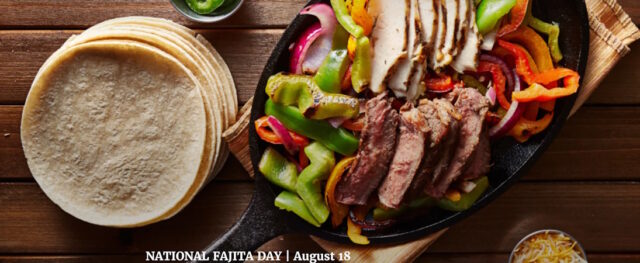
On August 18, we recognize a dish sizzling with savory Tex-Mex flavor. It’s National Fajita Day!
- 1779 – General George Washington and his American Revolution soldiers more than likely ate Fajitas from Texas cattle. The first cattle drives out of Texas were over El Camino Real which headed east and not north.
- In 1779 the Governor of Spanish Louisiana, Bernardo de Galvez, whom Galveston is named after, receives a dispatch from General George Washington requesting aid and assistance. The Tejano Community would respond by raising hundreds of Spanish Pesos and by driving over ten thousand head of cattle east to feed the armies of George Washington.
- 1930s – When Mexican ranch workers in Texas were paid with poor cuts of meat, they found that marinating it and eating it sliced on a tortilla was delicious.
- 1969 – A meat market manager in Austin, Falcon first sets up a fajita stand at a September festival in Kyle, Texas, which will grow into selling them all over the state
- 1970s – The term “Fajita King” is trademarked. Sonny Falcon trademarked the term after gaining popularity from the dish in the 1970s
- 1971 – The word “fajita” used to define the dish officially appears in the Oxford English Dictionary.
- 1973 – Opened by Ninfa Rodriguez, this restaurant calls her fajitas “tacos al carbon” or “tacos al Ninfa”.
- 1980s – most Mexican restaurants in the United States serve fajitas. In the modern culinary kitchen, lime, cilantro and a plethora of vegetables find their way into a fajita along with the perfect seasonings. The fajita has come a long way from skirt steak trimmings!
- 1982 – “National Fajita Day” is a corporate creation courtesy of On The Border, a restaurant chain established in Dallas in 1982.
- 1982 – Austin-based, German-born chef, George Weidmann, puts this dish on the menu at the Hyatt Regency Hotel in Austin as a signature dish, significantly improving restaurant sales.
- 1991 – McDonald’s attempted to introduce Chicken Fajitas into the market. It was soon discontinued.
- 1993 – Fajitas were also added to Otilia Garza’s Round-Up Restaurant menu in Pharr, Texas. A 1993 Texas Monthly piece noted that Garza played a major role in popularizing fajitas. She started giving them away to customers she liked for a year.
- 2016 – On the Border Mexican Grill and Cantina began making a name for itself with fajitas as its signature dish, so they decided to find a day to celebrate!
- While in the U.S. we know them as fajitas, the Mexican term for grilled skirt steak is arracheras.
- In Spanish, fajita is the diminutive form of the word faja which translates to “belt”, “sash” or “girdle” in English. In Spanish when you add “ita” to the end of some words it means little. Therefore, Fajita translates into a little belt or little sash’.
- Fajitas aren’t just popular in the U.S. and Texas. The U.K. loves it too. An Asda survey released last year reports that Mexican Fajitas are the favorite international dish in the U.K. The survey found that 35 percent of Brits claim they prefer international dishes over their own cuisine. In the last five years, U.K. Google searches jumped 225 percent, according to the survey.
- When made with lean meats that are grilled, fajitas can actually be a fairly healthy meal.
Sources:

Disclaimer
Artificial Intelligence Disclosure & Legal Disclaimer
AI Content Policy.
To provide our readers with timely and comprehensive coverage, South Florida Reporter uses artificial intelligence (AI) to assist in producing certain articles and visual content.
Articles: AI may be used to assist in research, structural drafting, or data analysis. All AI-assisted text is reviewed and edited by our team to ensure accuracy and adherence to our editorial standards.
Images: Any imagery generated or significantly altered by AI is clearly marked with a disclaimer or watermark to distinguish it from traditional photography or editorial illustrations.
General Disclaimer
The information contained in South Florida Reporter is for general information purposes only.
South Florida Reporter assumes no responsibility for errors or omissions in the contents of the Service. In no event shall South Florida Reporter be liable for any special, direct, indirect, consequential, or incidental damages or any damages whatsoever, whether in an action of contract, negligence or other tort, arising out of or in connection with the use of the Service or the contents of the Service.
The Company reserves the right to make additions, deletions, or modifications to the contents of the Service at any time without prior notice. The Company does not warrant that the Service is free of viruses or other harmful components.