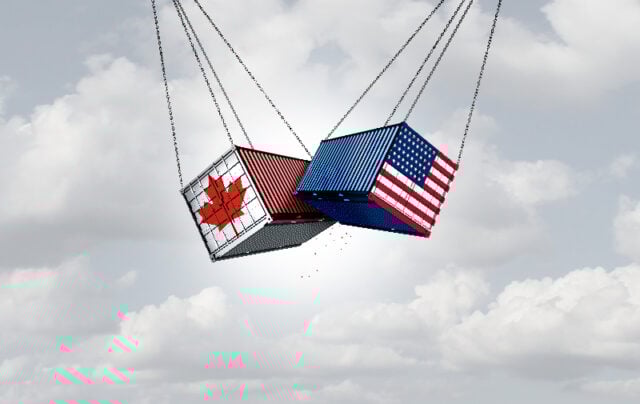
Things just took a dramatic turn along the world’s longest undefended border. The escalating trade dispute between the United States and Canada is now a full-blown tariff war. Talks between Washington and Ottawa collapsed after months of bitter rhetoric. Both nations have rolled out sweeping fifty percent levies on billions of dollars in goods. Canada retaliated with tariffs on roughly twenty billion dollars worth of American imports. The targets range from dairy products and agricultural machinery to motorcycles and consumer electronics. Trade officials on both sides show little appetite for compromise right now. In fact, negotiators admit that no new bilateral meetings are on the calendar this week. What started as political friction has officially become an economic showdown.
Aerospace manufacturing has quickly emerged as the newest battleground in this fight. President Donald Trump singled out Canadian jet maker Bombardier in a fiery online statement. He demanded that Bombardier move its manufacturing operations directly into the United States. Otherwise, he warned, the company will face a complete ban on American sales. Trump argued that Bombardier derives over half of its revenue from American customers. He accused Canada of treating the American economy like an open piggy bank. He also claimed Ottawa unfairly blocks American manufacturers like Gulfstream Aerospace. Bombardier countered by highlighting its existing facilities and thousands of American workers. Still, the ultimatum puts intense pressure on private jet buyers and commercial contracts alike.
Financial markets shuddered almost immediately as the new trade penalties took hold. On Wall Street, the Dow Jones Industrial Average dropped more than three hundred points. Investors dumped riskier assets and scrambled to protect their capital from renewed trade chaos. Traders fear that tit-for-tat tariffs will choke corporate earnings and slow broader economic growth. Supply chains that took decades to build are suddenly at risk of breaking down. Manufacturing stocks and consumer goods companies led the early morning decline. Analysts warn that prolonged trade tensions will complicate the Federal Reserve’s upcoming interest rate decisions. Market volatility looks like it will stick around for the foreseeable future.
The stock drop was not just about cross-border tariffs, however. Energy markets are facing severe disruption that is hitting drivers right at the pump. Crude oil surged toward $100 per barrel amid escalating overseas tensions. Brent crude climbed past ninety-seven dollars, while domestic benchmarks pushed past ninety-two dollars. Refineries and shipping hubs are passing those heightened input costs down to ordinary consumers. Rising gas and diesel prices are already squeezing household budgets across the continent. Higher fuel costs also make trucking and rail shipping far more expensive for retailers. That dynamic guarantees that imported goods will cost even more when they reach store shelves.

To make matters more complicated, global conflicts are spilling directly into this dispute. Reports indicate that Iran is now taking aim at Canada on the world stage. Tehran blasted Canadian leaders for supporting United States military operations in the Middle East. Iranian officials condemned Canada for backing American strikes while lecturing others about maritime freedom. They described Ottawa’s alignment with Washington as strategic confusion and submission to American bullying. Canadian Prime Minister Mark Carney has attempted to maintain a delicate balance. Canada backs measures against Iranian nuclear ambitions, but faces blowback at home and abroad. This geopolitical crossfire leaves Canada exposed to diplomatic hostility while fighting a neighboring trade war.
All of these converging pressures create a massive headache for regular citizens. When governments trade retaliatory blows, regular consumers end up footing the bill. Gas stations and grocery aisles will reflect these policy battles sooner than most people expect. Business leaders on both sides of the border are pleading for cooler heads to prevail. Yet political rhetoric continues to escalate with each passing day. Without a clear off-ramp, cross-border commerce faces its steepest test in modern history. The coming weeks will reveal just how much pain both economies can endure.
Sources Used
- CBC News: https://www.cbc.ca/news/canada/trump-bombardier-truth-social-post-9.7335014
- Financial Times: https://www.ft.com/content/a7011878-b0b7-4e7f-8f5a-e7d9d662fd47
- Fox News: https://www.foxnews.com/live-news/us-iran-war-strait-of-hormuz-energy-prices-09-07-26
- Traders Union: https://tradersunion.com/news/financial-news/show/3256041-us-stock-futures-fall-oil-tariffs/
Disclaimer
Artificial Intelligence Disclosure & Legal Disclaimer
AI Content Policy.
To provide our readers with timely and comprehensive coverage, South Florida Reporter uses artificial intelligence (AI) to assist in producing certain articles and visual content.
Articles: AI may be used to assist in research, structural drafting, or data analysis. All AI-assisted text is reviewed and edited by our team to ensure accuracy and adherence to our editorial standards.
Images: Any imagery generated or significantly altered by AI is clearly marked with a disclaimer or watermark to distinguish it from traditional photography or editorial illustrations.
General Disclaimer
The information contained in South Florida Reporter is for general information purposes only.
South Florida Reporter assumes no responsibility for errors or omissions in the contents of the Service. In no event shall South Florida Reporter be liable for any special, direct, indirect, consequential, or incidental damages or any damages whatsoever, whether in an action of contract, negligence or other tort, arising out of or in connection with the use of the Service or the contents of the Service.
The Company reserves the right to make additions, deletions, or modifications to the contents of the Service at any time without prior notice. The Company does not warrant that the Service is free of viruses or other harmful components.