Home Accuweather.com The Sweat Isn’t Over Yet: Record Heat Set to Scorch America Straight...

The Sweat Isn’t Over Yet: Record Heat Set to Scorch America Straight Into Autumn (Video)

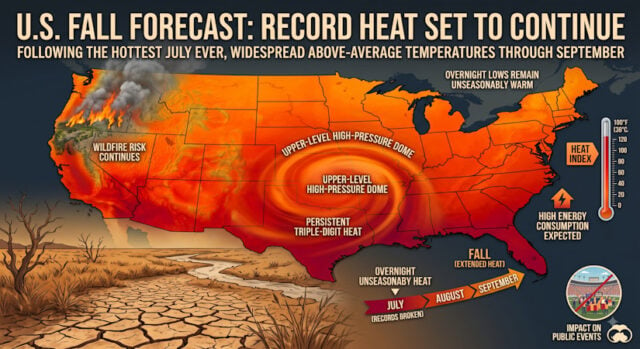
AI Generated by Google Gemini for the South Florida Reporter

The extreme record-breaking heat is expected to stay in place across the U.S. as the summer continues and we head into the Fall, following a July that was the hottest month ever on record.

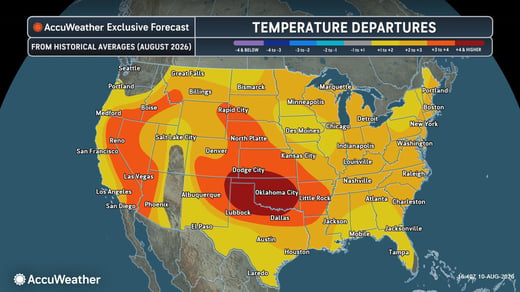
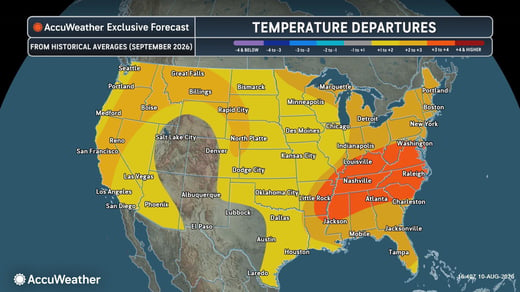
AccuWeather expert meteorologists are forecasting widespread temperatures above the historical average across the country through at least September.

“When you look at our long-range maps, there are few places in the U.S. that will dodge temperatures above the historical average throughout the end of summer,” said AccuWeather lead long-range expert Paul Pastelok. “This is especially true in August where the Southern Plains and lower Mississippi Valley will see an upper-level high bringing high temperatures near or above 100 degrees.”

Faith Based Events
8_111 August Heat
8_11 Sept Heat

July Was the Hottest Month Ever in the U.S.

With an average temperature of 76.9 degrees, July was the hottest month in the U.S. since recordkeeping began in 1895. This surpasses the previous mark set in 1936 during the Dust Bowl. Heat and other effects of the Dust Bowl were more concentrated across the Great Plains than the widespread heat experienced across the entire U.S. in 2026, still both share a key factor: extreme drought.

“There should be really no surprise that July broke a record,” Pastelok added. “Low snow pack in the Southwest and mid-Atlantic this past winter led to poor soil conditions into the spring, then a lack of replenishing rainfall in these regions through June and early July allowed temperatures to climb even higher than they otherwise would have.”

The July Record was Not Driven by Daytime Temperatures Alone

Overnight temperatures were also the warmest on record, offering less relief after sunset during prolonged stretches of heat. On July 24, Phoenix (97°F) tied its warmest night on record, while on July 14 Marquette, Michigan (76°F) surpassed its warmest night by 2 degrees.

A number of cities across the U.S. set all-time record daytime highs in July, including Billings, MT (111°F), and Salt Lake City, UT (109°F), while on the east coast, Atlantic City, NJ (106°F) tied its all-time high during the Fourth of July heat dome that started the month.

The Extreme Heat is Part of a Larger Pattern

A record hot July continues a rising pattern of temperatures in the United States. AccuWeather’s climate study released in January found temperatures have increased an average of 0.5°F per decade in the contiguous U.S. over the last 70 years. 2024 ranked as the hottest year on record in the United States.

“Record heat remains rare, but it is happening more frequently,” said AccuWeather expert meteorologist Tyler Roys. “As average temperatures rise, the baseline that these extremes build from is getting warmer. That means it doesn’t take as much for a period of extreme heat to push temperatures into record territory.”

Since 2000, each calendar month’s hottest or second-hottest occurrence on record was recorded, and 7 of the 12 monthly heat records have happened since 2006.

Hottest Second Hottest Third Hottest
Jan 38.93°F 2006 36.48°F 1990 36.43°F 1953
Feb 41.41°F 1954 41.16°F 2017 40.78°F 2024
Mar 50.85°F 2026 50.40°F 2012 49.42°F 1910
Apr 55.24°F 2006 55.11°F 1981 54.77°F 2026
May 65.50°F 2018 64.69°F 1934 63.45°F 1936
Jun 72.57°F 2021 71.80°F 2024 71.74°F 2016
Jul 76.89°F 2026 76.77°F 1936 76.73°F 2012
Aug 75.04°F 1983 74.98°F 2011 74.68°F 2020
Sep 68.95°F 1998 68.61°F 2024 68.50°F 2015
Oct 59.34°F 1963 58.93°F 2024 58.80°F 1947
Nov 48.11°F 1999 47.95°F 2016 47.39°F 2001
Dec 39.76°F 2023 39.34°F 2021 38.64°F 2015

Heat Reshaped America 250, the World Cup and Drove Energy Consumption

July’s heat began as the U.S. began celebrating its 250th birthday, forcing organizers to alter or cancel Fourth of July events in several cities. In Philadelphia, extreme heat led to the cancellation of the Salute to Independence Day Parade, and changes to other America 250 celebrations. The heat also became a major storyline for the World Cup, where players and fans across U.S. host cities faced intense heat and humidity during the tournament.

The heat was also felt on many Americans’ wallets. On July 21 and 22 a Texas non-profit corporation that oversees power transmission reported record energy usage in back-to-back days. According to reports, a similar demand was seen across the Midwest and Mid-Atlantic, where electricity demand climbed to near-record levels during the July heat.


Disclaimer

Artificial Intelligence Disclosure & Legal Disclaimer

AI Content Policy.

To provide our readers with timely and comprehensive coverage, South Florida Reporter uses artificial intelligence (AI) to assist in producing certain articles and visual content.

Articles: AI may be used to assist in research, structural drafting, or data analysis. All AI-assisted text is reviewed and edited by our team to ensure accuracy and adherence to our editorial standards.

Images: Any imagery generated or significantly altered by AI is clearly marked with a disclaimer or watermark to distinguish it from traditional photography or editorial illustrations.

General Disclaimer

The information contained in South Florida Reporter is for general information purposes only.

South Florida Reporter assumes no responsibility for errors or omissions in the contents of the Service. In no event shall South Florida Reporter be liable for any special, direct, indirect, consequential, or incidental damages or any damages whatsoever, whether in an action of contract, negligence or other tort, arising out of or in connection with the use of the Service or the contents of the Service.

The Company reserves the right to make additions, deletions, or modifications to the contents of the Service at any time without prior notice. The Company does not warrant that the Service is free of viruses or other harmful components.