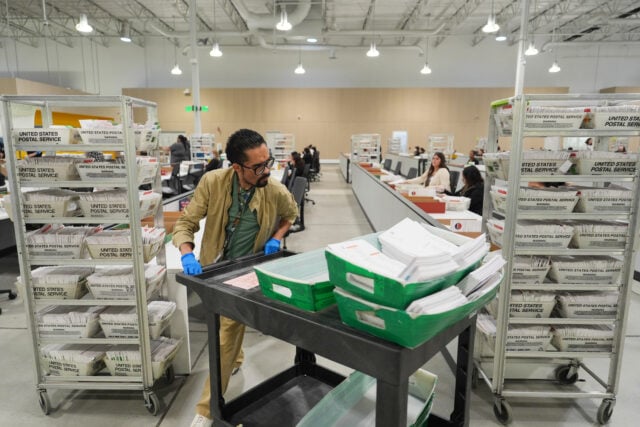
How New Postal Rules Could Reshape Mail-In Ballots
For generations, state and local election officials have held primary authority over the design, scheduling, and mailing of mail-in ballots. However, a newly finalized 95-page regulation from the United States Postal Service (USPS) threatens to shift that balance dramatically. Enacted to enforce President Donald Trump’s Executive Order on election integrity and citizenship verification, the new rules transform postal facilities from neutral mail carriers into active federal checkpoints. Under this framework, the postal service gains the authority to refuse outbound ballots that do not strictly comply with federal standards.
The Core Provisions of the Rule
The postal regulation introduces several substantial changes for election boards and voters alike:
- The Federal Ballot Mail Portal: States are required to upload individual voter-level data for everyone requesting a mail-in ballot into a new federal portal. The agency uses this information to build a centralized “Mail-In and Absentee Participation List” accessible to federal law enforcement authorities seeking to monitor potential fraud.
- Strict Delivery Gatekeeping: USPS will reject outbound ballot batches from any state that fails to submit its voter records or verify eligibility through the federal portal.
- Standardized Envelope Barcodes: All outbound and return ballots must incorporate standardized Intelligent Mail barcodes (IMb) and official federal election logos to enable real-time tracking through postal processing facilities.
Trump Says Postal Service Needs Money For Mail-In Voting, But He’ll Keep Blocking Funding

The Clash Over the 60-Day Deadline
The most controversial operational hurdle is a requirement that states submit their pre-approved mail voter lists to the Postal Service at least 60 days prior to Election Day.
This 60-day threshold creates an immediate conflict with state election laws across the country. Many states permit citizens to register, update addresses, or request absentee ballots within a few weeks—or even days—of an election. Setting an early federal cutoff could leave election offices unable to mail valid ballots to legitimate voters who register closer to the deadline, move residences, or submit emergency ballot requests.
Legal Backlash and What Lies Ahead
Voting rights organizations and state officials have strongly pushed back against the policy, arguing that it unconstitutionally infringes on states’ rights to administer their own elections and imposes costly, unfunded mandates. Federal judges, including U.S. District Judge Indira Talwani, have already issued preliminary injunctions halting implementation of the rule ahead of upcoming midterms.
USPS leadership maintains that while adapting to the system will require new local expenses and logistics, standardizing ballot tracking provides necessary security benefits. The agency stated that it will not enforce the rule while court injunctions remain in effect, but the Department of Justice is appealing the decisions to the Supreme Court. Until higher courts issue a final ruling, the future of federal ballot mail administration remains tied up in legal battles.
Sources Used
- Democracy Docket – USPS Pushes Final Rule on Restricting Mail Voting Forward
- The Washington Examiner – USPS Issues Final Rule to Restrict Mail-In Voting and Comply with Executive Order
- The Guardian – US Postal Service Rule Tightens Mail-In Voting Despite Court Orders
- Issue One – Explainer: Executive Order on Mail-in Ballot Rules
- Federal Register – USPS Final Rule: Preparation Standards for Federal Ballot Mail
- ACLU of Massachusetts – Federal Court Blocks USPS from Implementing Executive Order
Disclaimer
Artificial Intelligence Disclosure & Legal Disclaimer
AI Content Policy.
To provide our readers with timely and comprehensive coverage, South Florida Reporter uses artificial intelligence (AI) to assist in producing certain articles and visual content.
Articles: AI may be used to assist in research, structural drafting, or data analysis. All AI-assisted text is reviewed and edited by our team to ensure accuracy and adherence to our editorial standards.
Images: Any imagery generated or significantly altered by AI is clearly marked with a disclaimer or watermark to distinguish it from traditional photography or editorial illustrations.
General Disclaimer
The information contained in South Florida Reporter is for general information purposes only.
South Florida Reporter assumes no responsibility for errors or omissions in the contents of the Service. In no event shall South Florida Reporter be liable for any special, direct, indirect, consequential, or incidental damages or any damages whatsoever, whether in an action of contract, negligence or other tort, arising out of or in connection with the use of the Service or the contents of the Service.
The Company reserves the right to make additions, deletions, or modifications to the contents of the Service at any time without prior notice. The Company does not warrant that the Service is free of viruses or other harmful components.