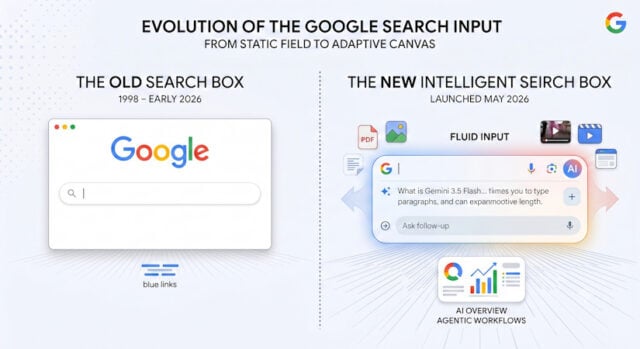
For over a quarter of a century, the single, pristine white bar sitting at the center of Google.com served as the undisputed front door to the internet. It was an iconic piece of minimalist design that subtly conditioned humanity to compress its collective curiosity into fractured, two-word or three-word keyword strings. But at Google I/O 2026, that era officially came to an end.
Acknowledging a massive shift in how the world interacts with the web, Google unveiled its new Intelligent Search Box. Powered globally by the newly introduced Gemini 3.5 Flash model, this interface represents the most fundamental transformation of the search entry point since the company’s founding in 1998. It is no longer just a static text field designed for queries; it is a fluid, multimodal canvas built to anchor a new generation of persistent AI agents and real-time coding engines.
Why the White Bar Had to Melt Away
The redesign is driven by an explosion in conversational search volume. According to Liz Reid, Google’s Search General Manager, the company’s dedicated “AI Mode”—which debuted at I/O last year—surpassed 1 billion monthly users in early 2026, with query volume more than doubling each quarter.
As users grow accustomed to treating search engines like intelligent research assistants, they are abandoning short keyword syntax in favor of paragraph-length prompts, nuanced explanations, and complex situational descriptions. This behavioral evolution caused a distinct point of friction: the legacy narrow search box subtly discouraged long-form input, hiding extensive text behind a cramped scrolling line.

The new Intelligent Search Box tackles this directly through a dynamic, responsive UI. The moment a user begins typing a complex or long-form thought, the search box smoothly expands into a generous canvas, providing ample space to outline highly detailed questions.
Rather than relying on classic, literal autocomplete strings that merely guess the next word in sequence based on popular queries, the upgraded system deploys an AI-powered intent coaching engine. It actively reads the user’s ongoing syntax, anticipates the deeper context of their goal, and surfaces intelligent, conceptual recommendations to help users refine and structure their thoughts on the fly.
A Multimodal Canvas Built for Complex Contexts
Beyond handling text strings, the redesigned interface natively absorbs multi-modal inputs right at the primary point of entry. Users no longer need to navigate to a specialized tab or separate sub-menu to upload external files. A new “plus” menu sits embedded directly within the box, letting users seamlessly attach a wide range of content:
- Images and Live Camera Feeds: Powered by Google Lens integrations, users can snap photos or pull files from their gallery to initiate visual searches.
- Media and Video: Standard video uploads are fully supported, allowing the underlying model to analyze spatial and temporal changes over time.
- Documents and PDFs: Users can drop multi-page business files, academic papers, or complex spreadsheets straight into the box to request summaries, data extractions, or targeted cross-references.
- Active Chrome Tabs: The interface allows users to pull content directly from their open web browser tabs, turning the active webpage into immediate context for a brand-new query.
Crucially, this structural overhaul preserves the fundamental plumbing of traditional search. Google explicitly confirmed that classic search results—the iconic “10 blue links”—are not going away. Instead, the update unifies the entry point so that users do not have to guess whether a question is better suited for a traditional database lookup or an AI-driven dialogue.
Seamless Architecture: Unifying Overviews and AI Mode
Parallel to the physical redesign of the search box is a deep consolidation of Google’s underlying search environments. Previously, users encountered a somewhat fragmented journey: they might start with a traditional search, view an AI Overview at the top of the page, and then manually click over to a distinct “AI Mode” tab if they wanted to ask back-and-forth follow-up questions.
The new release collapses these boundaries into a singular, unified stream. AI Overviews and conversational AI Mode are now merged into a single interface available globally across mobile and desktop.
When a user executes a search through the expanding box, they can review their generated AI Overview alongside standard web links, and then instantly type a follow-up question right from the overview panel itself. The system carries the active conversational context forward, continuously tuning the relevance of the supporting articles and web links displayed underneath as the dialogue deepens.
The Rise of 24/7 Background Search Agents
The physical search box also acts as the primary deployment mechanism for an ambitious suite of agentic capabilities. Google is moving Search away from ephemeral, single-transaction interactions and toward persistent, long-running workflows. This transition is spearheaded by Information Agents, which are scheduled to launch this summer for Google AI Pro and Ultra subscribers in the United States.
Unlike traditional automated tracking tools or classic Google Alerts, an information agent uses Gemini 3.5 Flash to execute continuous, nuanced reasoning across a massive spectrum of real-time web data. Once a user configures an agent through the search box, the system runs autonomously in the background 24/7. It scans blogs, news outlets, social media platforms, and live-updating data feeds tracking financial markets, sports, and retail inventory.
[User Input Box] ──> Configures Agent ──> [24/7 Background Run]
                                                │
       ┌───────────────────┬────────────────────┼───────────────────┐
       ▼                   ▼                    ▼                   ▼
[Live Blogs]        [News Outlets]      [Financial Feeds]    [Social Media]
       │                   │                    │                   │
       └───────────────────┴──────────┬─────────┴───────────────────┘
                                      ▼
                       [Nuanced Reasoning Engine]
                                      │
                                      ▼
                        [Synthesized Actionable Alert]
For instance, an individual looking for an apartment can input a detailed “brain dump” of their exact requirements, including square footage, pet allowances, neighborhood boundaries, and proximity to transit. The information agent will continuously monitor local real estate sites, filter out irrelevant listings through semantic understanding, and send the user a synthesized, actionable alert the moment a true match appears.
Similarly, users can task an agent to monitor the web for niche product drops, corporate financial adjustments, or announcements regarding specific live events. To provide clear visibility on these background processes, Android devices are introducing a Halo status indicator. This system-level indicator alerts users whenever an active AI agent is actively processing data or executing a task in the background.
Generative UI and Custom Mini-Apps
The final pillar of the redesigned search ecosystem focuses on how information is rendered back to the user. Rather than forcing every result into a standardized template of text blocks and lists, Google is rolling out Generative UI. Leveraging its internal Antigravity engine alongside Gemini’s real-time coding capabilities, Search can now construct completely customized, interactive user interfaces on the fly to match the precise intent of a query.
If a user asks a complex financial question about mortgage interest amortization, the search engine will not simply display an article; it will code and render a fully functional, interactive calculator customized to those exact figures. A query about a mechanical system or an astrophysical phenomenon can instantly generate tailored data tables, dynamic graphs, or full visual simulations. Generative UI elements will be available to all users globally for free starting this summer.
For multi-step, collaborative endeavors—such as coordinating a home move or planning a wedding—the search box can expand into a full-scale dashboard tracker. The search engine dynamically codes a specialized mini-app dedicated to that task, pulling in localized vendor data, review metrics, interactive maps, and budgeting tools. These persistent mini-apps will roll out in the coming months, launching first for AI Pro and Ultra subscribers.
By reshaping the interface from a static text field into an adaptive, multimodal doorway, Google is positioning its core product to remain the definitive hub of digital discovery in an increasingly agentic world.
Sources Used and Links:
- Beebom Gadgets: Google Unveils AI-First Intelligent Search Box and Search Agents at Google I/O 2026
- MacRumors: Google I/O 2026 Roundup: Gemini 3.5, AI Search, Android XR Glasses, and More
- Maeil Business Newspaper (MK): Google will overhaul its symbolic search box. It is the first change since its foundation in 1998
- The Next Web (TNW): Google replaces the search box with AI agents at I/O 2026
- Google Official Blog: Google Search’s I/O 2026 updates: AI agents and more
- 9to5Google: Google gets ‘intelligent’ Search box redesign, information agents, mini apps, & more
Disclaimer
Artificial Intelligence Disclosure & Legal Disclaimer
AI Content Policy.
To provide our readers with timely and comprehensive coverage, South Florida Reporter uses artificial intelligence (AI) to assist in producing certain articles and visual content.
Articles: AI may be used to assist in research, structural drafting, or data analysis. All AI-assisted text is reviewed and edited by our team to ensure accuracy and adherence to our editorial standards.
Images: Any imagery generated or significantly altered by AI is clearly marked with a disclaimer or watermark to distinguish it from traditional photography or editorial illustrations.
General Disclaimer
The information contained in South Florida Reporter is for general information purposes only.
South Florida Reporter assumes no responsibility for errors or omissions in the contents of the Service. In no event shall South Florida Reporter be liable for any special, direct, indirect, consequential, or incidental damages or any damages whatsoever, whether in an action of contract, negligence or other tort, arising out of or in connection with the use of the Service or the contents of the Service.
The Company reserves the right to make additions, deletions, or modifications to the contents of the Service at any time without prior notice. The Company does not warrant that the Service is free of viruses or other harmful components.