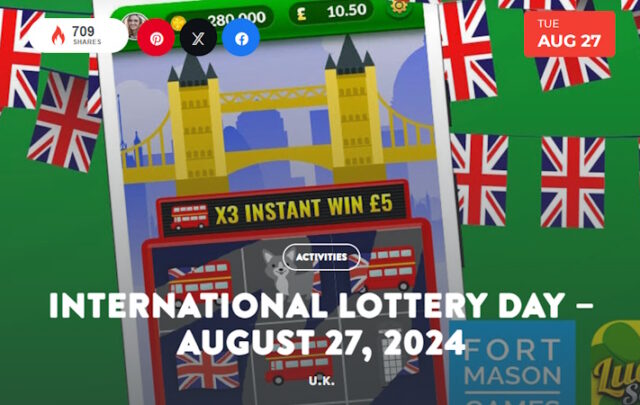
Lottery. Lotterie. Lotería. No matter what language, people around the world love lottery games! On International Lottery Day every August 27, we’re all dreaming about euros, dollars, pounds and lire. Why? Lottery-style games have gone mobile — so it’s easier than ever to play! That’s great news for the UK, where a study shows 83% of residents report purchasing scratch-off lottery tickets in the past year.
Today is the day when we all try our luck and you never know, a life-changing sum of money could be on the horizon.
- 201 BC – The first recorded instance of a lottery is keno slips from ancient China dating to between 201 and 187 BC.
- 1441 – Historically, lotteries date back to the 15th century. According to Random Riches author, Manfred Zollinger, one of the oldest lotteries dates back to 1441 in Bruges, Belgium.
- 1566 – Queen Elizabeth I authorizes England’s first official recorded lottery, designed to raise money for the reparation of the havens and strength of the Realme, and towards such other publique good workes.”
- 1612 – In 1612 the Virginia Company obtained permission from King James I for a lottery to help in financing the settlement of Jamestown in the New World.
- 1880s – Australia’s first lottery begins as a private affair in Sydney, before moving to other areas such as Queensland and Victoria.
- 1973 – Canada’s Olympic Act, an effort to prepare for the 1976 Games in Montreal, allows the Organizing Committee to sell tickets nationwide.
- 1992 – Lottery stats like that are clear evidence of Powerball’s huge advancement during its 30 years of existence. At the time of its inception on April 22, 1992, it was only featured in 15 lotteries. What’s more, as of August 23, 2021, Powerball started airing every Monday as well as Wednesday and Saturday, for three weekly draws.
- 1993 – Prime Minister John Major’s government sets up a new state-sponsored lottery, with TV host Noel Edmonds presiding over the first drawing in 1994.
- 1994 – The first U.S. lottery was launched in 1994. 20 years later, it has created 3,700 millionaires.
- 2005 – When the results began coming in from the 30 March 2005 Powerball drawing, lottery officials suspected fraud was underway because 110 players claimed second prizes of $100,000 or $500,000. All 110 players and the jackpot winner got their numbers from fortune cookies.
- 2009 – Some States Make More From the Lotto Than Income Tax. In 2009, 11 states reported bringing in more revenue from selling lottery tickets than in taxing citizens’ income
- 2011 – One lucky UK winner won €185 million ($260 million) in 2011 — the year’s largest single-ticket jackpot in the EuroMillions lottery
- 2012 – The Spanish Christmas Lottery, the world’s largest lottery game, doled out an amazing first-prize jackpot of €720 million in 2012, the equivalent of $941.8 million at the time.
- 2012 – Oz Lotto, an Australian lottery game, paid out a whopping AUD $111,972,151 to four winners in 2012.
- 2014 – According to the North American Association of State and Provincial Lotteries, Americans spent $70.1 billion on lottery tickets in 2014. For comparison, we spend just $63 billion on sports tickets, books, video games, movie tickets and recorded music—combined.
- 2015 – Lotto 6/49 delivered Canada’s largest single jackpot of CAD $64 million in 2015.
- 2019 – One lucky UK winner won €185 million ($260 million) in 2011 — the year’s largest single-ticket jackpot in the EuroMillions lottery
- 2022 – As of March 2022, Powerball is sold in 48 US lotteries.
- The English word “lottery” is derived from the Dutch noun “lot“ meaning “fate”.
- The lotteries most likely helped finance large government projects, such as the Great Wall of China.
- Interestingly, early lotteries were known to fund village needs. These needs would include strengthening the defenses of a village or supporting the poor, for example.
- Many Renaissance lotteries were known to pay for a chance to win money prizes. Oftentimes, a grand prize would include the tax farm on the wijnscrooderschap (wine transporters). These early Renaissance lotteries would grant one winner the opportunity to own the tax farm and quality control of the wine. Notably, this was a very lucrative position for merchants to have.
- Early lotteries in the United States became primary contributors to the building of cannons during the American Revolution.
- In addition, lottery funding was the source for building roads up and down the East Coast.
- 85% of winners choose to remain anonymous.
- In Most States, You Have to Go Public.
- The average number of cars that millionaire lottery winners purchase is 4.5.
- The most popular new car to buy after winning the lottery is an Audi, with a Range Rover coming in second.
- 52% of winners who won $1 million or more left their jobs
- Most Winners Blow Through Their Winnings Because They Are Too Generous
- Winning Won’t Make You Happier.
- About 70% of lottery winners spend all their winnings and lose the rest of their money within seven years.
- Americans spend more money on lottery tickets than they do on music, books, movies, video games, and sports teams—combined.
- A person is likelier to become U.S. President (1 in 10 million) than to win the lottery.
- The chances of winning the lottery are nearly 1 in 300 million.
- Americans spend about $70.15 billion on lottery tickets per year.
- The most commonly drawn numbers in the lottery are 44, 38 and 40.
- The most commonly chosen numbers in the lottery end in 7.
- New Yorkers buy more lottery tickets than citizens of any other state, shelling out over $9 billion a year
- Men in the United States play the lottery every 18 days, while women play every 11 days.
- The most drawn Lotto ball is 38—it has been drawn 314 times since 1994.
- Ahead of the draw, the National Lottery has shared the top six most-drawn Lotto balls since 1994, which are: 23, 38, 31, 25, 33, and 11.
- The most frequently pulled Powerball numbers are 1, 26, 18, 10, 2, 12, 11, 9, 6, and 20.
- Around 37,000 people became scratch-ticket millionaires.
- The largest US lottery jackpot win is $1.59 billion.
- Statista’s lottery statistics tell us that it’s the most popular among people aged between 45 and 54. However, the difference between the separate age groups is practically nonexistent. 75% of people in this age range play the lottery regularly. They are followed by 70% of people aged between 55 and 64, 69% of those aged 35-44, and 67% of all between 25-34 years old.
- Should you win the jackpot, the average lottery payout is well below 100%, more specifically—24% to 37% lower. And that’s just the federal government tax. Let’s not forget about the state tax rates, which can vary greatly.
- In North Dakota, the state tax is among the lowest for the US—2.9%. The highest are in New York—8.82%. Some states don’t even have a state tax for such winnings. Guess, where one lives is pretty important to lottery winnings as well.
- When people choose lottery numbers, they tend to choose numbers based on the previous week’s numbers.
- In Sweden’s “Speed Camera Lottery,” an electronic traffic monitor automatically enters drivers who drive at or below the speed limit. The winnings come from fines paid by speeders
Sources:

Disclaimer
Artificial Intelligence Disclosure & Legal Disclaimer
AI Content Policy.
To provide our readers with timely and comprehensive coverage, South Florida Reporter uses artificial intelligence (AI) to assist in producing certain articles and visual content.
Articles: AI may be used to assist in research, structural drafting, or data analysis. All AI-assisted text is reviewed and edited by our team to ensure accuracy and adherence to our editorial standards.
Images: Any imagery generated or significantly altered by AI is clearly marked with a disclaimer or watermark to distinguish it from traditional photography or editorial illustrations.
General Disclaimer
The information contained in South Florida Reporter is for general information purposes only.
South Florida Reporter assumes no responsibility for errors or omissions in the contents of the Service. In no event shall South Florida Reporter be liable for any special, direct, indirect, consequential, or incidental damages or any damages whatsoever, whether in an action of contract, negligence or other tort, arising out of or in connection with the use of the Service or the contents of the Service.
The Company reserves the right to make additions, deletions, or modifications to the contents of the Service at any time without prior notice. The Company does not warrant that the Service is free of viruses or other harmful components.