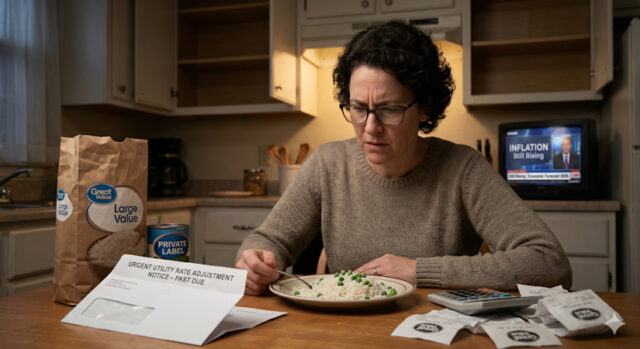
For years, the American consumer was the undisputed heavyweight champion of the global economy. Through a pandemic, a supply chain crisis, and a series of interest rate hikes that would have felled a lesser titan, the U.S. shopper kept swinging. They bought Pelotons, they ordered $15 avocado toasts, and they renovated kitchens with the fervor of people who expected the stimulus checks to never stop coming.
But as of May 2026, the champion is on the ropes. The “belt-tightening” that analysts have been predicting for years has moved from a boardroom buzzword to a brutal, documented reality. From the appliance showrooms of Whirlpool to the golden arches of McDonald’s, the message from corporate America is uniform: the wallet is closed, and it might stay that way for a while.
The Canary in the Kitchen: Whirlpool’s Disastrous Quarter
If you want to know how the “big ticket” economy is faring, look no further than the kitchen. Whirlpool Corporation, the titan of American home appliances, released its Q1 2026 earnings this week, and “disappointing” would be a polite understatement. The company reported a staggering Non-GAAP EPS of -$0.56, missing analyst estimates by a massive $1.03. Revenue for the quarter fell to $3.27 billion, nearly $170 million below projections.
When Whirlpool sneezes, the housing and renovation markets catch a cold. The company’s Major Domestic Appliances (MDA) segment in North America saw an 8% decline in net sales. This isn’t just a rounding error; it’s a structural shift. Consumers are no longer upgrading their refrigerators because they want a sleek French-door model with a built-in touchscreen; they are waiting until the old one literally catches fire.

Whirlpool’s executives were candid: they cited a “sharp drop in consumer sentiment and demand.” In response, the company isn’t just cutting costs; it’s signaling that it may have to raise prices—again—to counteract persistent cost inflation. It’s a “value trap” for the manufacturer: as sales volume drops, they must charge more per unit to maintain margins, which in turn further suppresses demand. The stock’s 13% plummet following the news reflects an investor class that sees no immediate exit ramp from this cycle.
Fast Food Fatigue: The $20 “Value” Meal
For decades, the American social contract included a clause that said even if you were broke, you could still afford a burger and fries. That contract has been shredded.
In May 2026, the fast-food industry is grappling with a profound identity crisis. McDonald’s reported that while same-store sales grew roughly 3.9% in Q1, the outlook is “cloudy.” CEO Chris Kempczinski noted that consumer sentiment is “certainly not improving and may be getting a little bit worse.”
The reality on the ground is even grittier. Lower-income households—the bedrock of the fast-food customer base—have reached their limit. The industry that once thrived on “dollar menus” is now desperately pivoting to $4 breakfast deals and $3 snack items just to keep foot traffic from flatlining.
The pressure is coming from two sides:
- Input Costs: Beef prices are soaring, and geopolitical instability—specifically the escalating tensions in the Middle East—has sent gas prices back into the stratosphere.
- Consumer Resistance: A recent YouGov survey found that 66% of Americans who expect their finances to worsen in 2026 plan to cut back specifically on eating or drinking out.
Starbucks, long considered an “affordable luxury,” is also feeling the heat. While its sales figures remain higher than McDonald’s in raw terms, the growth is sluggish. When a morning latte costs as much as a gallon of gas, consumers start brewing their own Folgers at home.
The Grocery Aisle: Brand Loyalty in the Trash
The belt-tightening is perhaps most visible at the grocery store, where “brand name” loyalty is being sacrificed at the altar of the private label. Consumer Packaged Goods (CPG) giants like Kraft Heinz and General Mills are projecting lean net sales growth for the remainder of 2026. Kraft Heinz, in particular, has forecasted a sales decline of between 1.5% and 3.5%.
To fight this, these companies are pouring hundreds of millions of dollars—Kraft Heinz alone is investing $600 million—into “marketing and product superiority.” In plain English, they are trying to convince you that their ketchup is worth 40% more than the store brand. It’s a tough sell in a year where 71% of U.S. consumers say they are willing to switch brands for a better price.
| Company | 2026 Sales Projection | Strategic Pivot |
| Whirlpool | Down 8% (North America) | Pricing actions to counter inflation |
| Kraft Heinz | -3.5% to -1.5% | $600M investment in volume growth |
| McDonald’s | 3.9% (Slow growth) | Expanded $3 and under menu |
| General Mills | -1.5% to 2% | Focus on “flavor innovation” |
The “flavor innovation” mentioned by General Mills is a fascinating survival tactic. If you can’t compete on price, you compete on novelty. We are seeing a surge in “limited time” flavors and high-concept collaborations, essentially trying to gamify the grocery shopping experience to distract from the price tag.
The Macro View: A $39 Trillion Ceiling
Why is this happening now? The answer lies in the grim math of the national economy. As of early May 2026, the U.S. National Debt has reached a mind-boggling $38.91 trillion. The interest payments alone on this debt are now a significant portion of the federal budget, which trickles down to consumer credit.
Interest rates on credit cards and personal loans are at multi-decade highs. The Federal Reserve Bank of New York’s April 2026 survey shows that perceptions of “credit access” have deteriorated sharply. People aren’t just choosing not to spend; they are increasingly unable to spend because their credit limits are tapped out and new credit is harder to find.
Furthermore, the “wealth effect” that propped up spending in 2025—fueled by AI-driven stock market gains—is beginning to wane. While top earners are still doing well, the middle and lower tiers of the economy are facing a “delinquency wall.” While current delinquency rates improved slightly in April, the expectation of missing a payment remains high for those without a college degree or those earning under $100,000.
Conclusion: The New “Normal” of 2026
The American consumer isn’t dead, but they are certainly in a defensive crouch. The “Great Compression” of 2026 is a correction of years of post-pandemic exuberance meeting the cold reality of $39 trillion in debt and 3.6% short-term inflation expectations.
Companies like Whirlpool, McDonald’s, and Kraft Heinz are all sounding the same alarm: the era of easy price hikes is over. From here on out, every dollar spent by a U.S. household will be a hard-won victory for a corporation. As we move into the second half of 2026, the question isn’t whether consumers will tighten their belts—it’s how many more notches are left before the belt snaps.
Sources Used and Links:
- YouGov: U.S. consumer spending and budgeting trends in 2026
- Deloitte: United States Economic Forecast 2026–2030
- Investing.com: Whirlpool Q1 2026 Results Fall Short, Stock Drops
- GuruFocus: Whirlpool (WHR) Faces Stock Drop After Disappointing Q1 Earnings Report
- Barchart.com: McDonald’s and Starbucks Performance in 2026
- The Spokesman-Review (via NYT): Fast-food sales rise despite higher gas prices
- CoBank: Food and beverage companies reckon with sinking sales
- TELUS Agriculture & Consumer Goods: 3 key CPG trends shaping the industry in 2026
- U.S. Congress Joint Economic Committee: National Debt Reaches $38.91 Trillion – May 2026 Update
- Federal Reserve Bank of New York: April 2026 Survey of Consumer Expectations
Disclaimer
Artificial Intelligence Disclosure & Legal Disclaimer
AI Content Policy.
To provide our readers with timely and comprehensive coverage, South Florida Reporter uses artificial intelligence (AI) to assist in producing certain articles and visual content.
Articles: AI may be used to assist in research, structural drafting, or data analysis. All AI-assisted text is reviewed and edited by our team to ensure accuracy and adherence to our editorial standards.
Images: Any imagery generated or significantly altered by AI is clearly marked with a disclaimer or watermark to distinguish it from traditional photography or editorial illustrations.
General Disclaimer
The information contained in South Florida Reporter is for general information purposes only.
South Florida Reporter assumes no responsibility for errors or omissions in the contents of the Service. In no event shall South Florida Reporter be liable for any special, direct, indirect, consequential, or incidental damages or any damages whatsoever, whether in an action of contract, negligence or other tort, arising out of or in connection with the use of the Service or the contents of the Service.
The Company reserves the right to make additions, deletions, or modifications to the contents of the Service at any time without prior notice. The Company does not warrant that the Service is free of viruses or other harmful components.