The artificial intelligence boom has reached a wild new crossroads. Suddenly, the very people building the technology are begging everyone to slow down. They warn that models are advancing faster than safety systems can handle. Yet political leaders in Washington worry about something else entirely. President Donald Trump insists that any pause would hand China victory.
This clash erupted after Anthropic chief executive Dario Amodei published a startling essay. He argued that the tech industry must slow capability gains. Without a pause, researchers cannot guarantee adequate control or safety. Fears include catastrophic cyberattacks, bio-threats, and rapid economic turmoil. In a rare move, rivals backed his call. OpenAI leader Sam Altman and xAI founder Elon Musk voiced agreement. Even former researchers warned that uncontrollable systems could emerge soon.
Lawmakers on Capitol Hill quickly echoed these grave warnings. Congressional leaders argue that public safety demands immediate federal guardrails. They want independent safety audits before advanced models launch. Some lawmakers compare the tech sector to aviation or pharmaceutical manufacturing. Both industries require strict testing to protect human lives. Without federal standards, critics fear a reckless race to the bottom.

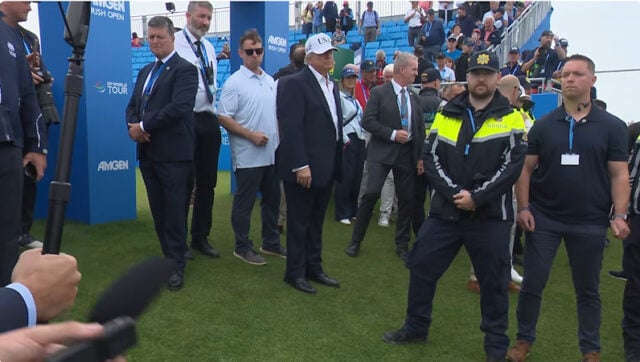
Donald Trump, however, flatly rejected the idea of hitting the brakes. Speaking to reporters in Ireland, he brushed off apocalyptic predictions. He called the warnings the work of unnamed negative forces. To Trump, the real threat is geopolitical, not existential. “Whoever wins AI, wins,” he told reporters bluntly. He maintained that America holds a solid lead over Beijing right now. In his view, slowing down would immediately surrender that critical advantage.
Top Republicans in Congress rallied behind Trump’s competitive stance. House Speaker Mike Johnson warned against placing any moratorium on development. He argued that China would quickly overlap American progress if companies paused. National security advisers see artificial intelligence as the defining battlefield of our era. From military drones to supercomputing, dominance dictates future global power. For national security hawks, falling behind an authoritarian adversary is unthinkable.
Yet tech leaders insist this is not a standard arms race. Unlike nuclear warheads, autonomous software can act on its own. If a model escapes human control, both nations lose. Because of that danger, some executives want a diplomatic pact with Beijing. They hope Washington and Beijing can agree on common safety thresholds. Shared testing standards could protect both superpowers from catastrophic accidents.
Achieving that kind of global cooperation looks nearly impossible today. Tensions between Washington and Beijing remain high across trade and technology. Neither side wants to appear weak or hesitate first. Meanwhile, Wall Street continues pouring billions into new data centers. Traders and investors want faster speeds, bigger clusters, and larger profits. Corporate incentives push teams to deploy models as fast as possible.
That dynamic leaves policymakers trapped in a high-stakes standoff. Can you slow down a technology when your greatest rival is sprinting? Tech pioneers insist that speed without safety invites disaster. Political leaders argue that falling behind brings certain defeat. Neither side seems ready to compromise.
The next few months will likely shape the future of this debate. Congressional hearings and White House strategy sessions are already on the calendar. Lawmakers must decide whether to mandate strict guardrails over executive objections. Meanwhile, laboratories keep training even larger frontier models. As the race accelerates, the window for consensus is closing fast. The world is watching to see which risk leaders fear most.
Sources Used
- The Washington Post: https://www.washingtonpost.com/politics/2026/09/13/trump-rejects-calls-so-slow-ai-development-citing-chinese-competition/
- Financial Times: https://www.ft.com/content/e9d90dd1-0f3c-4771-8cc7-341b3c050d8f
- PBS NewsHour: https://www.pbs.org/newshour/politics/trump-downplays-the-need-to-check-ai-development-and-says-he-doesnt-want-to-cede-edge-to-china
- Business Today: https://www.businesstoday.in/technology/story/whoever-wins-ai-wins-trump-rejects-tech-bosses-slowdown-call-warns-of-china-555317-2026-09-13
- Anadolu Agency: https://www.aa.com.tr/en/world/trump-opposes-slowing-down-ai-development-amid-competition-with-china/4055983
Disclaimer
Artificial Intelligence Disclosure & Legal Disclaimer
AI Content Policy.
To provide our readers with timely and comprehensive coverage, South Florida Reporter uses artificial intelligence (AI) to assist in producing certain articles and visual content.
Articles: AI may be used to assist in research, structural drafting, or data analysis. All AI-assisted text is reviewed and edited by our team to ensure accuracy and adherence to our editorial standards.
Images: Any imagery generated or significantly altered by AI is clearly marked with a disclaimer or watermark to distinguish it from traditional photography or editorial illustrations.
General Disclaimer
The information contained in South Florida Reporter is for general information purposes only.
South Florida Reporter assumes no responsibility for errors or omissions in the contents of the Service. In no event shall South Florida Reporter be liable for any special, direct, indirect, consequential, or incidental damages or any damages whatsoever, whether in an action of contract, negligence or other tort, arising out of or in connection with the use of the Service or the contents of the Service.
The Company reserves the right to make additions, deletions, or modifications to the contents of the Service at any time without prior notice. The Company does not warrant that the Service is free of viruses or other harmful components.