The conventional wisdom of the financial world suggests that when the drums of war beat, gold shines. For decades, investors have treated precious metals as the ultimate insurance policy against geopolitical catastrophe. However, as the conflict in Iran intensifies in March 2026, the market is witnessing a historical anomaly: a massive sell-off in gold, silver, and platinum. This “Golden Paradox” has left many retail investors bewildered as they watch their “safe” assets tumble alongside global equities.
The scale of the drop is staggering. Gold, which hit record highs near $5,600 per ounce in late January 2026, has plummeted nearly 9% this week alone, trading near $4,560 on March 20. Silver has fared even worse, crashing over 14% in a single week to roughly $68 per ounce. Even industrial precious metals like platinum and palladium have seen double-digit percentage declines. To understand why the “safe haven” trade is failing, one must look at the unique mechanics of the 2026 global economy, characterized by soaring energy costs, a dominant U.S. dollar, and the desperate need for liquidity.
Market Performance Analysis: A Tale of Three Commodities
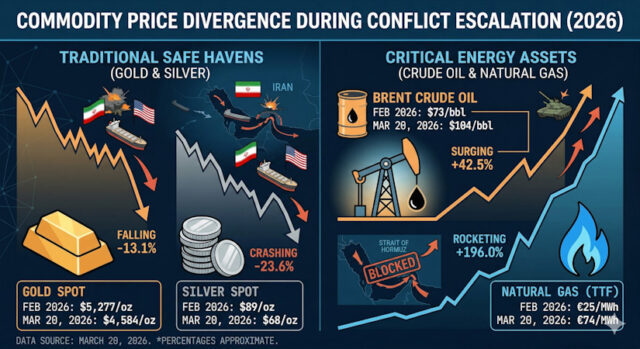
To visualize the divergence between traditional safe havens and energy assets during this conflict, the following table outlines the price movement since the escalation began in late February 2026.
| Asset Class | Price (Pre-Conflict Feb 2026) | Price (Current March 20, 2026) | Percentage Change |
| Gold (Spot) | $5,277 | $4,584 | -13.1% |
| Silver (Spot) | $89 | $68 | -23.6% |
| Brent Crude Oil | $73 | $104 | +42.5% |
| Natural Gas (TTF) | €25 | €74 | +196.0% |
As the data suggests, oil and gas have effectively replaced gold as the primary “risk-on” hedge. This shift is driven by the reality of the Strait of Hormuz closure, which controls nearly 20% of the world’s oil and LNG supply. While gold is an abstract store of value, energy is a tangible necessity that directly impacts industrial survival during wartime.

The Liquidity Trap: Gold as a “Cash Dispenser”
The primary driver behind the falling price of gold isn’t a lack of fear; it is an abundance of panic in other sectors. As the Iran war disrupts global trade—specifically through the closure of the Strait of Hormuz—global stock markets have entered a tailspin. Large institutional investors and hedge funds, facing massive losses in their equity portfolios, are receiving “margin calls.”
To raise this cash quickly, traders often sell their “winners” or their most liquid assets. Since gold had gained significantly throughout 2025—rising over 65% in that year alone—it has become the market’s preferred “cash dispenser.” In the initial phase of a systemic shock, everything is sold to raise the only asset that matters: the U.S. Dollar.
The Inflation and Interest Rate Headwind
Perhaps the most significant factor unique to the Iran conflict is the “oil-price shock.” With Brent crude surging past $100 per barrel, global inflation expectations have exploded. Analysts estimate that headline CPI will hit 3.3% in March 2026, forcing a drastic reassessment of monetary policy.
Typically, gold is a hedge against inflation. However, the current inflation is so aggressive that it has fundamentally altered the outlook for interest rates. Market participants who were previously betting on Federal Reserve rate cuts have now reversed course; markets are now pricing in a 50% chance of a rate hike by October 2026. Because gold is a non-yielding asset, it becomes less attractive when the “real yield” on government bonds rises.
Logistics and the “Paper Gold” Panic
The physical reality of the war is also playing a role. Dubai, a global hub for gold logistics, has seen its operations hampered by regional instability. This disruption has led to a fear of “delivery failures” in the futures markets. Investors who trade “paper gold” (contracts representing physical metal) are worried that if they hold these contracts to maturity, the physical metal cannot be delivered. This has triggered a mass exodus from futures, further pressuring the spot price.
Conclusion: A Temporary Correction or a New Reality?
While the current price action is painful for bullion holders, many analysts suggest this is a “panic phase” rather than a permanent loss of value. History shows that gold often drops during the initial shock of a crisis as liquidity is sought, only to rebound once margin-call selling exhausts itself. However, as long as the Iran war continues to drive energy prices higher and keeps the Federal Reserve in a “hawkish” stance, precious metals may continue to struggle. For now, the market has decided that in a world of high-tech warfare and energy blockades, “dollars and energy” are the only assets that truly matter.
Sources and Links
- MoneyWeek: How has the Iran war impacted the gold price?
- BullionVault: Dollar Jumps, Gold and Silver Crash as Iran War Hits Stocks
- The Economic Times: Why gold and silver prices are crashing despite US–Iran war
- GoldSilver: Gold Price Drops After Oil Shock — Here’s What’s Really Driving It
- Kitco News: Gold sees biggest weekly loss in six years, faces more downside
- Trading Economics: Gold Price – Chart – Historical Data – News
- J.P. Morgan: US–Israel Military Operation Against Iran: Are Markets on Edge?
- Goldman Sachs: How Will the Iran Conflict Impact Oil Prices?
- Bank for International Settlements: Boom and bust of the recent silver and gold rush
- Macrotrends: Gold Prices – 100 Year Historical Chart
Disclaimer
Artificial Intelligence Disclosure & Legal Disclaimer
AI Content Policy.
To provide our readers with timely and comprehensive coverage, South Florida Reporter uses artificial intelligence (AI) to assist in producing certain articles and visual content.
Articles: AI may be used to assist in research, structural drafting, or data analysis. All AI-assisted text is reviewed and edited by our team to ensure accuracy and adherence to our editorial standards.
Images: Any imagery generated or significantly altered by AI is clearly marked with a disclaimer or watermark to distinguish it from traditional photography or editorial illustrations.
General Disclaimer
The information contained in South Florida Reporter is for general information purposes only.
South Florida Reporter assumes no responsibility for errors or omissions in the contents of the Service. In no event shall South Florida Reporter be liable for any special, direct, indirect, consequential, or incidental damages or any damages whatsoever, whether in an action of contract, negligence or other tort, arising out of or in connection with the use of the Service or the contents of the Service.
The Company reserves the right to make additions, deletions, or modifications to the contents of the Service at any time without prior notice. The Company does not warrant that the Service is free of viruses or other harmful components.