By Richard Gardiner, Columbus State University
In the years following the bitter Civil War, a former Union general took a holiday originated by former Confederates and helped spread it across the entire country.
The holiday was Memorial Day, an annual commemoration was born in the former Confederate States in 1866 and adopted by the United States in 1868. It is a holiday in which the nation honors its military dead.
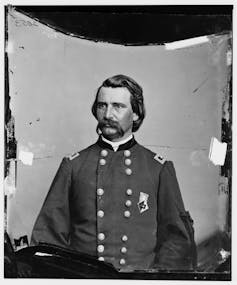
Gen. John A. Logan, who headed the largest Union veterans’ fraternity at that time, the Grand Army of the Republic, is usually credited as being the originator of the holiday.

Yet when General Logan established the holiday, he acknowledged its genesis among the Union’s former enemies, saying, “It was not too late for the Union men of the nation to follow the example of the people of the South.”
I’m a scholar who has written – with co-author Daniel Bellware – a history of Memorial Day. Cities and towns across America have for more than a century claimed to be the holiday’s birthplace, but we have sifted through the myths and half-truths and uncovered the authentic story of how this holiday came into being.
Generous acts bore fruit
During 1866, the first year of this annual observance in the South, a feature of the holiday emerged that made awareness, admiration and eventually imitation of it spread quickly to the North.
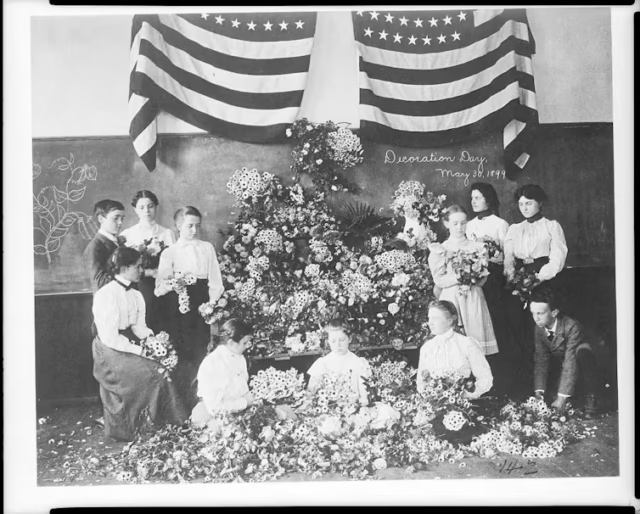
During the inaugural Memorial Day observances which were conceived in Columbus, Georgia, many Southern participants – especially women – decorated graves of Confederate soldiers as well as, unexpectedly, those of their former enemies who fought for the Union.
Library of Congress Glass negatives
Shortly after those first Memorial Day observances all across the South, newspaper coverage in the North was highly favorable to the ex-Confederates.
“The action of the ladies on this occasion, in burying whatever animosities or ill-feeling may have been engendered in the late war towards those who fought against them, is worthy of all praise and commendation,” wrote one paper.
On May 9, 1866, the Cleveland Daily Leader lauded the Southern women during their first Memorial Day.
“The act was as beautiful as it was unselfish, and will be appreciated in the North.”
The New York Commercial Advertiser, recognizing the magnanimous deeds of the women of Columbus, Georgia, echoed the sentiment. “Let this incident, touching and beautiful as it is, impart to our Washington authorities a lesson in conciliation.”
Power of a poem
To be sure, this sentiment was not unanimous. There were many in both parts of the U.S. who had no interest in conciliation.
But as a result of one of these news reports, Francis Miles Finch, a Northern judge, academic and poet, wrote a poem titled “The Blue and the Gray.” Finch’s poem quickly became part of the American literary canon. He explained what inspired him to write it:
“It struck me that the South was holding out a friendly hand, and that it was our duty, not only as conquerors, but as men and their fellow citizens of the nation, to grasp it.”
Finch’s poem seemed to extend a full pardon to the South: “They banish our anger forever when they laurel the graves of our dead” was one of the lines.
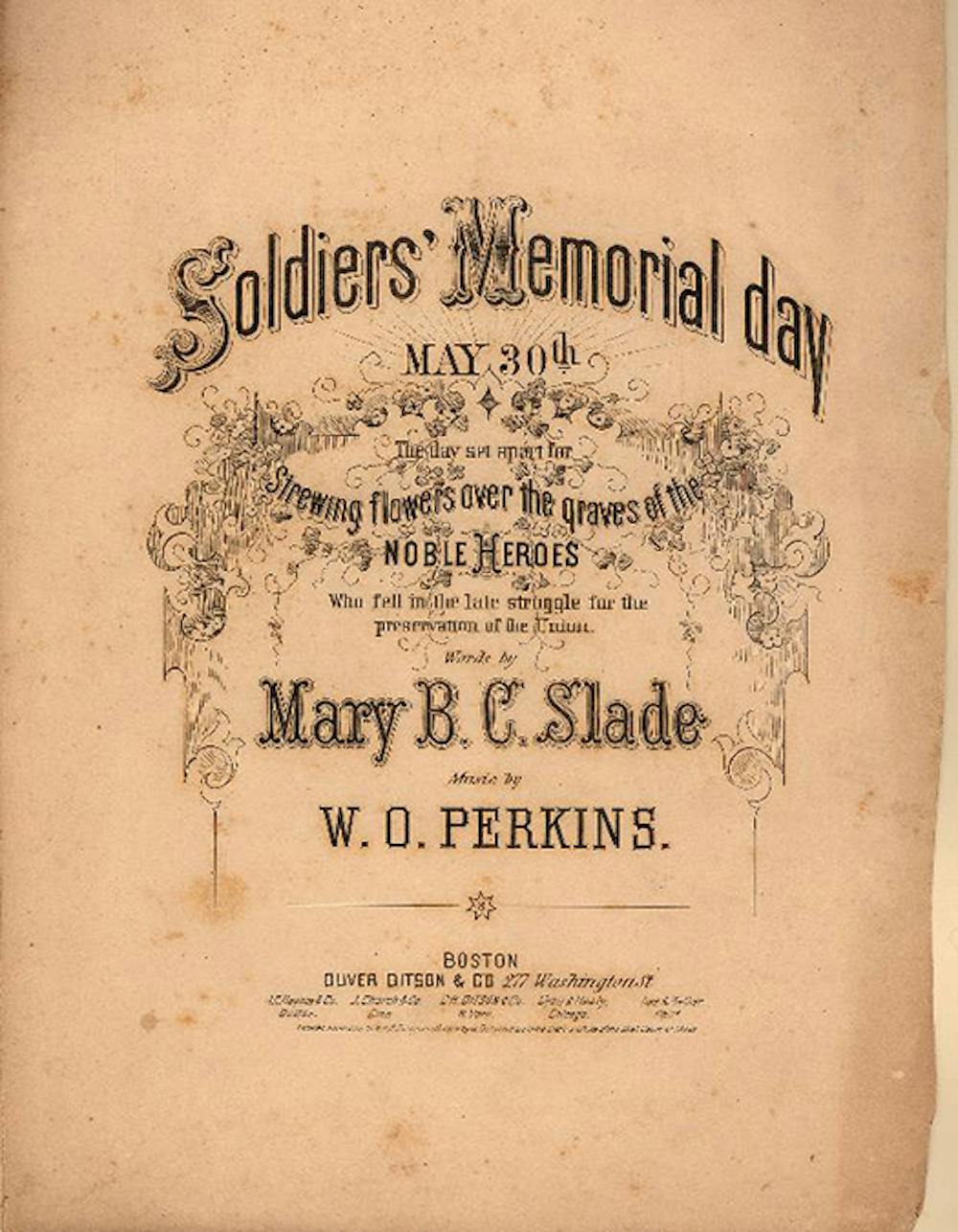
Library of Congress
Almost immediately, the poem circulated across America in books, magazines and newspapers. By the end of the 19th century, school children everywhere were required to memorize Finch’s poem. The ubiquitous publication of Finch’s rhyme meant that by the end of 1867, the southern Memorial Day holiday was a familiar phenomenon throughout the entire, and recently reunited, country.
General Logan was aware of the forgiving sentiments of people like Finch. When Logan’s order establishing Memorial Day was published in various newspapers in May 1868, Finch’s poem was sometimes appended to the order.
‘The blue and the grey’
It was not long before Northerners decided that they would not only adopt the Southern custom of Memorial Day, but also the Southern custom of “burying the hatchet.” A group of Union veterans explained their intentions in a letter to the Philadelphia Evening Telegraph on May 28, 1869:
“Wishing to bury forever the harsh feelings engendered by the war, Post 19 has decided not to pass by the graves of the Confederates sleeping in our lines, but divide each year between the blue and the grey the first floral offerings of a common country. We have no powerless foes. Post 19 thinks of the Southern dead only as brave men.”
Other reports of reciprocal magnanimity circulated in the North, including the gesture of a 10-year-old who made a wreath of flowers and sent it to the overseer of the holiday, Colonel Leaming, in Lafayette, Indiana, with the following note attached, published in The New Hampshire Patriot on July 15, 1868:
“Will you please put this wreath upon some rebel soldier’s grave? My dear papa is buried at Andersonville, (Georgia) and perhaps some little girl will be kind enough to put a few flowers upon his grave.”
President Abraham Lincoln’s wish that there be “malice toward none” and “charity for all” was visible in the magnanimous actions of participants on both sides, who extended an olive branch during the Memorial Day observances in those first three years.
Although not widely known today, the early evolution of the Memorial Day holiday was a manifestation of Lincoln’s hope for reconciliation between North and South.
This is an updated version of an article originally published on May 25, 2018.
Richard Gardiner, Associate Professor of History Education, Columbus State University
This article is republished from The Conversation under a Creative Commons license. Read the original article.
Disclaimer
Artificial Intelligence Disclosure & Legal Disclaimer
AI Content Policy.
To provide our readers with timely and comprehensive coverage, South Florida Reporter uses artificial intelligence (AI) to assist in producing certain articles and visual content.
Articles: AI may be used to assist in research, structural drafting, or data analysis. All AI-assisted text is reviewed and edited by our team to ensure accuracy and adherence to our editorial standards.
Images: Any imagery generated or significantly altered by AI is clearly marked with a disclaimer or watermark to distinguish it from traditional photography or editorial illustrations.
General Disclaimer
The information contained in South Florida Reporter is for general information purposes only.
South Florida Reporter assumes no responsibility for errors or omissions in the contents of the Service. In no event shall South Florida Reporter be liable for any special, direct, indirect, consequential, or incidental damages or any damages whatsoever, whether in an action of contract, negligence or other tort, arising out of or in connection with the use of the Service or the contents of the Service.
The Company reserves the right to make additions, deletions, or modifications to the contents of the Service at any time without prior notice. The Company does not warrant that the Service is free of viruses or other harmful components.