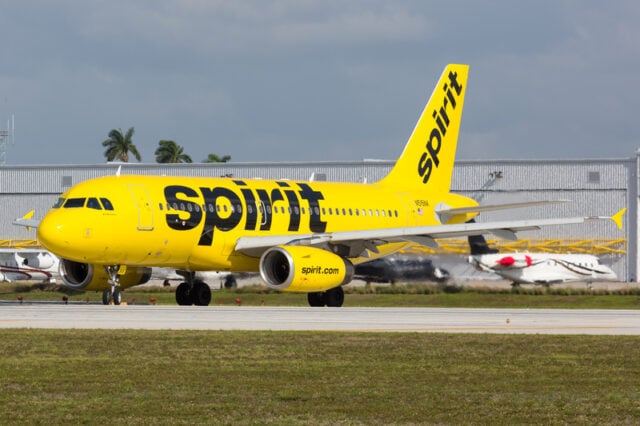
The vibrant yellow wings that have become a staple of American low-cost travel for decades have officially been clipped. In an announcement that sent shockwaves through the aviation industry and left thousands of passengers standing in silent disbelief at terminal gates, Spirit Airlines announced early Saturday morning, May 2, 2026, that it has ceased all commercial operations. The move, effective immediately, marks the end of an era for the pioneer of the “unbundled” fare model and leaves a gaping hole in the budget travel market.
From its primary hub at Fort Lauderdale-Hollywood International Airport (FLL) to satellite operations in over 40 cities across the United States, Latin America, and the Caribbean, the scene was one of chaos and heartbreak. At FLL, where Spirit’s headquarters is located in nearby Dania Beach, the usual early-morning rush was replaced by the sight of blank departure boards and “Closed” signs at check-in counters. Security personnel were seen redirecting bewildered travelers who had arrived for 6:00 AM flights only to find that their carrier no longer existed.
The $500 Million Collapse
The sudden shutdown follows a frantic, weeks-long negotiation period between Spirit’s leadership, its primary creditors, and the federal government. Spirit had been seeking a $500 million emergency bailout from the Trump administration to stay afloat. While President Trump expressed interest in saving the airline’s approximately 10,000 jobs, talks ultimately stalled late Friday night.
The administration had proposed a deal that would have given the U.S. government a 90% equity stake in the carrier, effectively nationalizing the airline in exchange for the cash infusion. However, major bondholders—including Ken Griffin’s Citadel and Ares Management Corp.—reportedly balked at the terms, fearing the restructuring would leave them with pennies on the dollar.

“We are deeply disappointed that we were unable to reach an agreement that would allow Spirit to continue its mission,” said Dave Davis, CEO of Spirit Airlines, in a statement released at 3:00 AM. “The sudden and sustained rise in fuel prices, coupled with the inability to secure a viable path forward with our creditors and the government, has left us with no alternative but to pursue an orderly wind-down of the company.”
The Fuel Crisis and the Iran War
While Spirit’s financial troubles were well-documented—including two bankruptcy filings since late 2024—the catalyst for the final collapse was the geopolitical instability in the Middle East. The onset of the U.S.-Israel war in Iran earlier this spring led to a catastrophic surge in jet fuel prices, which rose over 80% in a matter of months.
For an ultra-low-cost carrier (ULCC) like Spirit, which operates on razor-thin margins, the fuel spike was a death blow. Unlike legacy carriers that often use sophisticated fuel-hedging strategies, Spirit’s business model relied on high volume and low overhead. When the cost to fill an Airbus A320 exceeded the revenue from its famously low fares, the math simply stopped working.
Immediate Impact: Flight Cancellations and Stranded Passengers
As of Saturday morning, every single one of Spirit’s approximately 550 daily scheduled flights has been canceled. Estimates suggest that between 80,000 and 100,000 passengers may be affected in the first 48 hours of the shutdown alone.
Spirit’s reach was extensive, serving as a critical link for leisure travelers heading to Florida and the Caribbean. The cancellation of these routes has left passengers stranded in foreign countries and domestic hubs with little notice. Unlike a typical bankruptcy restructuring, where an airline continues to fly (Chapter 11), Spirit has entered a liquidation phase (Chapter 7), meaning there are no crews to fly the planes and no customer service agents to answer the phones.
The Rescue Effort: JetBlue and Other Airlines Step In
In the wake of the collapse, several major carriers have announced emergency “rescue” measures to assist travelers and absorb the displaced workforce.
JetBlue Airways, which had previously attempted to merge with Spirit before the deal was blocked by federal regulators in 2024, has taken the lead in the relief effort. CEO Joanna Geraghty announced a series of measures aimed at stabilizing the South Florida market:
- Rescue Fares: JetBlue is offering $99 one-way rescue fares for stranded Spirit travelers. These fares are available for those who can show a valid Spirit itinerary for the same or “co-located” routes through May 6, 2026.
- Price Caps: To prevent predatory pricing as demand for remaining seats skyrockets, JetBlue has capped its “Blue Basic” fares at $299 for nonstop flights to and from Fort Lauderdale and San Juan through May 8.
- Service Expansion: JetBlue plans to backfill Spirit’s departure by adding 11 new destinations from Fort Lauderdale-Hollywood International, including international routes to Colombia and domestic flights to Chicago, Detroit, and Houston.
Other major carriers, including American Airlines, United Airlines, and Frontier Airlines, have also issued statements indicating they are exploring ways to accommodate impacted travelers. Frontier, Spirit’s primary ULCC rival, is expected to see a significant surge in demand as the only remaining major budget option on many of Spirit’s former routes.
Supporting the Workforce
The human cost of Spirit’s demise is staggering. More than 10,000 employees—from pilots and flight attendants to mechanics and gate agents—found themselves unemployed overnight.
JetBlue has extended its “jumpseat agreement” for two weeks, allowing displaced Spirit flight crews to use available seats on JetBlue flights to return home. Furthermore, JetBlue, American, and United have indicated they will fast-track interview opportunities for qualified Spirit personnel to fill open roles within their own operations.
“These are highly skilled professionals who have dedicated their careers to the ‘Yellow Wing,'” Geraghty said. “We want to help fill the void created by this loss and provide a path forward for as many team members as possible.”
What To Do If You Were Booked on Spirit
If you have an upcoming flight with Spirit Airlines, the most important advice from travel experts is: Do not go to the airport. There are no Spirit staff members present, and all check-in kiosks have been disabled.
Here is the protocol for recovery:
- Automatic Refunds: Spirit has stated that it will automatically process refunds for flights purchased directly through the airline using a credit or debit card. However, given the company’s insolvent state, these refunds could take weeks or months to materialize.
- Credit Card Chargebacks: Travel analysts recommend contacting your credit card company immediately to initiate a chargeback for “services not rendered.” This is often the fastest way to recover funds from a defunct merchant.
- Rescue Fares: If you are currently stranded, call 1-800-JETBLUE to inquire about the $99 rescue fares. You will need to provide your Spirit confirmation code.
- Travel Insurance: If you purchased a travel insurance policy (such as through Allianz or TravelGuard), check your policy for “financial default” coverage. This may cover the cost of rebooking on a different airline at a higher price.
- Alternative Transportation: For domestic travelers, consider Amtrak or long-haul bus services like Greyhound or FlixBus, as airline prices on competing carriers are expected to remain high in the short term.
The Economic Ripple Effect in South Florida
The loss of Spirit Airlines is a heavy blow to the South Florida economy. As the region’s “hometown airline,” Spirit was a major employer and a driver of tourism revenue. The Dania Beach headquarters was a center for aviation innovation, and the airline’s heavy presence at FLL made the airport one of the most competitive in the country for low-cost travel.
Industry analysts warn that without Spirit’s downward pressure on pricing, airfares out of Fort Lauderdale and Miami could rise permanently. “The ‘Spirit Effect’ was real,” said Henry Harteveldt, an airline industry analyst. “When Spirit entered a market, legacy carriers were forced to lower their prices. With that competition gone, the consumer is the ultimate loser.”
Conclusion: The End of an Era
As the sun sets on Spirit Airlines, the aviation industry faces a period of intense reflection. The airline’s “Bare Fare” model changed the way Americans thought about flying, making air travel accessible to millions who previously could not afford it. While it was often the target of late-night comedy for its fees and service levels, its impact on the democratization of the skies was undeniable.
For now, the focus remains on the thousands of families whose travel plans have been upended and the thousands more whose livelihoods have been lost. The “Yellow Wing” may be gone, but the fallout from its final descent will be felt for years to come.
Sources Used and Links:
- Aspen Public Radio: Spirit Airlines ceases operations after escalating financial struggles
- CBS News: Spirit Airlines shutting down after failed effort at government rescue deal
- JetBlue News (via Las Vegas Sun): JetBlue Steps in to Help Stranded Spirit Customers with $99 Rescue Fares
- Airlines for America (A4A): A4A Statement on Spirit Airlines Ceasing Operations
- The Washington Post: Spirit Airlines shuts down after White House rescue deal falls through
- The Points Guy: Spirit Airlines could shut down imminently, reports say — here’s what to do
- Travel Tourister: Spirit Airlines Meltdown Feb 9: 50+ Cancellations Hit Florida
- CBS News Miami: South Florida travelers caught by surprise by Spirit Airlines impending shutdown
Disclaimer
Artificial Intelligence Disclosure & Legal Disclaimer
AI Content Policy.
To provide our readers with timely and comprehensive coverage, South Florida Reporter uses artificial intelligence (AI) to assist in producing certain articles and visual content.
Articles: AI may be used to assist in research, structural drafting, or data analysis. All AI-assisted text is reviewed and edited by our team to ensure accuracy and adherence to our editorial standards.
Images: Any imagery generated or significantly altered by AI is clearly marked with a disclaimer or watermark to distinguish it from traditional photography or editorial illustrations.
General Disclaimer
The information contained in South Florida Reporter is for general information purposes only.
South Florida Reporter assumes no responsibility for errors or omissions in the contents of the Service. In no event shall South Florida Reporter be liable for any special, direct, indirect, consequential, or incidental damages or any damages whatsoever, whether in an action of contract, negligence or other tort, arising out of or in connection with the use of the Service or the contents of the Service.
The Company reserves the right to make additions, deletions, or modifications to the contents of the Service at any time without prior notice. The Company does not warrant that the Service is free of viruses or other harmful components.