On Wednesday, April 15, 2026, the long-simmering friction between the White House and the Federal Reserve reached a boiling point. In a morning interview with Fox Business, President Donald Trump issued his most direct threat to date: Federal Reserve Chair Jerome Powell must resign by the end of his term in May or face a formal firing.
“I’ll have to fire him,” Trump declared. “If he’s not leaving on time.”
The President’s comments represent an unprecedented escalation in a multi-year campaign to exert more control over monetary policy. As the U.S. economy navigates a complex post-inflationary landscape, the stability of the dollar and the independence of the central bank now hang in the balance.
The Dual-Term Dilemma
To understand why this is a “showdown” and not a standard transition, one must look at the unique structure of Federal Reserve appointments. Jerome Powell’s four-year term as Chair of the Federal Reserve is set to expire in May 2026. However, his 14-year term as a Governor on the Federal Reserve Board does not expire until January 2028.

Historically, outgoing Chairs have resigned from the Board entirely once their leadership term ends. The last time a Chair remained as a Governor after being replaced was Marriner Eccles in 1948. Jerome Powell, however, has signaled that he may not follow that tradition. In March 2026, Powell stated he does not plan to leave his position on the Board of Governors until several ongoing investigations involving him and the Fed are concluded.
By staying on as a Governor, Powell would retain a vote on interest rates and a seat at the table, potentially acting as a “buffer” against the President’s preferred policies. This “stay-on-board” strategy is viewed by many as a final act of institutional defense for the Fed’s autonomy.
The $2.5 Billion Pretext: The DOJ Investigation
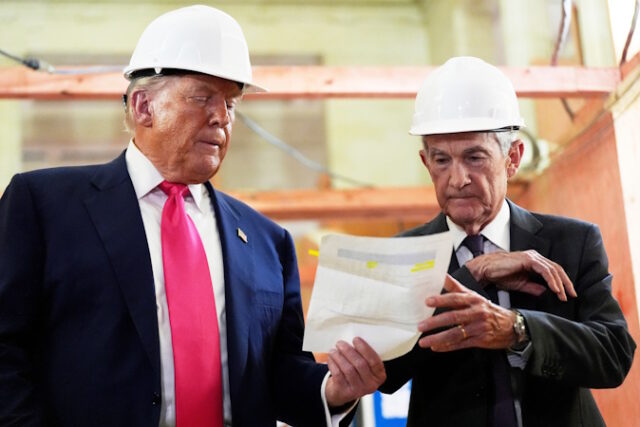
The President isn’t just relying on rhetoric; he is leveraging the Department of Justice. A central pillar of the White House pressure campaign is a criminal investigation into the Fed’s $2.5 billion office renovation project in Washington, D.C.
The probe, which has seen federal prosecutors make surprise visits to the Fed’s headquarters as recently as yesterday, alleges “incompetence” or “corruption” regarding 80% cost overruns. While a federal judge previously found the investigation to be part of a “White House pressure campaign,” Trump has refused to distance himself from it.
“Whether it’s incompetence, corruption or both, I think you have to find out,” Trump said on Fox Business. “I have to find out.”
The strategic importance of this investigation cannot be overstated. Under the Federal Reserve Act, a President can only remove a member of the Board of Governors “for cause.” While the Act does not define “cause,” legal precedents like Humphrey’s Executor v. United States (1935) suggest it requires evidence of inefficiency, neglect of duty, or malfeasance. By framing the renovation overruns as “corruption,” the administration is attempting to build the legal scaffolding necessary to meet that “for cause” standard.
Table: Federal Reserve Board Terms and Key Players (as of April 2026)
| Individual | Role | Term Expiration (Chair) | Term Expiration (Governor) |
| Jerome Powell | Current Chair | May 2026 | January 2028 |
| Kevin Warsh | Rumored Successor | N/A | Nominee Potential |
| Kevin Hassett | Rumored Successor | N/A | Nominee Potential |
| Scott Bessent | Treasury Secretary | N/A | N/A |
The Legal Fortress: Can the President Actually Fire Powell?
The question of whether a President can fire a Fed Chair at will is one of the most significant constitutional debates in modern history. The general rule of executive power, established in Myers v. United States (1926), allows a President to remove executive officials at will. However, independent agencies—like the Fed—are different.
The “For Cause” Protection
The Supreme Court has repeatedly upheld the idea that Congress can protect certain officials from being fired for purely political reasons.
- Humphrey’s Executor (1935): Confirmed that the President cannot fire commissioners of independent regulatory agencies without a valid reason (inefficiency, neglect of duty, etc.).
- Seila Law LLC v. CFPB (2020): While the court allowed the President more power over single-headed agencies, it reaffirmed the protection for multi-member boards like the Federal Reserve.
If Trump attempts to fire Powell without a clear, documented case of malfeasance, Powell would likely sue. The resulting legal battle would reach the Supreme Court, creating a period of extreme uncertainty for global markets.
Market Reaction: The “Sell America” Trade
Financial markets, which usually abhor uncertainty, have begun to flinch. On Monday, following the initial reports of the DOJ’s “surprise visit” to the Fed, the Dow Jones Industrial Average dropped nearly 500 points before recovering.
The most telling sign of investor anxiety, however, is in the “debasement trade.”
- Gold Prices: Gold surged to a record settlement of $4,614.70 per ounce this week.
- The US Dollar: The dollar has weakened against major global currencies as investors fear that a Fed controlled by the White House would prioritize low interest rates over controlling inflation, leading to a devalued currency.
Market strategists like Krishna Guha of Evercore ISI have described the situation as “unambiguously risk-off.” There is a growing fear of a “Sell America” trade, where global investors apply a higher risk premium to U.S. assets because they can no longer rely on a predictable, independent central bank.
The Successor Shortlist: A New Vision for the Fed
As Trump pushes Powell toward the exit, attention has turned to who might replace him. The administration is reportedly looking for more than just a “dove” who will cut rates; they want an ally who shares their supply-side view of the economy.
1. Kevin Warsh
A former Fed Governor and a finalist for the Chair position in 2017, Warsh is considered a frontrunner. While he has been a critic of the Fed’s recent “wait-and-see” approach, his nomination might be complicated by his historical “hawkish” tendencies. However, his close personal ties to the President make him a formidable candidate.
2. Kevin Hassett
Currently the Director of the National Economic Council, Hassett is a loyalist who has argued that there is “no reason at all for the Fed not to cut rates right now.” His appointment would be seen as a move toward total alignment between the White House and the central bank.
3. Scott Bessent
The current Treasury Secretary has been in lockstep with the President’s views on tariffs and interest rates. While moving from Treasury to the Fed is rare, it would signal a complete integration of fiscal and monetary policy—a prospect that excites some and terrifies others.
The Nickname: “Too Late”
A hallmark of Trump’s pressure campaign has been his rebranding of Powell as “Too Late” Powell. The President argues that the Fed was too late to recognize inflation in 2021 and has been too late to cut rates in 2025 and 2026. This narrative bypasses technical economic debate in favor of a simpler populist message: the Fed is hurting the American worker by keeping borrowing costs unnecessarily high.
Conclusion: The Stakes of Independence
Central bank independence is not just a bureaucratic technicality; it is a pillar of the global financial system. It ensures that monetary policy is dictated by data (like unemployment and the Consumer Price Index) rather than the election cycle.
If President Trump succeeds in firing Jerome Powell—or in pressuring him into a premature resignation—the precedent could permanently change how the U.S. economy is managed. A central bank that serves the immediate political needs of the executive branch may provide short-term growth, but history suggests it often leads to long-term instability and hyperinflation.
As we approach the May deadline, the eyes of the world are on a single building in Washington. Whether Powell holds his ground or Trump breaks the “legal fortress” of the Fed, the outcome will define American economic policy for a generation.
Sources Used and Links:
- The Washington Post: Trump threatens to fire Powell, won’t halt probe of Fed renovations
- AFP / NAMPA: Trump says he will fire Fed chair if he stays beyond mandate
- Chase: Will Jerome Powell remain at the Federal Reserve after his term as chair ends?
- NatWest Corporates and Institutions: Who will replace Fed Chair Jerome Powell?
- Law Office of Daniel Horowitz: Can the President Fire the Federal Reserve Chair?
- Seeking Alpha: Trump says he will fire Fed’s Powell if he doesn’t leave ‘on time’
- AP News: Wall Street ticks to records after shaking off worries about Trump’s feud with the Fed
- London Business School: Markets flinch as Trump DOJ targets Fed Chair
- Federal Reserve Board: Section 10. Board of Governors of the Federal Reserve System
Disclaimer
Artificial Intelligence Disclosure & Legal Disclaimer
AI Content Policy.
To provide our readers with timely and comprehensive coverage, South Florida Reporter uses artificial intelligence (AI) to assist in producing certain articles and visual content.
Articles: AI may be used to assist in research, structural drafting, or data analysis. All AI-assisted text is reviewed and edited by our team to ensure accuracy and adherence to our editorial standards.
Images: Any imagery generated or significantly altered by AI is clearly marked with a disclaimer or watermark to distinguish it from traditional photography or editorial illustrations.
General Disclaimer
The information contained in South Florida Reporter is for general information purposes only.
South Florida Reporter assumes no responsibility for errors or omissions in the contents of the Service. In no event shall South Florida Reporter be liable for any special, direct, indirect, consequential, or incidental damages or any damages whatsoever, whether in an action of contract, negligence or other tort, arising out of or in connection with the use of the Service or the contents of the Service.
The Company reserves the right to make additions, deletions, or modifications to the contents of the Service at any time without prior notice. The Company does not warrant that the Service is free of viruses or other harmful components.