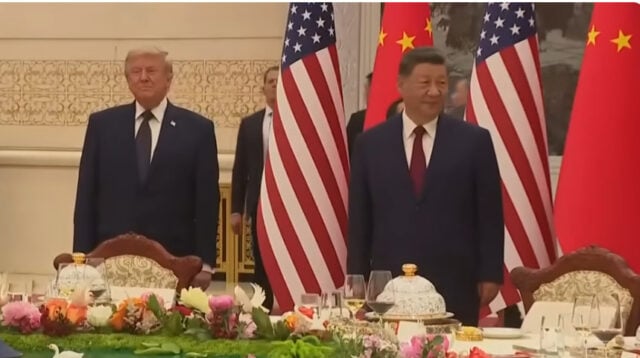
On May 14, 2026, the global political landscape converged on the Great Hall of the People in Beijing. As U.S. President Donald J. Trump and Chinese President Xi Jinping met for their first formal summit of 2026, the world stood at a precarious juncture. The meeting, set against a backdrop of escalating conflict in the Middle East and intensifying “gray zone” warfare in the Taiwan Strait, represented more than just a diplomatic dialogue; it was a desperate attempt to prevent a dual-theater global catastrophe.
The Shadow of the Iran Conflict and the Oil Crisis
The defining characteristic of the 2026 summit is the ongoing “Iran War,” which began in late February 2026 with coordinated strikes by the United States and Israel against Iranian military infrastructure (Schnitkey, 2026). This conflict has fundamentally altered the economic calculus of both superpowers.
The closure and subsequent “weaponization” of the Strait of Hormuz have sent shockwaves through energy markets. By May 2026, international oil prices had surged by approximately 70%, with crude oil consistently trading near $120 per barrel (Wolff, 2026). For China, which is the world’s largest oil importer, this energy shock is an existential threat. Prior to the summit, Beijing had aggressively stockpiled reserves, with imports surging 16% in early 2026 to mitigate the impact of U.S. sanctions on Tehran (García-Herrero, 2026).

During the meetings, President Trump reportedly pushed for China to use its significant leverage with Iran to secure a reopening of the Strait. However, the price for such cooperation is steep. Industry leaders have warned the Trump administration that without a stable resolution, the global “fuel crunch” will worsen throughout the 2026 planting and shipping seasons (Eaton & Morenne, 2026).
Taiwan: The “Reddest of Red Lines”
While oil dominated the economic discussions, the status of Taiwan remained the most volatile point of friction. President Xi used the summit to deliver his most direct warning to date, stating that “Taiwan independence” and peace are as “irreconcilable as fire and water” (Ministry of Foreign Affairs of China, 2026).
The tension is fueled by a new era of “lawfare” and airspace weaponization. In April 2026, Taiwan was forced to cancel high-level diplomatic visits due to China’s intensified tactics in deploying electronic warfare and airspace closures (Rich, 2026). This follows the 2025 “Justice Mission” exercises, where the People’s Liberation Army (PLA) demonstrated a capacity for a comprehensive blockade of the island.
Despite this, the Trump administration has maintained a policy of “calculated realism.” While the U.S. approved an $11 billion arms package for Taiwan in late 2025—including HIMARS and advanced drone systems—President Trump has simultaneously signaled a willingness to negotiate “deals” that could redefine the traditional “One China” policy (Glaser, 2026). Taiwan, in response, has accelerated its “Silicon Shield” strategy, rapidly scaling unmanned vehicle development to offset the PLA’s numerical advantage (Chan, 2026).
Trade 2.0: Tariffs and Tenders
Economically, the summit is serving as a compliance check for the “America First Trade Policy” of 2026. The Trump administration has implemented a baseline 10% tariff on various imports, with threats to increase rates to 15% for non-compliant partners (Lowell, 2026).
Central to the 2026 negotiations are:
- Agricultural Purchases: China has committed to significant purchases of U.S. soybeans and corn to stabilize American farm returns, which have been hammered by rising fertilizer costs linked to the Middle East conflict (Glauber, 2026).
- The “Board of Trade”: A proposed bilateral body designed to manage “non-sensitive” commerce and prevent the complete decoupling of the two largest economies.
- Rare Earths: China continues to use export controls on medium and heavy rare earths (including dysprosium and yttrium) as a counterweight to U.S. technology restrictions (Lowell, 2026).
Fentanyl and Synthetic Security
A rare bright spot in the bilateral relationship has been a tactical increase in cooperation regarding synthetic opioids. Following the 2025 Busan summit, Chinese authorities have shared intelligence leading to the indictment of several nationals involved in precursor chemical distribution (Greenwood, 2021). However, U.S. officials remain cautious, noting that while finished fentanyl shipments from China have declined, the production of precursors has simply shifted to third-party hubs in Mexico and India (Chivvis, 2026).
Conclusion: The Thucydides Trap in 2026
As the summit concluded on May 15, the overarching sentiment was one of managed competition rather than true reconciliation. The “Beijing Accord” provides a temporary floor for the relationship, but the structural rivalries—ranging from AI dominance to maritime sovereignty—remain unresolved. In a world where a single miscalculation in the Taiwan Strait or the Persian Gulf could ignite a global conflict, the Trump-Xi dialogue remains the only viable circuit breaker against the “Thucydides Trap.”
Sources and Links:
- Lowell, M. (2026). Trump 2.0 tariff tracker – Trade Compliance Resource Hub. https://www.tradecomplianceresourcehub.com/2026/05/07/trump-2-0-tariff-tracker/
- Rich, T. S. (2026). The Eswatini Incident: Is China Changing Its Pressure Campaign Against Taiwan? The Prospect Foundation. https://www.pf.org.tw/en/pfen
- Wolff, G. B. (2026). Could a Hormuz toll solve the oil crisis and who pays? Bruegel. https://www.bruegel.org/analysis/could-hormuz-toll-solve-oil-crisis-and-who-pays
- Glaser, B. S. (2026). The role of diplomacy in US management of cross-Strait relations. Brookings Institution. https://www.brookings.edu/wp-content/uploads/2026/03/FP-20260319-glaser.pdf
- García-Herrero, A. (2026). What the war in Iran means for China. Bruegel. https://www.bruegel.org/analysis/what-war-iran-means-china
- Burack, B. (2026). China | The Heritage Foundation. Assessing Threats to US Vital Interests. https://www.heritage.org/military-strength/assessing-threats-us-vital-interests/china
- Authority, J. (2020). Trump Administration Continues Trade Negotiations with Major Trade Partners. American Journal of International Law. https://www.cambridge.org/core/journals/american-journal-of-international-law/article/trump-administration-continues-trade-negotiations-with-major-trade-partners/FCEB6BB710EC8CA33C8188BAA7204191
- Chivvis, C. S. (2026). Implementing the Biden Administration’s China Strategy. Carnegie Endowment for International Peace. https://carnegieendowment.org/research/2026/03/implementing-the-biden-administrations-china-strategy
- Greenwood, L. (2021). Illicit Fentanyl from China: An Evolving Global Operation. U.S.-China Economic and Security Review Commission. https://www.uscc.gov/sites/default/files/2021-08/Illicit_Fentanyl_from_China-An_Evolving_Global_Operation.pdf
- Schnitkey, G. (2026). The Iran Conflict: Potential Impacts on 2026 Corn and Soybean Returns. farmdoc daily. https://farmdocdaily.illinois.edu/2026/03/the-iran-conflict-potential-impacts-on-2026-corn-and-soybean-returns.html
- Eaton, C., & Morenne, B. (2026). Oil Industry Warns Trump Administration That Fuel Crunch Will Likely Worsen. The Wall Street Journal. https://www.wsj.com/business/energy-oil/oil-industry-warns-trump-administration-energy-crisis-will-likely-worsen-0a5c8b1a
- Glauber, J. (2026). The Iran War: Potential Food Security Impacts. IFPRI Blog. https://www.ifpri.org/blog/the-iran-war-potential-food-security-impacts/
- Wescott, B., & Thornber, E. (2026). Soybeans Slump More Than 3% on Possible US-China Talk Delays. Bloomberg. https://www.bloomberg.com/news/articles/2026-03-15/soybeans-slump-on-talk-delays
- Chan, E. (2026). Full Speed Ahead: Taiwan’s Unmanned Vehicle Development. The Prospect Foundation. https://www.pf.org.tw/en/pfen/2.2.1
- Ministry of Foreign Affairs of China. (2026). Official Readout: President Xi Jinping Meets with U.S. President Donald Trump in Beijing. https://www.fmprc.gov.cn/eng/xw/zyxw/202605/t20260514_11910330.html
Disclaimer
Artificial Intelligence Disclosure & Legal Disclaimer
AI Content Policy.
To provide our readers with timely and comprehensive coverage, South Florida Reporter uses artificial intelligence (AI) to assist in producing certain articles and visual content.
Articles: AI may be used to assist in research, structural drafting, or data analysis. All AI-assisted text is reviewed and edited by our team to ensure accuracy and adherence to our editorial standards.
Images: Any imagery generated or significantly altered by AI is clearly marked with a disclaimer or watermark to distinguish it from traditional photography or editorial illustrations.
General Disclaimer
The information contained in South Florida Reporter is for general information purposes only.
South Florida Reporter assumes no responsibility for errors or omissions in the contents of the Service. In no event shall South Florida Reporter be liable for any special, direct, indirect, consequential, or incidental damages or any damages whatsoever, whether in an action of contract, negligence or other tort, arising out of or in connection with the use of the Service or the contents of the Service.
The Company reserves the right to make additions, deletions, or modifications to the contents of the Service at any time without prior notice. The Company does not warrant that the Service is free of viruses or other harmful components.