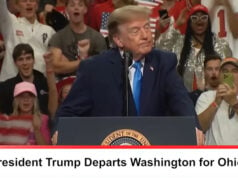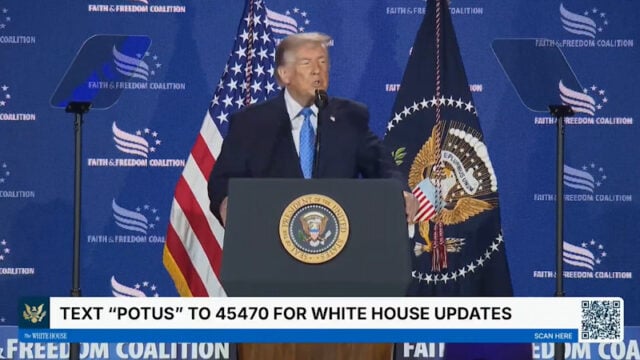
On Friday, June 26, 2026, President Donald J. Trump returned to the iconic International Ballroom of the Washington Hilton to deliver a defining keynote address at the Faith & Freedom Coalition’s 16th annual “Road to Majority” policy conference. The choice of venue carried a heavy, unspoken symbolic weight; it marked Trump’s first return to the Hilton podium since security disruptions earlier in his second term canceled his scheduled remarks at the White House Correspondents’ Dinner after a security breach at the main entrance. Speaking to an energized crowd of over 2,000 grassroots conservative activists, legislative organizers, and prominent faith leaders, Trump framed the upcoming 2026 midterm elections—now less than 150 days away—as an existential turning point for the future of the republic.
The Grassroots Electoral Engine
To understand the political gravity of Trump’s appearance, one must examine the immense grassroots infrastructure backing the event. The Faith & Freedom Coalition, under the long-term stewardship of veteran strategist Ralph Reed, has spent nearly two decades refining a highly sophisticated, data-driven voter mobilization apparatus. With the full composition of the United States Congress hanging in the balance this November, the coalition utilized the 2026 policy conference to unveil its most aggressive, well-funded ground-game blueprint to date.
Trump explicitly lauded the coalition’s operational layout, detailing the exact metrics designed to catalyze what he projected would be a conservative landslide in the midterms. Over the next 145 days, the organization is deploying a multi-state field program across twenty-seven battleground states, powered by the following initiatives:

- 8 Million Direct Door Knocks: Field representatives visiting targeted Christian and pro-life households to secure commitments.
- 15 Million Voters Monitored: Utilizing sophisticated data modeling to track and engage low-propensity religious voters who skipped previous midterm cycles.
- 10 Million Phone Calls & 25 Million Targeted Texts: A continuous digital communications layer designed to reinforce the physical canvassing footprint.
- 100,000 Congregations Engaged: The widespread distribution of localized, non-partisan voter guides directly to tens of thousands of church communities nationwide.
Trump emphasized that this operational matrix is the essential engine of modern conservative electoral viability, noting that “no organization has worked harder to deliver a landslide victory.” For the administration, the mathematics of the 2026 midterms are absolute: maximizing evangelical turnout is the single most effective counterweight against historical midterm trends, which traditionally penalize the incumbent president’s party with sweeping legislative losses.
Institutionalizing Faith in the Second Term
While Trump’s first-term addresses to religious groups focused heavily on judicial appointments and the eventual overturning of Roe v. Wade, his 2026 policy speech reflected a fundamental shift toward institutionalizing conservative religious priorities within the executive branch’s structure. Rather than focusing solely on external legal battles, Trump spent a significant portion of his remarks detailing how his administration has systematically altered the federal bureaucracy to protect and promote faith-based initiatives.
A core milestone celebrated during the speech was the establishment of the White House Faith Office on February 7, 2025, which Trump described as an unyielding administrative voice for people of faith inside the West Wing. This was followed in May 2025 by the formal creation of the Religious Liberty Commission, a high-level federal entity tasked with reviewing administrative regulations and reversing what conservatives characterize as the weaponization of government agencies against religious entities.
Trump methodically walked the audience through a checklist of secondary term bureaucratic victories, detailing changes that have reshaped multiple federal departments:
- Centers for Faith: The successful insertion of dedicated Faith Directors and Liaisons within every major cabinet department and independent federal agency to evaluate policy through a religious accommodation lens.
- The Task Force to Eradicate Anti-Christian Bias: Reviewing federal enforcement histories and publishing an initial report alleging a systematic pattern of discrimination against conservative believers under the previous administration.
- Executive Orders on Financial Protections: Landmark directives aimed at halting the “debanking” of individuals, businesses, and non-profits targeted due to their public religious or political assertions.
- Administrative Rollbacks: Ordering the wholesale repeal of federal regulations that conflict with recent Supreme Court religious liberty precedents, ensuring religious accommodations extend fully to federal employees and teleworkers via updated Office of Personnel Management guidance.
- Partnerships in Foster Care: Implementing executive directives—heavily championed by First Lady Melania Trump—to maximize federal partnerships with faith-based foster care and adoption agencies, explicitly overturning state-level rules that restricted organizations adhering to traditional definitions of marriage.
This systematic approach underscores a broader strategic doctrine: the administration is no longer relying exclusively on the courts to enforce conservative policy, but is instead embedding faith-aligned oversight directly into the operational mechanism of the state.
Freedom 250 and the Rhetoric of Civil Renewal
The timing of the 2026 Road to Majority conference provided an exceptionally potent historical backdrop. With the 250th anniversary of the signing of the Declaration of Independence arriving on July 4, 2026, the administration has spent over a year executing a massive, patriotism-focused cultural rollout via the “Salute to America 250” Task Force. Trump masterfully leveraged this upcoming milestone to construct a narrative of national and spiritual renewal, explicitly fusing American exceptionalism with notions of divine providence.
Trump recalled the “Rededicate 250” gathering held on the National Mall in May, which drew nearly 50,000 in-person attendees and millions of livestream viewers for a day rooted in scripture, testimony, and prayer. In his remarks on Friday, Trump echoed those themes, asserting that America’s grand political journey began with a single sheet of parchment and fifty-six signatures, but was ultimately sustained by an unyielding trust in God.
He used this historical framing to mount a fierce defense of traditional values in public education, arguing that American schools should not be spaces that drive out faith, but rather institutions that welcome religion with “wide, open, beautiful arms.” By explicitly linking his administration’s political agenda with the country’s semiquincentennial celebrations, Trump effectively positioned the “America First” movement as the legitimate custodian of the nation’s founding heritage.
The Populist Matrix: Borders, Tariffs, and National Defense
While the conference was explicitly billed as a faith policy summit, Trump ensured that the core secular pillars of his populist platform were seamlessly integrated into the text of his address. The speech served as a vivid reminder that for the modern conservative base, cultural traditionalism, hardline border security, and economic nationalism are viewed as interconnected components of a singular political struggle.
On border enforcement, Trump touted historic statistical drops in illegal immigration, claiming a 75 percent reduction in unauthorized southern border crossings. He credited this shift to the rapid deployment of specialized border defense units across land, air, and maritime domains, alongside the aggressive federal deportation of transnational gang members, specifically targeting MS-13. He reiterated his administration’s firm opposition to sanctuary cities, framing border security as an essential prerequisite for protecting the domestic sovereignty of local communities.
Turning to economic policy, Trump reminded the audience of his administration’s persistent defense of domestic manufacturing through the implementation of sweeping tariff frameworks and proposed tax cuts. He argued that true religious freedom is hollow without economic security, pledging to maintain a level playing field for American workers against international trade agreements.
On national defense, Trump’s messaging closely mirrored the “peace through strength” doctrines championed by his administration, including Secretary of War Pete Hegseth. Trump defended his recent $1.5 trillion defense budget proposal for fiscal year 2027, which builds upon a historic $1 trillion topline from the previous year. He asserted that the military has been successfully realigned away from “woke moralizing,” nation-building, and open-ended foreign interventions, focusing instead on core national interests and defensive innovations like the domestic “Golden Dome” missile defense shield.
The Secular Counter-Narrative: Accusations of Christian Nationalism
The administration’s systematic effort to weave religious advocacy into federal governance has ignited a fierce, highly organized resistance from secular organizations, civil rights groups, and progressive lawmakers. As Trump spoke to the thousands cheering inside the Washington Hilton, a coalition of opposing policy centers launched a series of sharp public rebuttals, highlighting the deep ideological polarization defining the 2026 political landscape.
Critics from organizations such as the Interfaith Alliance and the Center for American Progress issued formal statements warning that administrative bodies like the Religious Liberty Commission and the White House Faith Office are effectively functioning as vehicles for right-wing Christian nationalism. Opponents argue that by creating sectarian compliance offices within every federal agency, the administration is actively undermining the Establishment Clause of the First Amendment and forcing a diverse, multi-religious nation to adhere to a narrow, politicized interpretation of Christian doctrine.
Prominent congressional critics, including Representative Jamie Raskin, warned that the administration’s aggressive policy shifts have thrown traditional houses of worship into programmatic chaos. Secular legal experts argue that the federal government’s wholesale dismantling of Diversity, Equity, and Inclusion (DEI) frameworks—a move Trump celebrated during his speech—has been weaponized to dissolve long-standing multi-faith advisory councils within departments like the State Department, replacing them with exclusive sectarian pipelines. This deep ideological rift ensures that the administrative achievements celebrated at the Road to Majority conference will serve as primary battlegrounds in local congressional races, transforming the midterms into a direct referendum on the definition of American pluralism.
Conclusion: The Path Forward to November
Trump’s high-profile appearance at the Faith & Freedom Coalition’s policy summit underscored the immutable bonds that anchor the contemporary Republican coalition. By offering the evangelical base tangible administrative power through the institutionalization of faith offices and aggressive executive actions, the administration has successfully locked in the enthusiasm of its most vital voting bloc ahead of a volatile election cycle.
As the thousands of grassroots activists exit the Washington Hilton and return to their respective states to launch an unprecedented ground game of 8 million door knocks, the ultimate efficacy of Trump’s message will face its true test this November. Whether this intensive merging of populist politics and institutionalized faith will secure a durable “pro-family majority” in Congress, or conversely trigger an equally massive counter-mobilization from an increasingly alarmed secular left, remains the defining question of the 2026 political calendar.
Sources and Links:
- The White House Historical Archives: Remarks by President Trump at the Faith and Freedom Coalition’s Road to Majority Conference
- The White House Official Policy Site: Priorities on Faith and Protecting Religious Liberty
- The White House Freedom 250 Portal: Salute to America 250 Task Force and Freedom 250 Celebrations
- Faith & Freedom Coalition: Road to Majority Conference Overview and Grassroots Mission
- Faith & Freedom Coalition: Road to Majority 2026 Sponsorship and Activist Guidelines
- Faith & Freedom Coalition: Donald Trump Policy Statements and Archive
- Washington Examiner: Watch Live: Trump Speaks at the Faith and Freedom Coalition’s Road to Majority Conference
- House Armed Services Committee: Record Version Posture Statement by the Honorable Pete Hegseth, Secretary of War
- Interfaith Alliance: Analysis of Trump Administration Policy and Faith Communities
- Center for American Progress: Religious Liberty for All: Celebrating This Founding Freedom at America 250
Disclaimer
Artificial Intelligence Disclosure & Legal Disclaimer
AI Content Policy.
To provide our readers with timely and comprehensive coverage, South Florida Reporter uses artificial intelligence (AI) to assist in producing certain articles and visual content.
Articles: AI may be used to assist in research, structural drafting, or data analysis. All AI-assisted text is reviewed and edited by our team to ensure accuracy and adherence to our editorial standards.
Images: Any imagery generated or significantly altered by AI is clearly marked with a disclaimer or watermark to distinguish it from traditional photography or editorial illustrations.
General Disclaimer
The information contained in South Florida Reporter is for general information purposes only.
South Florida Reporter assumes no responsibility for errors or omissions in the contents of the Service. In no event shall South Florida Reporter be liable for any special, direct, indirect, consequential, or incidental damages or any damages whatsoever, whether in an action of contract, negligence or other tort, arising out of or in connection with the use of the Service or the contents of the Service.
The Company reserves the right to make additions, deletions, or modifications to the contents of the Service at any time without prior notice. The Company does not warrant that the Service is free of viruses or other harmful components.