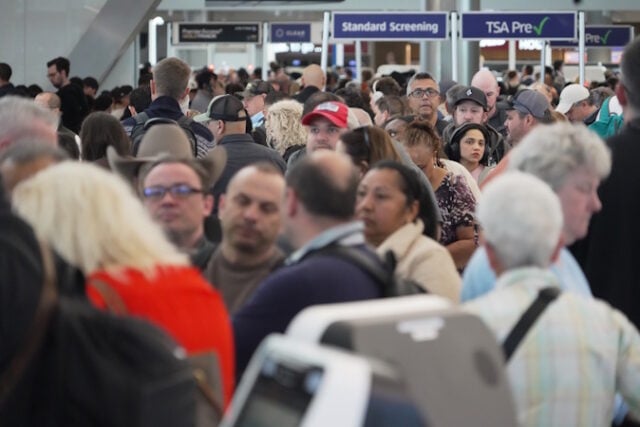
WASHINGTON, D.C. — In a Saturday morning escalation that has sent shockwaves through the aviation industry, President Donald Trump threatened to deploy U.S. Immigration and Customs Enforcement (ICE) agents to the nation’s airports to take over security operations. The move comes as a month-long funding impasse has left tens of thousands of Transportation Security Administration (TSA) officers working without pay, leading to a surge in resignations and record-breaking wait times for travelers.
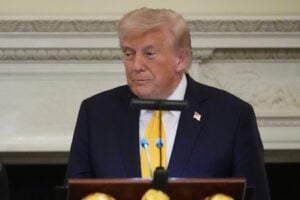
Writing on Truth Social, the President stated that if “Radical Left Democrats” do not immediately agree to a Department of Homeland Security (DHS) funding deal, he will move “patriotic ICE Agents” into airports by Monday, March 23. Trump claimed these agents would perform security “like no one has ever seen before,” specifically targeting undocumented immigrants for immediate arrest, with a stated focus on individuals from Somalia.
A Three-Way Collision of Power and Capital
The President’s threat was met with a series of high-profile counter-proposals from his closest allies, turning a federal funding crisis into a debate over the very nature of public infrastructure.

Billionaire Elon Musk, currently leading the Department of Government Efficiency, intervened via his X social media platform by offering to personally cover the salaries of the nation’s 50,000 TSA officers. With daily payroll costs estimated at roughly $23.6 million, Musk’s proposal would cost him over $165 million per week—a sum he described as necessary to prevent the “negative impact on the lives of so many Americans.” However, legal experts noted that federal law generally prohibits agencies from accepting private donations to fund their statutory operations without congressional approval.

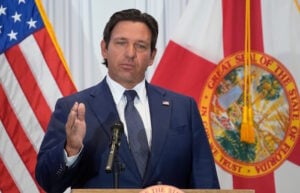
Simultaneously, Florida Governor Ron DeSantis utilized the crisis to renew his long-standing call for the total privatization of airport security. Citing the success of the Screening Partnership Program (SPP) at airports like San Francisco International (SFO), DeSantis argued that the federal government’s monopoly on security is a “relic of the past” that leaves travelers “hostage to Washington’s dysfunction.” DeSantis’s proposal suggests that airlines and local airport authorities should be empowered to hire private security firms, which are funded through pre-established contracts rather than direct federal appropriations, theoretically insulating them from future government shutdowns.
Chaos at the Checkpoint
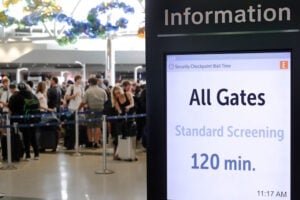
The stakes for these maneuvers are visible at major hubs across the country. Since the funding lapse began on February 14, over 300 TSA officers have officially resigned, and thousands more have called in sick to take second jobs. At Hartsfield-Jackson Atlanta International and Los Angeles International (LAX), security lines have reportedly stretched into parking garages, with some passengers waiting upwards of four hours.
Critics and former aviation officials have expressed alarm at the prospect of ICE agents—who are trained for enforcement and removal rather than screening—taking over passenger checkpoints. “This is an example of the President seeking to utilize ICE in a way that achieves political goals,” said John Sandweg, a former acting director of ICE. “The operations don’t seem designed to focus on public safety.”
Legal Challenges: The Looming Court Battle
The proposed deployment faces significant legal hurdles. Aviation law experts point to 49 U.S.C. § 44901, which mandates that all airport screening must be supervised by uniformed TSA personnel who meet specific training requirements—typically a minimum of 40 hours of classroom instruction and extensive on-the-job mentorship. ICE agents, while highly trained in customs and enforcement, lack this specialized aviation security training.
The American Federation of Government Employees (AFGE), the union representing approximately 47,000 TSA officers, has already signaled it will file for an emergency injunction. Union President Everett Kelley emphasized that TSA officers are “patriotic public servants” who cannot be legally replaced by an enforcement agency on 48 hours’ notice. This follows a string of legal victories for the union; as recently as January 15, 2026, U.S. District Judge Jamal Whitehead ruled against DHS Secretary Kristi Noem’s attempt to terminate the union’s collective bargaining agreement, ordering the administration to honor the contract despite the shutdown.
Furthermore, civil liberties groups have raised Fourth Amendment concerns. Recent litigation, such as the 2026 challenges following enforcement actions in Minnesota, has highlighted the potential for racial profiling. Legal scholars argue that using ICE agents—who possess the authority to make administrative arrests—at security checkpoints could transform a standard safety screening into an unconstitutional “pretextual stop” for immigration enforcement.
Political Deadlock and the “All or Nothing” Strategy
The current shutdown was triggered by a Democratic refusal to fund ICE and CBP unless the administration agrees to new restrictions on immigration enforcement. Senate Democrats have proposed a “clean” bill to fund the TSA separately to keep travel moving, but Republicans have blocked the measure, insisting on a comprehensive deal.
As the Monday deadline for the ICE deployment nears, the aviation industry remains in a state of high anxiety. While Musk’s checkbook and DeSantis’s privatization plans offer a glimpse into a potential future of decentralized security, the immediate reality for millions of Americans is a crumbling federal system caught in the crosshairs of a historic political battle.
Sources Used and Links
- View from the Wing: Trump Says ICE Will Fix TSA Lines Monday — Thats Illegal And Weakens Security
- National Today / Houston Today: Trump Threatens to Deploy ICE to Airports as Musk Offers to Pay TSA Worker Salaries
- KQ2 (CNN Affiliate): TSA workers go unpaid as unpredictable wait times mount during shutdown
- Courthouse News Service: TSA union opposes second Trump admin attempt to cancel labor agreement
- AFGE: Huge Win for TSA Workers as Judge Orders Agency to Honor Contract
- WKZO (Reuters): Trump threatens to put ICE agents in airports over funding impasse
- Paddle Your Own Kanoo: Elon Musk Offers to Pay Wages of TSA Officers at a Cost of More Than $23 Million a Day
- Stanford Law School: Can ICE Agents Be Prosecuted? Stanford Law’s Robert Weisberg Explains
Disclaimer
Artificial Intelligence Disclosure & Legal Disclaimer
AI Content Policy.
To provide our readers with timely and comprehensive coverage, South Florida Reporter uses artificial intelligence (AI) to assist in producing certain articles and visual content.
Articles: AI may be used to assist in research, structural drafting, or data analysis. All AI-assisted text is reviewed and edited by our team to ensure accuracy and adherence to our editorial standards.
Images: Any imagery generated or significantly altered by AI is clearly marked with a disclaimer or watermark to distinguish it from traditional photography or editorial illustrations.
General Disclaimer
The information contained in South Florida Reporter is for general information purposes only.
South Florida Reporter assumes no responsibility for errors or omissions in the contents of the Service. In no event shall South Florida Reporter be liable for any special, direct, indirect, consequential, or incidental damages or any damages whatsoever, whether in an action of contract, negligence or other tort, arising out of or in connection with the use of the Service or the contents of the Service.
The Company reserves the right to make additions, deletions, or modifications to the contents of the Service at any time without prior notice. The Company does not warrant that the Service is free of viruses or other harmful components.