The Pacific Giant Awakes: The State of the Climate in 2026
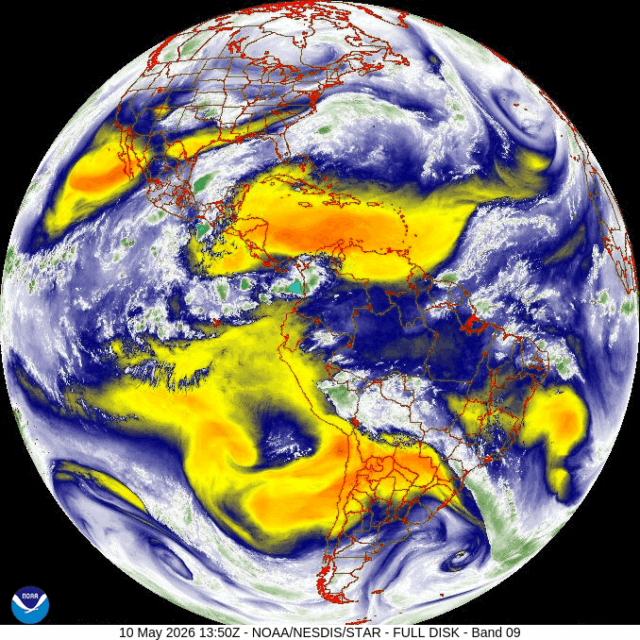
As of May 10, 2026, the global climate community is focusing its collective attention on the tropical Pacific Ocean. Data from the Climate Prediction Center and leading private forecasters, such as AccuWeather, indicate that we are no longer dealing with a standard climate fluctuation. Instead, we are witnessing the birth of a “Super El Niño”—a phenomenon of such magnitude that it has the potential to redefine global weather for the next eighteen months.
Current sea surface temperature anomalies in the central and eastern Pacific have surged past the critical $+2.0$ degrees Celsius threshold. According to AccuWeather’s long-range forecasting team, the rapid rate of warming observed throughout the spring of 2026 suggests this event could rival or even surpass the historic El Niños of 1997-98 and 2015-16. This shift represents a massive release of thermal energy from the ocean into the atmosphere, acting as a high-octane fuel for global storm systems.

Understanding the Super El Niño Without the Math
The El Niño-Southern Oscillation (ENSO) is often described as the “heartbeat” of the global climate. In a typical year, trade winds blow strongly from east to west across the equator. This pushes warm surface water toward Indonesia and Australia, allowing cooler, nutrient-dense water to rise along the coast of South America.
A Super El Niño occurs when these trade winds don’t just weaken but essentially collapse or reverse. This allows the massive pool of warm water in the Western Pacific to slide eastward toward the Americas. For 2026, meteorologists are observing a series of powerful “westerly wind bursts” that are effectively shoving this heat toward the coast of Peru. This atmospheric restructuring changes where clouds form and where the jet stream flows, creating a domino effect that reaches every corner of the planet.
AccuWeather Analysis: The 2026-2027 Outlook
AccuWeather’s expert meteorologists emphasize that the 2026 event is unique because it is occurring amid record-high global ocean temperatures. This “double-whammy” effect means that the atmospheric response is likely to be more volatile than in previous decades.
The United States: A Tale of Two Coasts
For the United States, a Super El Niño typically brings a dramatic shift in the winter storm track. AccuWeather forecasters are warning of a highly active southern jet stream.
- California and the West: The risk of “Atmospheric Rivers”—long plumes of moisture extending from the tropics—is significantly elevated. While this can help replenish reservoirs, the intensity of rainfall predicted for late 2026 poses a severe threat of landslides and catastrophic flooding, particularly in regions previously affected by wildfires.
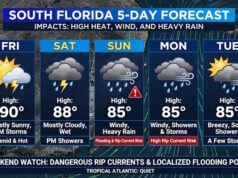
- The Gulf Coast and Florida: These regions should prepare for a winter that is much wetter and cooler than average. For maritime interests and coastal communities, this means an increase in “non-tropical” coastal storms. These storms can cause significant beach erosion and dangerous rip current conditions, even without a formal hurricane present.
- The Northern Tier: Conversely, the northern United States and parts of Canada are likely to experience a much milder winter. This “Pacific air influence” often results in below-average snowfall for the Northern Plains and Great Lakes, impacting the winter tourism industry and heating fuel demand.
The Economic Fallout: Trillions at Risk
The financial implications of a Super El Niño are not merely theoretical; they are quantifiable. Economists monitoring the 2026 event suggest that the global price tag for damages and lost productivity could exceed $3 trillion by the end of the decade.
Agriculture and Viticulture
The agricultural sector is the first to feel the impact. In the Southern Hemisphere, Australia is already bracing for a severe drought that could devastate wheat exports. In the Northern Hemisphere, the shifts in rainfall patterns can disrupt planting cycles for corn and soybeans.
Of particular interest in 2026 is the impact on global viticulture. Major wine-producing regions like Napa Valley and parts of South America often face “feast or famine” moisture cycles during El Niño. While increased rain can lead to higher yields, it also raises the risk of fungal diseases and can dilute the flavor profile of the grapes, impacting the luxury market and investment-grade vintages.
Energy and Infrastructure
In South America, countries like Brazil and Colombia rely heavily on hydropower. The droughts associated with a Super El Niño can deplete reservoirs, forcing these nations to turn to more expensive fossil fuel alternatives to keep the lights on. Meanwhile, in the United States, the increased storminess along the Atlantic seaboard poses a risk to aging power grids and coastal infrastructure.
Commodities and Global Trade
The mining and shipping sectors are equally vulnerable. In Indonesia and Chile, extreme weather—whether drought or flood—can halt mining operations for copper and nickel. Furthermore, lower water levels in critical transit points like the Panama Canal can restrict ship drafts, leading to delays in global supply chains and increased costs for consumer goods.
The Climate Change Force Multiplier
The most alarming aspect of the 2026 Super El Niño is how it interacts with human-induced climate change. We are no longer living in the climate of the 1990s. The baseline temperature of the planet has risen, meaning that the “peaks” of El Niño heat are now reaching dangerous new heights.
Climate change increases the moisture-holding capacity of the atmosphere. For every degree of warming, the air can hold more water vapor. This means that when an El Niño-driven storm hits California or Florida, it is capable of dropping significantly more rain than a similar storm would have forty years ago. Additionally, the melting of polar ice and rising sea levels mean that the storm surges associated with El Niño events are pushing further inland, threatening more homes and businesses.
Maritime Safety and the Atlantic Buffer
For the maritime community, El Niño offers a rare piece of “good” news regarding hurricanes, but with a major caveat. The 2026 forecast suggests high levels of vertical wind shear across the Atlantic. This shear acts as a “decapitator” for developing tropical systems, often leading to a below-average number of named hurricanes.
However, AccuWeather warns that this should not lead to complacency. While there may be fewer hurricanes, the storms that do form can still be intense. Furthermore, the active southern jet stream can create frequent, powerful “Gale” conditions for mariners in the Gulf of Mexico and off the coast of the Southeastern United States, making sea state forecasting more critical than ever for commercial shipping and recreational boating.
The Role of Technology and AI in 2026
In 2026, our ability to predict these events has been transformed by Artificial Intelligence. Advanced AI modeling now allows meteorologists to process billions of data points from ocean buoys and satellites in real-time. These models are helping to identify the “signatures” of a Super El Niño months earlier than was possible during the last major event in 2015. This lead time is crucial for governments and industries to implement mitigation strategies, from reinforcing levees to adjusting global investment portfolios.
Conclusion: A Test of Global Resilience
The 2026 Super El Niño is more than a weather forecast; it is a test of our global infrastructure and economic resilience. As the warm waters of the Pacific continue to surge eastward, the impacts will ripple through the food we eat, the energy we consume, and the safety of our coastal cities.
While we cannot stop the Pacific from warming, the combination of AccuWeather’s precise forecasting and proactive global preparation provides a roadmap for navigating this atmospheric titan. The months ahead will be defined by extreme weather, but they will also be defined by our ability to adapt to a rapidly changing planet.
Sources Used and Links:
- AccuWeather: “Super El Niño Alert: Global Impacts and 2026 Outlook” – accuweather.com
- Climate Prediction Center (NOAA): ENSO Diagnostic Discussion (May 2026) – cpc.ncep.noaa.gov
- World Meteorological Organization (WMO): State of the Global Climate 2026 – wmo.int
- National Hurricane Center (NHC): 2026 Seasonal Outlook and Wind Shear Analysis – nhc.noaa.gov
- Journal of Climate: “Anthropogenic Climate Change and the Intensification of ENSO” – journals.ametsoc.org
- The World Bank: Economic Impact Assessment of Extreme Weather Events (2025-2026) – worldbank.org
- Napa Valley Vintners: “Vintage Safety and Climate Adaptation Reports” – napavintners.com
- Reuters: “Global Shipping Disruptions and the 2026 El Niño” – reuters.com
Disclaimer
Artificial Intelligence Disclosure & Legal Disclaimer
AI Content Policy.
To provide our readers with timely and comprehensive coverage, South Florida Reporter uses artificial intelligence (AI) to assist in producing certain articles and visual content.
Articles: AI may be used to assist in research, structural drafting, or data analysis. All AI-assisted text is reviewed and edited by our team to ensure accuracy and adherence to our editorial standards.
Images: Any imagery generated or significantly altered by AI is clearly marked with a disclaimer or watermark to distinguish it from traditional photography or editorial illustrations.
General Disclaimer
The information contained in South Florida Reporter is for general information purposes only.
South Florida Reporter assumes no responsibility for errors or omissions in the contents of the Service. In no event shall South Florida Reporter be liable for any special, direct, indirect, consequential, or incidental damages or any damages whatsoever, whether in an action of contract, negligence or other tort, arising out of or in connection with the use of the Service or the contents of the Service.
The Company reserves the right to make additions, deletions, or modifications to the contents of the Service at any time without prior notice. The Company does not warrant that the Service is free of viruses or other harmful components.