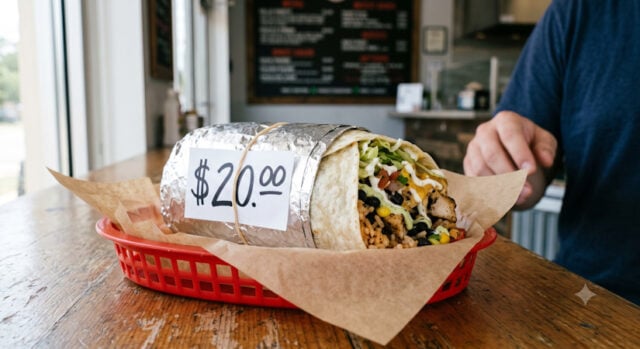
If you thought American politics couldn’t get any spicier, take a look at the $20 burrito. What began as a routine social media rant about fast-food receipts quickly exploded into a full-scale economic argument, pitting conservative commentators against each other and placing President Donald Trump’s economic policies directly under the microscope. Dubbed “Burrito-Gate” or “The Great Burrito Debate,” the viral online clash revealed just how deeply everyday price tags, menu costs, and inflation are weighing on the American public consciousness right now.
The online spark ignited when Turning Point USA spokesman Andrew Kolvet shared a candid comment from a college student who complained, “A burrito shouldn’t cost $20”. Popular podcaster Matt Walsh immediately chimed in, arguing that grocery prices and general affordability ought to be the single highest priority for any elected leader in Washington. But the discussion truly caught fire when podcast producer Joel Berry pushed back with a very different perspective. Berry posted that his wife had recently prepared delicious homemade burritos for their entire family of eight for under twenty dollars total, suggesting that the current nationwide affordability crisis might actually just be an “I don’t know how to cook” crisis.
From that point forward, the digital back-and-forth escalated with surprising speed across political media. American Enterprise Institute fellow Marc Thiessen dismissed the student complaints entirely, telling critics to “cry me a river” and pointing out that campus meal plans already cover cafeteria food options for students. Even Vice President JD Vance jumped into the fray, adding his own lighthearted commentary to the online feud. Before long, conservative commentators found themselves divided into two distinct factions: those insisting that voters’ frustration over daily living expenses is deeply real and urgent, and those counter-arguing that people simply need better personal budgeting and home cooking skills.
Yet beneath all the viral memes, Twitter jabs, and cooking advice lies a genuine political challenge for the Trump administration. Throughout his presidential campaign, Donald Trump repeatedly reassured voters with a clear and memorable promise: “A vote for Trump means your groceries will be cheaper”. However, lingering post-pandemic inflation, coupled with recent tariffs and ongoing trade uncertainties, has kept consumer costs elevated across both supermarket aisles and fast-casual restaurant counters. Policy analysts at the Cato Institute highlighted that while a twenty-dollar burrito usually involves delivery app markups or premium add-ons, the public outcry points to a much larger economic reality—overall consumer prices have jumped nearly 30 percent over recent years.

For everyday families, whether a burrito is bought at Chipotle or wrapped up on a home stove isn’t really the core issue. The debate exposes a deep-seated voter anxiety over purchasing power, wage growth, and unmet campaign promises. When a simple lunch item transforms into a high-stakes political battleground, it sends a strong signal that citizens are closely tracking every dollar in their pocketbooks. Whether political leaders choose to address structural inflation or simply offer home recipes, Burrito-Gate proves that food prices remain one of the most digestible measures of political performance in America today.
Sources Used
- Cato Institute: Burrito-Gate Reflects Inflation’s Toxic Legacy
- Poynter: Trump’s revived Wall Street Journal lawsuit meets more skepticism in court
- Real America’s Voice: The Charlie Kirk Show: The Great Burrito Debate
Disclaimer
Artificial Intelligence Disclosure & Legal Disclaimer
AI Content Policy.
To provide our readers with timely and comprehensive coverage, South Florida Reporter uses artificial intelligence (AI) to assist in producing certain articles and visual content.
Articles: AI may be used to assist in research, structural drafting, or data analysis. All AI-assisted text is reviewed and edited by our team to ensure accuracy and adherence to our editorial standards.
Images: Any imagery generated or significantly altered by AI is clearly marked with a disclaimer or watermark to distinguish it from traditional photography or editorial illustrations.
General Disclaimer
The information contained in South Florida Reporter is for general information purposes only.
South Florida Reporter assumes no responsibility for errors or omissions in the contents of the Service. In no event shall South Florida Reporter be liable for any special, direct, indirect, consequential, or incidental damages or any damages whatsoever, whether in an action of contract, negligence or other tort, arising out of or in connection with the use of the Service or the contents of the Service.
The Company reserves the right to make additions, deletions, or modifications to the contents of the Service at any time without prior notice. The Company does not warrant that the Service is free of viruses or other harmful components.