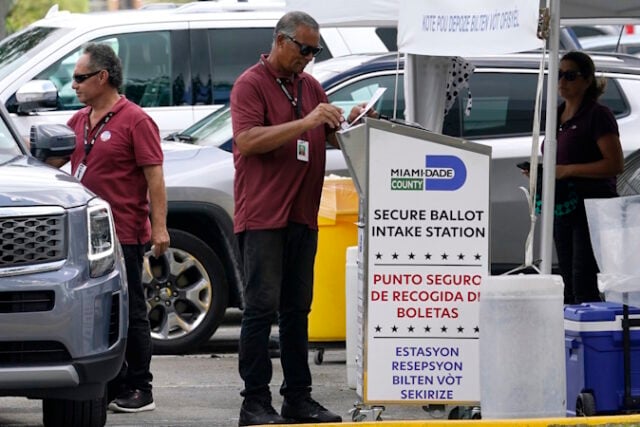
WASHINGTON — The United States Supreme Court’s conservative majority sounded deeply skeptical on Monday regarding the legality of state laws that permit election officials to count mail-in ballots arriving after Election Day. Hearing oral arguments in a highly anticipated case originating from Mississippi, the justices signaled a readiness to upend established voting procedures across roughly half the country, a decision that could profoundly impact the upcoming 2026 midterm elections.
At the heart of the dispute in Watson v. Republican National Committee is a fundamental question of statutory interpretation: Does federal law, which established a singular national “Election Day” more than a century and a half ago, mandate that ballots must be both cast by voters and received by state election officials by that specific date? Or do states possess the constitutional leeway to accept ballots that arrive days or even weeks later, provided they were postmarked before the polls closed?
The high court’s impending ruling, expected by late June or early July, carries immense national weight. A decision striking down Mississippi’s five-day grace period could immediately invalidate similar statutes in 13 other states and the District of Columbia. Furthermore, an adverse ruling could imperil the voting accommodations of 15 additional states that offer extended receipt deadlines specifically for military personnel and citizens living overseas.
The Core Conflict and Mississippi’s Law
In 2020, amid operational disruptions from the COVID-19 pandemic, the Mississippi legislature—by a bipartisan, nearly unanimous vote—enacted a statute allowing mail-in ballots to be counted if they are postmarked by Election Day and received within 5 business days thereafter. The law was designed to prevent the disenfranchisement of voters who mailed their ballots in a timely manner but were affected by unexpected postal service delays.

However, four years later, a coalition of challengers including the Republican National Committee, the Mississippi Republican Party, the Libertarian Party of Mississippi, and individual voters filed lawsuits against Mississippi Secretary of State Michael Watson. They argued that the state’s grace period directly conflicts with an 1845 act of Congress that designates the Tuesday after the first Monday in November as the uniform, national day for choosing presidential electors. In 1872, Congress extended this uniform date to encompass congressional elections as well.
The challengers contend that a uniform Election Day fundamentally requires the final consummation of the voting process—both the casting and the receipt of the ballot—to occur on or before that Tuesday. A three-judge panel of the U.S. Court of Appeals for the 5th Circuit previously agreed with this logic, ruling that federal law preempts Mississippi’s grace period. After the full 5th Circuit declined to rehear the case, Mississippi appealed to the Supreme Court.
Conservative Skepticism During Oral Arguments
During more than two hours of intense oral arguments on Monday, March 23, 2026, the Supreme Court’s 6-3 conservative supermajority peppered the defense with hypotheticals and textual questions that suggested a strong inclination to side with the challengers. The justices focused heavily on the definition of an “election” and the potential consequences of allowing ballot receipt to bleed into the weeks after the official date.
Justice Samuel Alito appeared particularly concerned with the public perception of election integrity and the systemic risks of delayed results. Alito questioned Mississippi Solicitor General Scott Stewart about the possibility of a “big stash of ballots” arriving after Election Day that could radically flip the election outcome. Such scenarios, Alito suggested, could severely undermine public confidence in the democratic process, echoing longstanding criticisms of mail-in voting championed by President Donald Trump and his political allies.
Justice Neil Gorsuch pushed the boundaries of the state’s logic, expressing concern over the finality of the vote. He presented a hypothetical scenario in which a voter might attempt to recall their mail-in ballot through the U.S. Postal Service or a private carrier such as FedEx after Election Day if a late-breaking scandal involving their chosen candidate emerged. While Stewart repeatedly assured the Court that Mississippi law absolutely forbids ballot recalls, Gorsuch remained noticeably unconvinced, retorting that “FedEx isn’t an election official.” Gorsuch further questioned whether there was any logical limit to the state’s argument, asking whether states could, in theory, accept ballots right up until the seating of the new Congress in January.
Justice Brett Kavanaugh approached the issue pragmatically, focusing on the mechanics of implementing a potential sea change in election administration so close to the 2026 midterms. Kavanaugh directly asked Paul Clement, the veteran conservative litigator representing the Republican challengers, whether a decision handed down in late June would trigger administrative chaos. Clement confidently replied that it would not, pointing out that under federal law, absentee ballots for military and overseas voters must be mailed out 45 days before the November general election. Because this deadline falls in mid-September, Clement argued that states would have ample time over the summer to adjust their receipt deadlines and clearly communicate the new rules to the electorate.
The Liberal Wing’s Defense of State Prerogatives
Conversely, the Court’s three liberal justices—Sonia Sotomayor, Elena Kagan, and Ketanji Brown Jackson—signaled they would uphold the post-Election Day grace periods, viewing the Republican challenge as an unwarranted federal intrusion into state election administration. They pointed to the Constitution’s Elections Clause, which traditionally grants state legislatures broad authority to determine the “Times, Places and Manner” of holding elections, unless Congress explicitly overrides them.
Justice Sotomayor was emphatic that the decision regarding when a ballot is considered validly cast should remain with democratically elected bodies rather than the judiciary. “The people who should decide this issue are not the courts, but Congress, the states and Congress,” Sotomayor stated, highlighting that the federal legislature has never explicitly mandated a uniform receipt deadline, despite having the constitutional authority to do so.
Justice Kagan interrogated the foundational logic of the challengers’ argument, warning of a potential slippery slope that could threaten other deeply ingrained voting practices. If the federal statute requiring an election to occur on a single day means that all voting activity must be strictly confined to that 24-hour period, Kagan asked, would that not logically invalidate early in-person voting as well? “Is there any limit to how early people can vote?” Chief Justice John Roberts also chimed in on this point, appearing to share some of Kagan’s concerns regarding the broader implications for early voting.
Clement attempted to thread this needle by arguing that early voting operates under an entirely different set of rules and does not present the same problem of an election remaining unresolved long after the polls have closed. However, the liberal justices remained unconvinced by this distinction, noting that early votes are often stored and counted on Election Day, as are mail-in ballots postmarked early.
Justice Jackson questioned the originalist approach to the 1845 statute. She asked why the Court should interpret a 19th-century law to strictly forbid modern voting procedures that Congress has observed and left undisturbed for decades. She suggested that the challengers were asking the Court to read a prohibition into the text that simply does not exist.
The Arguments of the Challengers and the Specter of Fraud
Paul Clement, arguing on behalf of the Republican and Libertarian parties, maintained that the concepts of casting and receiving a ballot have historically been inextricably intertwined. He argued that allowing votes to be counted after Election Day inherently extends the election, violating the clear text of federal law.
Clement also leaned into the policy argument that delayed results inherently foster suspicion. He argued that when the candidate who appears to be leading on Election Day ultimately loses due to a slow trickle of late-arriving mail-in ballots, it fuels narratives of voter fraud and illegitimacy.
D. John Sauer, representing the Trump administration—which has joined the challengers in attempting to curtail the practice—echoed these sentiments. President Trump has persistently attacked mail-in balloting, frequently asserting that post-Election Day counting is ripe for abuse. Last year, the administration even issued an executive order directing the Justice Department to take action against states counting late ballots, though that order remains tied up in separate lower-court litigation.
Despite these overarching claims of potential fraud, Mississippi Solicitor General Scott Stewart pointedly told the justices that the challengers have utterly failed to produce a single documented case of voter fraud tied to late-arriving mail ballots in Mississippi. Stewart argued that existing law reasonably requires voters to perform their necessary action—filling out the ballot and transferring it to the custody of the postal service—on or before Election Day. The subsequent delivery, he argued, is purely a ministerial act outside the voter’s control.
National Implications and the Military Vote
The ramifications of a ruling in favor of the challengers would extend far beyond Mississippi’s borders. A sweeping decision mandating that all ballots be received by Election Day would invalidate the grace periods of 14 states (including major population centers like California, Texas, New York, and Illinois) and the District of Columbia. State and big-city election officials submitted written filings to the Court, warning that forcing a systemic change just months before a major election risks widespread “confusion and disenfranchisement.”
Perhaps the most fraught aspect of the case involves the Uniformed and Overseas Citizens Absentee Voting Act (UOCAVA). While roughly 14 states have general grace periods, an additional 15 states maintain specific, forgiving receipt deadlines for ballots cast by military personnel deployed overseas and American expatriates. These voters frequently face severe logistical hurdles. According to amicus briefs filed in the case, mail from military bases in Japan can take 6 to 8 weeks to reach the United States.
During oral arguments, Clement acknowledged this complication, noting that some states historically required soldiers’ ballots to be received by Election Day. However, Justice Sotomayor quickly countered that other states had historically allowed military officers to collect and transmit ballots on behalf of their units, demonstrating a long tradition of accommodating overseas service members.
Voting rights advocates, including the Brennan Center for Justice, have warned that eliminating grace periods would disproportionately disenfranchise the military. Only about 8 percent of eligible overseas voters successfully cast ballots in the 2020 election, and removing the grace period for transit time would likely depress that figure further. They argue that Congress, in passing UOCAVA, implicitly recognized and relied upon state-level ballot receipt rules, showing no intent to establish a rigid national receipt deadline.
Looking Ahead to June
As the justices retreated to their chambers to deliberate, the political and legal landscape of the 2026 midterms hung in the balance. Chief Justice John Roberts, often a moderate conservative on voting issues, appeared to be the member of the majority most likely to side with Mississippi, expressing reservations about the cascading effects a broad ruling might have on early voting. However, even if Roberts defects, the challengers would only need the votes of the remaining five conservative justices to secure a majority.
If the Court rules as expected by late June, election administrators nationwide will have a rapidly shrinking window to redesign their mail-in voting protocols, update voter education materials, and prepare for an influx of mail-in ballots that must navigate the postal system with zero margin for error. In a closely divided political climate where control of Congress rests on agonizingly thin margins, the disqualification of even a few thousand late-arriving ballots in battleground states could easily determine the balance of power in Washington.
The Broader Landscape of Election Litigation
The current Supreme Court battle is merely the apex of a broader, years-long conservative legal campaign to tighten the rules surrounding mail-in voting. In battleground states like Pennsylvania, mail-in ballots have been the subject of relentless litigation since the widespread adoption of no-excuse absentee voting. For instance, Pennsylvania has faced intense legal battles over ballots that arrive in undated or misdated return envelopes. Just months ago, the 3rd U.S. Circuit Court of Appeals ruled that throwing out mail ballots for minor clerical errors violated voters’ constitutional rights, noting that such mistakes have no bearing on fraud detection. Similarly, the Pennsylvania Supreme Court recently had to intervene to ensure that voters whose mail-in ballots were disqualified due to technical errors were still permitted to cast provisional ballots on Election Day.
These state-level skirmishes underscore the high stakes of Watson v. Republican National Committee. While the Mississippi case concerns only the federal receipt deadline, it represents a profound test of the federal judiciary’s willingness to override state election statutes designed to maximize voter participation. Should the Supreme Court embrace the argument that federal law imposes a strict, national cutoff for the physical receipt of ballots, it would represent one of the most significant judicial interventions into the mechanics of American elections in modern history.
For now, voters, politicians, and election administrators must wait until summer to learn whether the rules of the game will fundamentally shift just as the 2026 campaign season enters its final, frantic stretch.
Sources Used and Links
- AP News: Supreme Court sounds skeptical of late-arriving ballots, a Trump target
- DeSoto County News: Supreme Court appears skeptical of counting late-arriving mail ballots in Mississippi case
- The Washington Post: Supreme Court appears ready to limit mail-in balloting ahead of midterms
- SCOTUSblog: Court appears ready to overturn state law allowing for late-arriving mail-in ballots
- Votebeat: Supreme Court justices ask sharp questions in case over late-arriving mail ballots
- OPB: Supreme Court sounds skeptical of Mississippi law allowing late-arriving ballots
- TPR (Texas Public Radio): Supreme Court skeptical of laws counting mail-in ballots after election day
- WPSU: Supreme Court skeptical of laws counting mail-in ballots after election day
- The Floridian: Supreme Court Majority Skeptical of Mail-In Ballots Extensions
- LOOTPRESS: Supreme Court conservatives appear skeptical of mail-in ballots that arrive after Election Day
- Brennan Center for Justice: Supreme Court Could Protect the Right to Vote for Military and Overseas Voters
- National Constitution Center: Supreme Court tackles the question of late-arriving mail-in ballots
- State Court Report: Pennsylvania Supreme Court Says Provisional Ballots Cast by Voters Whose Mail-Ballots Were Invalid Must Be Counted
- WHYY: Pennsylvania must stop throwing out mail ballots over date errors, court rules
- ACLU of Pennsylvania: Victory for Democracy as State Supreme Court Rules Washington County Must Alert Voters Whose Mail Ballots Contain Errors
- Public Interest Law Center: Voting Rights Advocates respond to Pennsylvania Supreme Court Ruling
Disclaimer
Artificial Intelligence Disclosure & Legal Disclaimer
AI Content Policy.
To provide our readers with timely and comprehensive coverage, South Florida Reporter uses artificial intelligence (AI) to assist in producing certain articles and visual content.
Articles: AI may be used to assist in research, structural drafting, or data analysis. All AI-assisted text is reviewed and edited by our team to ensure accuracy and adherence to our editorial standards.
Images: Any imagery generated or significantly altered by AI is clearly marked with a disclaimer or watermark to distinguish it from traditional photography or editorial illustrations.
General Disclaimer
The information contained in South Florida Reporter is for general information purposes only.
South Florida Reporter assumes no responsibility for errors or omissions in the contents of the Service. In no event shall South Florida Reporter be liable for any special, direct, indirect, consequential, or incidental damages or any damages whatsoever, whether in an action of contract, negligence or other tort, arising out of or in connection with the use of the Service or the contents of the Service.
The Company reserves the right to make additions, deletions, or modifications to the contents of the Service at any time without prior notice. The Company does not warrant that the Service is free of viruses or other harmful components.