You may think you’re too smart to fall for an online shopping scam. Though that may be true, fraudsters are getting frighteningly good at passing off as the stores you trust.
A new report from fraud prevention company Signifyd shows that retail fraud is becoming increasingly complex and growing fast, with attacks targeting shoppers’ online accounts up 78% year over year in the first four months of 2026. The likely culprit? AI.
This may not come as a surprise if you’ve been keeping an eye on the data. The FBI’s Internet Crime Complaint Center received more than 22,000 complaints that mentioned artificial intelligence last year, which amounted to more than $893 million in reported losses. In its 2025 internet crime report, the center noted that AI-enabled content is becoming difficult to detect while being easier to make.
John Breyault, vice president of public policy, telecommunications and fraud at the National Consumers League, says that while it’s difficult to quantify exactly how many online scams are fueled by AI, these tools have certainly lowered the barrier to entry for budding scammers.

“You don’t need to have a lot of coding skills when Claude — or the dark web equivalent of Claude — can code a convincing-looking website for you very quickly and at scale,” he adds.
This also means that what used to be obvious red flags (such as misspellings, poor design and robotic language) are becoming unreliable as a way to distinguish fake websites or messages from the real ones.
“These are things that we were never prepared for until AI made them ubiquitous and accessible to scammers,” Breyault says.
How scammers are using AI to trick online shoppers
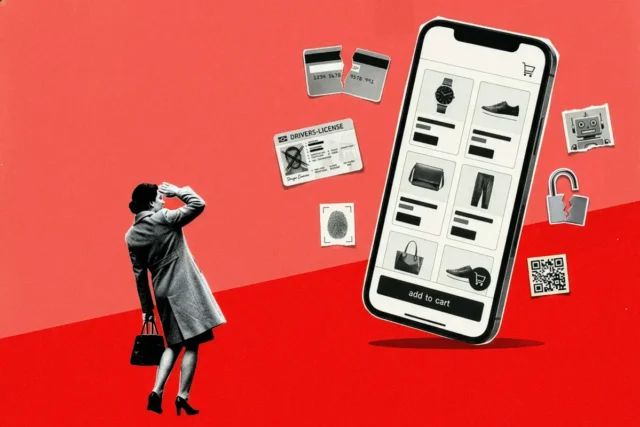
One of the clearest ways AI-fueled fraud can cause damage to online shoppers is through account takeovers. AI makes it easy to steal account credentials by generating websites, emails and texts with enough contextual information to trick you into giving scammers your login information.
In its report, Signifyd describes one operation that used an AI model to help build look-alike websites impersonating a major grocery chain, along with emails directing consumers to malicious landing pages. Once a shopper entered their information, the scammers could use it to break into other accounts. They could also sell it — Signifyd found stolen retail accounts advertised on illicit marketplaces for as little as $2 to $3 apiece.
Think about all the places you stored your credit card credentials “a year, two years or even four years ago,” says Nicole Jass, head of strategy at Signifyd. We don’t often think of these “dormant accounts” as a major attack channel because we forget they have our credentials in the first place.
But in reality, she adds, “someone just has to log in to that account, and they can use it.”
The payoff for breaking in can go beyond whatever card is saved on file. Fraudsters can use other saved payment methods, gift cards and discounts, or even your loyalty points, which have become increasingly profitable. In a recent report from the National Retail Federation, 51% of retailers said loyalty fraud had become more frequent over the prior year.
“Even though we don’t call them U.S. dollars, [points] can often be redeemed for actual physical goods or services,” Breyault says, which makes them especially valuable for scammers. They also often aren’t protected as rigorously as email or financial accounts.
Return fraud could mean more friction for honest shoppers
Fraudsters using AI are also changing what happens after checkout. By generating images of packages with damaged or incorrect goods as well as fake receipts that mimic a retailer’s branding, they can fool businesses into refunding them for goods they received in perfect condition — or that they never received in the first place.
The retail federation documented $850 billion in returns in 2025, with close to $76.5 billion of that being fraudulent returns.
“That’s about 9%. If I’m a business, that’s a concern,” Jass says.
Current numbers show similar pressure, with 35% of surveyed retailers saying external return or refund fraud was trending higher in 2026 than the year before.
That naturally pushes retailers to take a closer look at returns. But could a higher return fraud numbers result in tighter refund policies? While there’s not enough data to confirm that’s the case, Jass does say it’s a concern.
“Merchants have to decide: Do I risk having more fraudulent returns with easy, simple return policies or do I err on the side of caution and limit your amount of returns or charge you for refunds?” she adds.
How to shop online safely in the age of AI
As AI makes scams harder to recognize, you may need to rely less on whether a store’s website or message looks legitimate and more on basic account security.
Jass suggests going through old shopping accounts and shutting down those you no longer use, or at least updating your passwords — ideally to something unique that isn’t floating around on the dark web.
The federal Cybersecurity and Infrastructure Security Agency recommends using a password manager to generate strong passwords and turning on multi-factor authentication to keep fraudsters out even if they obtain your login information.
When dealing with unfamiliar sellers, the Federal Trade Commission says to search their name alongside terms like “complaint” or “scam” before buying anything. And if a merchant or store you do know about sends you an unexpected offer, avoid clicking any links in the message, especially if it seems to good to be true.
Instead, type in the web address yourself or open its app to confirm whether it’s the real deal.
Disclaimer
Artificial Intelligence Disclosure & Legal Disclaimer
AI Content Policy.
To provide our readers with timely and comprehensive coverage, South Florida Reporter uses artificial intelligence (AI) to assist in producing certain articles and visual content.
Articles: AI may be used to assist in research, structural drafting, or data analysis. All AI-assisted text is reviewed and edited by our team to ensure accuracy and adherence to our editorial standards.
Images: Any imagery generated or significantly altered by AI is clearly marked with a disclaimer or watermark to distinguish it from traditional photography or editorial illustrations.
General Disclaimer
The information contained in South Florida Reporter is for general information purposes only.
South Florida Reporter assumes no responsibility for errors or omissions in the contents of the Service. In no event shall South Florida Reporter be liable for any special, direct, indirect, consequential, or incidental damages or any damages whatsoever, whether in an action of contract, negligence or other tort, arising out of or in connection with the use of the Service or the contents of the Service.
The Company reserves the right to make additions, deletions, or modifications to the contents of the Service at any time without prior notice. The Company does not warrant that the Service is free of viruses or other harmful components.