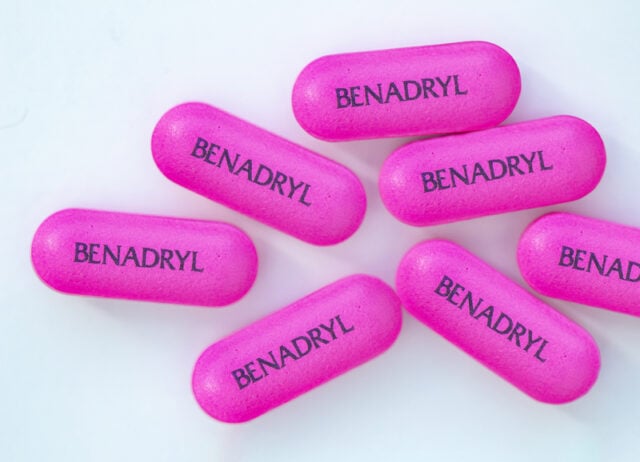
Diphenhydramine, sold under the brand name Benadryl, can relieve allergy symptoms, such as runny noses, watery eyes, and rashes. Newer antihistamines may be safer since they cause less harmful side effects, such as drowsiness.
What Is Benadryl?
Diphenhydramine can be taken by adults and children and is used to treat seasonal allergies, hives, motion sickness, and insomnia.
The medication is a “first-generation” antihistamine, meaning it’s an older drug that works by binding to and blocking the body’s histamine receptors, specifically the H1 receptors.
Cells throughout the body produce histamine during allergic reactions in blood vessels, airways, and nerves, and it’s also produced in the brain and plays a part in wakefulness.

Diphenhydramine is available in approximately 300 formulations either on its own or combined with other ingredients.
Clark JH, Meltzer EO, Naclerio RM. Diphenhydramine: it is time to say a final goodbye. World Allergy Organ J. 2025;18(2):101027. doi:10.1016/j.waojou.2025.101027
While there’s no available data on OTC use, more than 1 million prescriptions for stronger versions of diphenhydramine are written in the United States every year.
Benadryl is widely used because it’s affordable and can effectively treat a variety of allergy-related symptoms, from watery, itchy eyes to hives and bug bite reactions.
How Does Benadryl Work Compared to Newer Antihistamines?
“If Benadryl underwent clinical trials today, in my opinion, it would certainly not be approved for the OTC market due to adverse reactions,” Lawrence B. Schwartz, MD, PhD, an allergy and immunology specialist at VCU Health who did not work on the paper, told Health.
Like all antihistamines, Benadryl causes drowsiness by blocking H1 receptors and crossing the blood-brain barrier.
But it also does other things that can create side effects. For instance, it blocks sodium channels, helping it to act as a local anesthetic and potentially leading to dangerous cardiac effects.
Additionally, it can cause dry mouth, blurry vision, constipation, urinary retention, and an elevated heart rate because it blocks acetylcholine, a neurotransmitter in the central nervous system, Trisha Ray, MD, clinical director of Allergy and Immunology at Beth Israel Deaconess Medical Center, told Health.
Manufacturers eventually developed “second-generation” antihistamines, such as loratadine (Claritin), cetirizine (Zyrtec), or fexofenadine (Allegra), to offer gentler options.
These newer medications bind only to H1 receptors and cross the blood-brain barrier at much lower levels than Benadryl, making them less likely to cause drowsiness and other adverse effects, said Ray.
Why Are Some Experts Shifting Away From Benadryl?
Some experts say that second-generation antihistamines are simply safer than Benadryl.
Benadryl’s sedating effects—so effective that the pharmaceutical industry began marketing it as a sleep aid in the 1970s—can affect concentration, attention, memory, and performance well into the next day.
“Patients are frequently unaware of the potential for these well-established effects,” said James H. Clark, MD, the co-director of the Johns Hopkins Dysphagia and Deglutition Clinic at The Johns Hopkins School of Medicine and a co-author of the paper.
“This scenario has resulted in vehicular accidents in patients who have underestimated their sedation after taking such medications.”
A single dose of diphenhydramine can impair driving more than a 0.1% blood alcohol level, but fexofenadine (Allegra) does not affect driving.
Experts cite other reasons Benadryl should be phased out, including its ability to cause:
- Heart rhythm disruptions
- Constipation
- Urinary retention
- Dry eyes
- Blurry vision
- Skin flushing
- Increased risk of confusion and dementia, including Alzheimer’s
- An increased risk of agitation and confusion in children, which can be followed by extreme sedation and coma
- Potential for abuse, which can lead to hospitalizations and deaths
Should You Still Take Benadryl?
When treating rhinitis, a collection of symptoms affecting the nose and nasal passages, clinicians are now prescribing second-generation oral antihistamines over first-generation options to reduce the risk of adverse effects.
Many global guidelines also favor second-generation antihistamines for hives and rhinitis.
For those with chronic (long-term) allergies, second-generation antihistamines are superior not only because they have fewer side effects but also because they last longer, allowing for consistent use at higher doses, said Ray.
But Benadryl still has its place in certain situations, Jessica Hui, MD, a pediatric allergist and immunologist at National Jewish Health, told Health.
For example, Benadryl can be preferable if you don’t want a medication that lasts as long in the body, or in situations where drowsiness is desired, such as before a procedure, said Hui.
In cases of acute (sudden) allergic reactions or anaphylaxis, Benadryl’s rapid onset of action, 15-30 minutes versus 20-60 minutes for second-generation antihistamines, can also make it the top choice, explained Ray.
“This may not be a major difference in most cases, but in my clinical experience, I have witnessed firsthand the rapid improvement in symptoms from administration of Benadryl in an acute setting,” she said.
Other than select uses, Hui said she advises allergy sufferers to use second-generation antihistamines for relief.
Disclaimer
Artificial Intelligence Disclosure & Legal Disclaimer
AI Content Policy.
To provide our readers with timely and comprehensive coverage, South Florida Reporter uses artificial intelligence (AI) to assist in producing certain articles and visual content.
Articles: AI may be used to assist in research, structural drafting, or data analysis. All AI-assisted text is reviewed and edited by our team to ensure accuracy and adherence to our editorial standards.
Images: Any imagery generated or significantly altered by AI is clearly marked with a disclaimer or watermark to distinguish it from traditional photography or editorial illustrations.
General Disclaimer
The information contained in South Florida Reporter is for general information purposes only.
South Florida Reporter assumes no responsibility for errors or omissions in the contents of the Service. In no event shall South Florida Reporter be liable for any special, direct, indirect, consequential, or incidental damages or any damages whatsoever, whether in an action of contract, negligence or other tort, arising out of or in connection with the use of the Service or the contents of the Service.
The Company reserves the right to make additions, deletions, or modifications to the contents of the Service at any time without prior notice. The Company does not warrant that the Service is free of viruses or other harmful components.