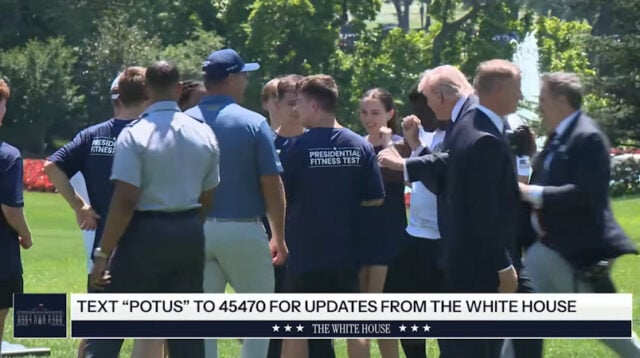
In a move that has political analysts checking their step-counts and orthopedic surgeons reaching for their clipboards, President Donald Trump transformed the South Lawn of the White House into a makeshift dance studio this morning. The occasion was the official restoration of the Presidential Fitness Test Award, a benchmark of physical excellence that has, apparently, been upgraded to include the “Double-Fisted Air-Punch” and the “Accordion Lean.”
SPOTTED: PRESIDENT TRUMP TEACHING THE TRUMP DANCE ON THE SOUTH LAWN 🇺🇸 pic.twitter.com/oDrjneBbd7
— The White House (@WhiteHouse) May 5, 2026
As the D.C. humidity began to wilt the collars of the press corps, the President stepped onto the grass with the confidence of a man who knows that cardio is best performed in a suit and tie. Surrounded by a gaggle of local students who were likely expecting a lecture on the merits of the pull-up, the Commander-in-Chief instead provided a masterclass in what social media has dubbed “The Executive Shuffle.”
The Return of the Gold Standard (and Gold Medals)
The morning began with the signing of a memorandum reviving the school-based fitness benchmarks phased out during previous administrations. “We’re bringing back the test,” the President declared, brandishing a pen with the flourish usually reserved for trade deals. “But we’re making it better. We’re making it fun. We’re making it rhythmic. You have to have the moves. If you can’t move, you can’t lead.”

While the traditional test involved the dreaded “beep test” and sit-ups that mostly served to embarrass teenagers, the 2026 version apparently includes a “freestyle” component. To demonstrate, the President signaled the audio booth—manned, in a surreal turn of events, by Secretary of State Marco Rubio, who appeared to treat the DJ setup with the same intensity he usually reserves for Iranian naval blockades.
As the iconic opening horns of the Village People’s “YMCA” began to blare across the lawn, the President did not merely watch. He instructed.
Step-by-Step Sovereignty
“Watch the hands,” the President told a bewildered ten-year-old in the front row. “It’s all in the elbows. You don’t want to over-extend. You keep it tight. It’s a power move.”
For the next ten minutes, the South Lawn witnessed a sight that would have made George Washington drop his wooden teeth in confusion. The President demonstrated the “Trump Dance”—that signature rhythmic shifting of weight accompanied by rhythmic, vertical fist-pumping—to a group of children who seemed caught between the desire to join in and the instinct to look for their parents.
The curriculum, according to unofficial sources close to the White House catering staff, was divided into three distinct phases:
- The Bilateral Swing: A low-impact motion involving the swaying of the shoulders while maintaining a fixed gaze on a hypothetical teleprompter.
- The Double-Pump: A specialized move where the fists are raised to ear-level in a gesture that signals both “victory” and “I am checking for rain.”
- The Stately Point: A final, decisive gesture toward a random child in the crowd, designed to instill a sense of both civic duty and mild “who, me?” anxiety.
The Rubio Remix
Not to be outdone, Secretary Rubio—fresh off a busy morning of diplomatic “juggling”—seemed to be enjoying his role as the administration’s Chief Musical Officer. Wearing headphones that cost more than some small-town budgets, Rubio nodded along to the beat, occasionally pumping a fist in solidarity with the South Lawn “fitness” enthusiasts.
At one point, the President paused the music to critique the form of a young boy who was attempting a traditional breakdance move. “No, no,” the President corrected. “Too much floor work. You want to stay upright. You want people to see the tie. If you’re on the ground, they can’t see the suit. It’s about the silhouette.”
A New Era of Physical Education
The comedic spectacle served a broader purpose, of course. By reviving the Presidential Fitness Test, the administration is leaning into a “health through heritage” narrative. However, the inclusion of “stage Presence” as a metric for 5th graders has raised some eyebrows in the Department of Education.
“We’re looking at the whole child,” a White House spokesperson (who was still humming ‘YMCA’ under their breath) told reporters. “Flexibility isn’t just about touching your toes; it’s about being able to pivot during a press conference while maintaining a consistent tempo.”
Critics have been quick to point out that rhythmic fist-pumping burns significantly fewer calories than the 600-meter run, but supporters argue that the “Executive Shuffle” provides essential training for future gala attendance and campaign trail stamina.
The Aftermath: Viral Diplomacy
By noon, clips of the “South Lawn Salsa” (as one intern called it) had already racked up millions of views on X. The footage shows the President leading a “conga line of fitness” that briefly included a very confused Secret Service agent who was clearly trying to maintain a 360-degree security perimeter while also keeping time with the bass line.
The children, for their part, were rewarded with commemorative “Presidential Fitness” medals and, reportedly, a very enthusiastic lecture on the importance of “looking like a winner” even when your hamstrings are tight.
As the event concluded, the President made one final pass through the crowd, demonstrating a high-speed version of the pump for a group of kindergarteners. “Remember,” he told them, “it’s not about the dance. It’s about the energy. And maybe a little bit about the song. It’s a great song. People are saying it’s more popular than ever.”
Whether the new fitness test will actually improve the cardiovascular health of the nation’s youth remains to be seen. But one thing is certain: the class of 2026 will be the first generation of Americans capable of performing a mid-tempo disco classic during a diplomatic crisis without missing a single beat.
Sources Used and Links:
- WFMD News: Trump teaches students his iconic dance during White House fitness event
- WFMD News (Marco Rubio Context): Rubio’s Trump admin juggling act grows as meme-worthy role list becomes reality
- DWS News (YouTube): President Trump’s Dance Shakes Up FIFA 2026 Draw
- APT (YouTube): Trump Dances to “YMCA” at World Cup Draw, Shows Off His Signature Moves
- Times of Israel: Claiming ‘great progress’ in Iran talks, Trump says US pausing naval escorts in Hormuz (Context for current administration activities on May 5/6, 2026)
Disclaimer
Artificial Intelligence Disclosure & Legal Disclaimer
AI Content Policy.
To provide our readers with timely and comprehensive coverage, South Florida Reporter uses artificial intelligence (AI) to assist in producing certain articles and visual content.
Articles: AI may be used to assist in research, structural drafting, or data analysis. All AI-assisted text is reviewed and edited by our team to ensure accuracy and adherence to our editorial standards.
Images: Any imagery generated or significantly altered by AI is clearly marked with a disclaimer or watermark to distinguish it from traditional photography or editorial illustrations.
General Disclaimer
The information contained in South Florida Reporter is for general information purposes only.
South Florida Reporter assumes no responsibility for errors or omissions in the contents of the Service. In no event shall South Florida Reporter be liable for any special, direct, indirect, consequential, or incidental damages or any damages whatsoever, whether in an action of contract, negligence or other tort, arising out of or in connection with the use of the Service or the contents of the Service.
The Company reserves the right to make additions, deletions, or modifications to the contents of the Service at any time without prior notice. The Company does not warrant that the Service is free of viruses or other harmful components.