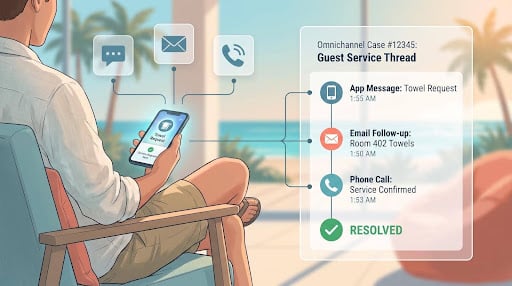
You land in Fort Lauderdale, request a towel in the hotel app, wait, email, then call, repeating the same details each time. The numbers echo that frustration: Salesforce research found that 79 percent of customers expect consistent interactions across departments, yet 56 percent say they often have to repeat or re-explain information to different representatives. Omnichannel customer service treats that three-message saga as one living case, so the story, and your patience, stay intact.
What omnichannel customer service means
Omnichannel customer service is an operating model where every interaction, whether chat, email, voice, messaging, or in person, attaches to the same customer identity, single case record, and shared knowledge base. Move from a bot to a live agent and the transcript, order status, and any promises follow, so the next rep fixes the issue without starting over.
Buyer’s guides for service software use a simple test for this: when one customer conversation spans three channels, does the system show one thread, or three tickets that someone has to merge? Omnichannel service means one thread.
The five ones: how omnichannel service works behind the scenes
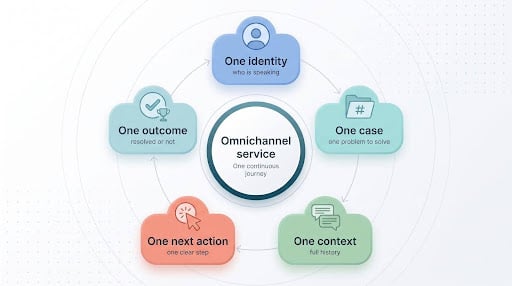
One identity. An email address, phone number, app login, or guest chat must point to the same customer. If identity breaks, the system greets “Maria” in chat but “Mary” by phone.

One case. A shopper may start six conversations, but they still have a single problem to fix. Link every chat, email, call recording, and note to one case ID, and duplicate tickets disappear.
One context. The next agent must see every transcript line, workflow step, and promise so far, so the phone agent knows the chatbot already confirmed the order number. Comm100’s omnichannel customer service platform, for example, brings live chat, email, SMS, social messaging, voice and an AI agent into one agent console. The company reports 223 million conversations a year and a 95 percent CSAT rate.

One next action. The same screen must let the agent issue the refund, reschedule the delivery, or update billing, without opening ten extra tabs or saying “let me transfer you.”
One outcome. Measure success the way customers do: was the issue fully resolved, yes or no? Tracking one outcome per case shows whether automation truly saves money instead of merely deflecting calls.
Why omnichannel customer service matters
It lowers customer effort. Zendesk’s CX Trends 2026 report found that 81 percent of consumers want representatives to pick up where they left off, and 74 percent get frustrated when they have to repeat information.
It helps agents solve, not search. A National Bureau of Economic Research study of 5,179 customer support agents found that access to a generative AI assistant raised issues resolved per hour by 14 percent on average, with the biggest gains for newer agents.
It exposes the true customer journey. Channel dashboards may look healthy while customers still feel stuck. McKinsey’s survey of some 27,000 American consumers found that a company’s performance on whole journeys is 35 percent more predictive of customer satisfaction than its performance on individual touchpoints.
It protects loyalty and revenue. Zendesk’s CX Trends 2023 research found that more than half of customers will switch to a competitor after a single unsatisfactory experience. Qualtrics XM Institute reports that consumers cut or stop spending with a brand after 51 percent of bad experiences.
Why the stakes feel bigger in South Florida
South Florida conversations jump between languages, devices, and, during hurricane season, even locations. U.S. Census Bureau figures show that about 75 percent of Miami-Dade residents speak a language other than English at home, and nearly 44 percent do in Broward. If any hop loses history, service fails when people need help most.
Tourism raises the bar. Greater Miami and Miami Beach welcomed about 28.3 million visitors in 2025, and Greater Fort Lauderdale drew 20.9 million, according to the two areas’ tourism bureaus.
Hurricanes turn continuity into business survival. Florida’s Division of Emergency Management urges businesses to keep their continuity plans up to date and make sure employees know their roles. For a service team, that plan should cover remote agents, rerouted calls, and synchronized updates when offices close.
The benefits, and where the ROI comes from
Customers stop repeating themselves and issues close faster. Customer effort research from CEB, now part of Gartner, found that 94 percent of customers who had a low-effort service experience said they intended to buy again, compared with 4 percent after a high-effort one.
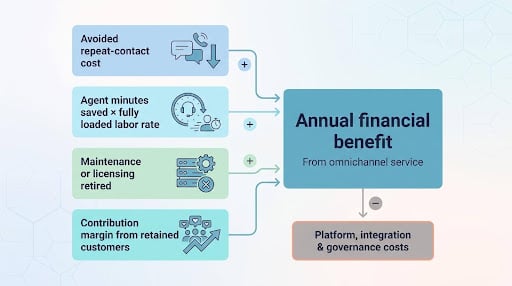
The business case rests on fewer repeat contacts. SQM Group puts the call center industry average for first call resolution at about 70 percent, so roughly three in ten callers have to get in touch again about the same issue. To size your own return, add avoided repeat-contact cost, agent minutes saved, retired licenses, and margin from retained customers, then subtract platform, integration, and governance costs.
The risks and common failure modes
Data and identity problems. Duplicate and outdated profiles build up in almost every customer database. Use strict match rules (email plus phone, or a verified login), add extra authentication before showing sensitive history, and keep a quick way to undo a bad merge.
Channel sprawl. The typical contact center now juggles voice, email, chat, social media and messaging apps, and many struggle to meet response targets on all of them. Add a channel only when customers already use it and identity and context work on day one.
Legacy integration and hidden costs. If CRM, billing, or order systems don’t sync in real time, agents fall back on copy-and-paste. Budget for usage fees, middleware, and testing in year two, not just at launch.
A practical implementation roadmap
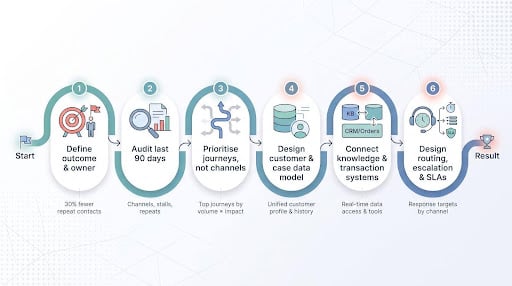
- Define the outcome and owner. Pick one executive sponsor and one specific, time-bound goal, such as 30 percent fewer repeat contacts in six months. Name a journey owner responsible for the whole story from “hello” to “issue closed.”
- Audit the last 90 days of contacts. Find which channels customers use, how often they switch before the issue is fixed, and where conversations stall or repeat.
- Prioritize journeys, not channels. Start with one or two painful journeys, such as “Where’s my order?” or storm-related updates, narrow enough to pilot in 60 to 90 days.
- Design the customer and case data model. Name one source of truth for identity and one case record that carries the reason, promised date, language, and consent.
- Connect knowledge and transaction systems. Link CRM, billing, knowledge base, and telephony so agents can finish the job without leaving the console.
- Design routing, escalation, and channel SLAs. Route by intent, skill, and language, pass the full transcript on every escalation, and set response targets that match each channel.
Conclusion
Omnichannel customer service means making sure every message, call, and chat about one problem lands in one place, with one owner and one outcome. Run the test again: when a customer reaches you on three channels about one issue, does your team see one thread, or three tickets? If the answer is three tickets, start small with one painful journey. For South Florida businesses that serve multilingual residents, millions of visitors, and a long hurricane season, that continuity keeps service working when customers need it most.
Disclaimer
Artificial Intelligence Disclosure & Legal Disclaimer
AI Content Policy.
To provide our readers with timely and comprehensive coverage, South Florida Reporter uses artificial intelligence (AI) to assist in producing certain articles and visual content.
Articles: AI may be used to assist in research, structural drafting, or data analysis. All AI-assisted text is reviewed and edited by our team to ensure accuracy and adherence to our editorial standards.
Images: Any imagery generated or significantly altered by AI is clearly marked with a disclaimer or watermark to distinguish it from traditional photography or editorial illustrations.
General Disclaimer
The information contained in South Florida Reporter is for general information purposes only.
South Florida Reporter assumes no responsibility for errors or omissions in the contents of the Service. In no event shall South Florida Reporter be liable for any special, direct, indirect, consequential, or incidental damages or any damages whatsoever, whether in an action of contract, negligence or other tort, arising out of or in connection with the use of the Service or the contents of the Service.
The Company reserves the right to make additions, deletions, or modifications to the contents of the Service at any time without prior notice. The Company does not warrant that the Service is free of viruses or other harmful components.