

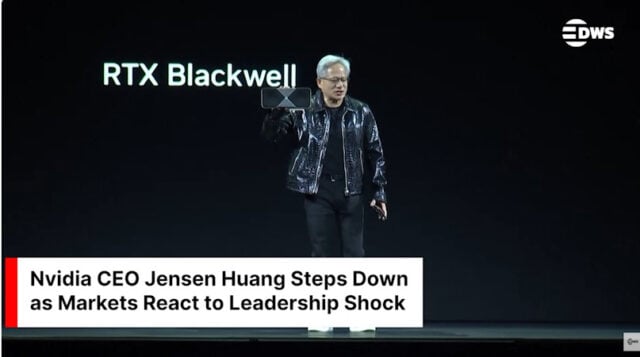
The announcement that Nvidia CEO Jensen Huang would step down after an affair scandal sent shockwaves through Wall Street on Thursday. Huang, a co-founder of the chip giant, is one of the most visible and vocal proponents of the artificial intelligence boom.
This, taken with the fact that Nvidia is the world’s second-most valuable company, means his departure could have serious ramifications for your 401(k).
Video report by DWS
Must Read
- You’re probably eligible to save money on car insurance. Compare rates for your ZIP code with this free — and fast — tool from Money.
- These 6 hacks can help retirees save money on things they’re already buying.
- A $10,000 investment 10 years ago would be worth over $30,000 today. It wasn’t a stock. See how investors are adding gold to their IRAs with Goldco’s free guide.
On Thursday, Nvidia’s stock partially recovered from a drop of over 10% but remained down roughly 5% as of midday, and its market cap fell below $4 trillion for the first time since last year.

Wall Street’s anxiety in the aftermath of Huang’s ouster stems from the singular position Huang held. More so than some other Silicon Valley titans, Huang had become an avatar of the growing AI buildout, a proponent of its expansion and a lightning rod for its controversies.
As a member of the Magnificent Seven — Alphabet, Amazon, Apple, Meta, Microsoft, Nvidia and Tesla — Nvidia itself is a primary architect of the AI data center arms race. Nvidia manufactures as many as 90% of the most advanced semiconductors: chips also sought by China as it seeks to expand its AI ambitions.
Huang has also been influential in the Trump administration’s approach to AI regulation and oversight. Earlier this year, Huang accompanied the president on a trip to China and helmed a $500 billion funding push for AI infrastructure announced on CNBC in August in coordination with half a dozen Wall Street heavyweights, including BlackRock and Goldman Sachs.
As a result, Huang’s resignation affects the broader sector to a greater extent than would a typical CEO departure, according to Dan Ives, partner and senior managing director and analyst at Yorkville Ives & Co.
“Other U.S. tech leaders are now going to have step in up even more as visionaries with Jensen gone,” he wrote in a research note Thursday.
Despite the controversy, some investing pros are more sanguine, expressing confidence that Nvidia’s performance won’t be materially affected by Huang’s departure.
“Scandals come and go. This does not alter Nvidia’s prospects for its chips,” says Jamie Cox, managing partner for Harris Financial Group. “This situation is more headline risk than material risk” that doesn’t fundamentally change Nvidia’s ability to make and sell chips, he adds.
What does the Nvidia scandal mean for your money?
Tom Hainlin, national investment strategist at U.S. Bank Wealth Management, says the main takeaway for investors is to avoid making any knee-jerk changes to your 401(k) allocations out of panic.
“Resist making big changes just because of a headline. The market as a whole has done very well this year,” he tells Money. “The market is a lot broader than Nvidia itself.”
A properly diversified portfolio should be minimally exposed to short-term volatility affecting any one stock, although experts acknowledge that attaining appropriate diversification has gotten harder for retirement savers who rely on low-cost index funds in their 401(k)s.
The explosive, AI-fueled growth of tech company valuations has distorted the composition of major indices, creating concentration risk. Currently, just 10 companies comprise roughly 40% of the broad-based S&P 500 — along with the countless mutual funds and exchange-traded funds, or ETFs, that mirror it. The tech-heavy Nasdaq is even more skewed, with its top 10 holdings comprising nearly half of its overall valuation.
What’s more, the complex dynamic between many of the top tech companies means if one hyperscaler suffers an adverse event, ripple effects could drag down the performance of its vendors and suppliers.
“At the top of the market, the so-called Mag Seven stocks, there’s been a lot of correlation between those type of stocks,” says Erin Kolo, manager of private wealth management, equity and fixed-income research at Baird.
While the S&P is a broad-based index, containing the 500 biggest public companies in the U.S., Kolo says you shouldn’t rely solely on its performance to grow your nest egg. Consider funds focused on small-cap and mid-cap stocks, as well as international equities and fixed-income asset classes.
“If you have those additional investment and asset classes… there’s potential to reduce that concentration within the overall portfolio,” she says.
On the flip side, if you’re bullish on Nvidia and the AI boom, Cox says you could use the dip in its share price as a buying opportunity.
“You’ve got to think big picture,” he says. “If you’ve wanted to own Nvidia, here’s your chance.”
Disclaimer
Artificial Intelligence Disclosure & Legal Disclaimer
AI Content Policy.
To provide our readers with timely and comprehensive coverage, South Florida Reporter uses artificial intelligence (AI) to assist in producing certain articles and visual content.
Articles: AI may be used to assist in research, structural drafting, or data analysis. All AI-assisted text is reviewed and edited by our team to ensure accuracy and adherence to our editorial standards.
Images: Any imagery generated or significantly altered by AI is clearly marked with a disclaimer or watermark to distinguish it from traditional photography or editorial illustrations.
General Disclaimer
The information contained in South Florida Reporter is for general information purposes only.
South Florida Reporter assumes no responsibility for errors or omissions in the contents of the Service. In no event shall South Florida Reporter be liable for any special, direct, indirect, consequential, or incidental damages or any damages whatsoever, whether in an action of contract, negligence or other tort, arising out of or in connection with the use of the Service or the contents of the Service.
The Company reserves the right to make additions, deletions, or modifications to the contents of the Service at any time without prior notice. The Company does not warrant that the Service is free of viruses or other harmful components.






.)