
Longevity has become one of the biggest buzzwords in wellness. It’s often associated with extending lifespan, delaying aging, and optimizing every aspect of health. But when we asked Americans what longevity actually means to them, we heard a different story.
For our newest survey, HEALTH’s Longevity Insights Report, we asked 1,000 people what they really think about when they think about longevity, and the answers were surprisingly consistent: they’re not focused on living forever—they want to live better. That means staying mentally sharp, remaining independent, having energy, and continuing to do the things they love with the people they love.
What Surprised Us the Most
Longevity conjures up thoughts of living as long as possible (or maybe freezing yourself in a cryochamber), but people aren’t hyper-focused on reaching triple digits—they simply want to live well.
Quality of life consistently outranked lifespan: Seventy-three percent of survey respondents said they’d rather focus on living better than living longer, and 68% said longevity should focus on aging well, not staying young. In fact, over half (57%) actually prefer the phrase “aging well” to “longevity.”

Living or aging well covers a wide swath. It’s not just avoiding disease—although 89% said being free of serious illness is essential to doing well—but it also covers staying mentally sharp, feeling emotionally at peace, living independently, being physically strong and active, and, yes, looking good for their age.
And people aren’t expecting trendy health hacks or high-tech devices to move the needle. Instead, they’re looking for realistic, sustainable approaches—85% agreed that small lifestyle changes can make a huge difference, and more than half (52%) would rather focus on the basics of healthy aging.
What Aging Well Means To Americans
Looking Good: 61% of respondents listed “looking good for my age” as a component of aging well.
Maintaining Relationships: 78% of respondents say relationships and a social life are priorities. Only 48% say sex and intimacy is part of aging well.
Why This Matters for HEALTH
The longevity landscape has evolved and HEALTH is evolving with it. The goal? To make healthy aging feel more accessible to everyone.
Our survey shows that we’re right on time. Three in four people said they want to learn more about longevity and find the topic exciting and empowering—but also told us the current conversation doesn’t always reflect what they’re looking for. More than half said they reject the idea that aging is synonymous with decline, and 69% disagree with the idea that older people stop caring about beauty, style, and looking good.
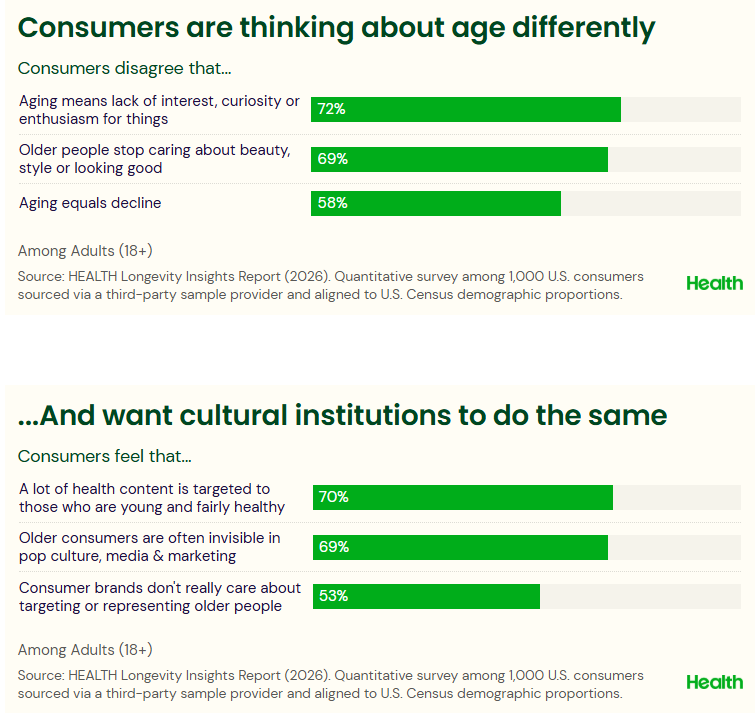
That’s why we’re broadening the conversation around longevity. Rather than focusing solely on extending lifespan or chasing the latest wellness trend, this package explores what aging well actually looks like to Americans—and the practical, evidence-based habits that can help support it.
What You’ll Find in This Package
HEALTH’s Longevity Insights Report uncovered a wealth of meaningful findings about the state of longevity in America.
You’ll get an inside look at what people really think “aging well” means (and why mental sharpness and emotional well-being rank so high on that list), why consumers are rejecting extreme longevity hacks for simpler tried-and-true habits, and what motivates people to start thinking about aging (hint: it’s not turning 40).
Also on deck: We’ll parse out the barriers that keep people from making (and sustaining) healthy aging habits, and why people with chronic conditions—all 194 million of us—need to be included in the longevity discourse, too.
We hope that this survey—and our renewed focus on aging well—keeps pushing the longevity conversation forward. Aging well isn’t about living forever or staying completely disease-free. It’s about preserving the things that make life meaningful: our health, our relationships, our independence, and our ability to participate fully in the lives we want to live.
Disclaimer
Artificial Intelligence Disclosure & Legal Disclaimer
AI Content Policy.
To provide our readers with timely and comprehensive coverage, South Florida Reporter uses artificial intelligence (AI) to assist in producing certain articles and visual content.
Articles: AI may be used to assist in research, structural drafting, or data analysis. All AI-assisted text is reviewed and edited by our team to ensure accuracy and adherence to our editorial standards.
Images: Any imagery generated or significantly altered by AI is clearly marked with a disclaimer or watermark to distinguish it from traditional photography or editorial illustrations.
General Disclaimer
The information contained in South Florida Reporter is for general information purposes only.
South Florida Reporter assumes no responsibility for errors or omissions in the contents of the Service. In no event shall South Florida Reporter be liable for any special, direct, indirect, consequential, or incidental damages or any damages whatsoever, whether in an action of contract, negligence or other tort, arising out of or in connection with the use of the Service or the contents of the Service.
The Company reserves the right to make additions, deletions, or modifications to the contents of the Service at any time without prior notice. The Company does not warrant that the Service is free of viruses or other harmful components.