Male breast cancer is a rare condition that forms in the small amount of breast tissue men possess. Most people view this disease as strictly affecting women, yet anyone born with breast tissue can develop it. For men, the average lifetime risk of receiving this diagnosis is roughly 1 in 726. Because awareness remains low and routine screenings do not exist for men, doctors often find tumors at later stages.
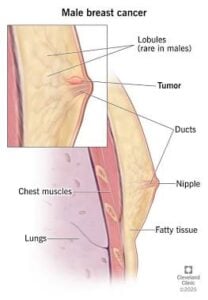
As shown in the anatomical diagram below, tumors in men typically form in the ducts right behind the nipple. Men have very little fatty tissue and almost no lobules compared to women. Consequently, a growing tumor sits very close to the skin and underlying chest muscles, allowing it to spread to nearby tissues more quickly.
Common Symptoms and Warning Signs
Men have less tissue in their chests, which actually makes feeling small lumps easier if you pay attention. However, many men delay seeing a doctor because they do not expect cancer in that area. You should schedule a medical evaluation promptly if you notice any of these physical changes:

- Painless lumps: A firm, painless mass or thickening right beneath the nipple or areola is the primary sign.
- Nipple changes: Watch for a nipple that suddenly turns inward, flattens, or pulls to one side.
- Skin alterations: Look for dimpling, puckering, redness, or scaly skin that resembles the texture of an orange peel.
- Fluid discharge: Any clear, yellow, or bloody fluid leaking from the nipple requires an immediate medical checkup.
- Swollen lymph nodes: Lumps or swelling under your armpit or around your collarbone can indicate that cells have spread.
Primary Types of Male Breast Cancer
Doctors categorize the disease based on where the abnormal cells begin growing inside the chest.
| Cancer Type | Where It Starts | Prevalence in Men |
| Invasive Ductal Carcinoma (IDC) | Begins in the milk ducts and breaks through into surrounding fatty tissue. | Accounts for at least 80% of all male cases. |
| Ductal Carcinoma In Situ (DCIS) | Abnormal cells form inside the duct lining but have not spread outward. | Makes up about 10% of cases and is highly curable. |
| Invasive Lobular Carcinoma (ILC) | Starts in the milk-producing lobules and invades deeper layers. | Very rare because male chests have very few lobules. |
| Paget Disease of the Nipple | Starts in the ducts and moves to the surface skin of the nipple. | Rare, presenting as crusted, scaly, or oozing nipple skin. |
Key Risk Factors
Several biological, genetic, and lifestyle factors can raise a man’s chances of developing malignant chest tumors. Age is a major factor, with most diagnoses occurring in men during their sixties and seventies. Genetics also play a heavy role, as roughly 20% of male patients have a close relative with the disease. Inherited mutations in the BRCA1 and BRCA2 genes significantly elevate your lifetime risk.
Furthermore, an imbalance between estrogen and androgen hormones can trigger abnormal cell growth. Conditions that increase estrogen levels include obesity, severe liver disease like cirrhosis, and Klinefelter syndrome. Previous radiation treatment directed at the chest area also increases future vulnerability. Finally, men with benign breast enlargement, known as gynecomastia, should monitor their chests closely alongside a doctor.
Survival Rates and Treatment Options
When caught early, prognosis is very encouraging. According to the American Cancer Society, the five-year relative survival rate is 95% for localized tumors confined to the breast. If the cancer spreads to regional lymph nodes, the five-year survival rate sits at 84%. If it metastasizes to distant organs, the rate drops to 20%.
Doctors tailor treatment plans based on the tumor stage and hormone receptor status:
- Surgery: Most men undergo a mastectomy to remove the breast tissue, nipple, and nearby underarm lymph nodes.
- Hormone Therapy: About 90% of male tumors are hormone receptor-positive, meaning drugs like tamoxifen can block estrogen to stop growth.
- Radiation Therapy: High-energy rays eliminate any microscopic cancer cells remaining in the chest wall after surgery.
- Chemotherapy and Targeted Therapy: Doctors use specialized medications to destroy fast-growing cells or target specific genetic proteins like HER2.
Sources Used
- Hindustan Times: https://www.hindustantimes.com/lifestyle/health/breast-cancer-awareness-month-2026-does-breast-cancer-only-affect-women-breast-cancer-specialist-reveals-everything-about-male-breast-cancer-101792394965272.html
- Medical News Today: https://www.medicalnewstoday.com/articles/179457
- Mayo Clinic: https://www.mayoclinic.org/diseases-conditions/male-breast-cancer/symptoms-causes/syc-20374740
- Male Breast Cancer Global Alliance: https://mbcglobalalliance.org/about-male-breast-cancer/
- UT MD Anderson Cancer Center: https://www.mdanderson.org/cancer-types/breast-cancer/male-breast-cancer.html
- American Cancer Society: https://www.cancer.org/cancer/types/breast-cancer-in-men.html
- Cleveland Clinic: https://my.clevelandclinic.org/health/diseases/9011-male-breast-cancer
Disclaimer
Artificial Intelligence Disclosure & Legal Disclaimer
AI Content Policy.
To provide our readers with timely and comprehensive coverage, South Florida Reporter uses artificial intelligence (AI) to assist in producing certain articles and visual content.
Articles: AI may be used to assist in research, structural drafting, or data analysis. All AI-assisted text is reviewed and edited by our team to ensure accuracy and adherence to our editorial standards.
Images: Any imagery generated or significantly altered by AI is clearly marked with a disclaimer or watermark to distinguish it from traditional photography or editorial illustrations.
General Disclaimer
The information contained in South Florida Reporter is for general information purposes only.
South Florida Reporter assumes no responsibility for errors or omissions in the contents of the Service. In no event shall South Florida Reporter be liable for any special, direct, indirect, consequential, or incidental damages or any damages whatsoever, whether in an action of contract, negligence or other tort, arising out of or in connection with the use of the Service or the contents of the Service.
The Company reserves the right to make additions, deletions, or modifications to the contents of the Service at any time without prior notice. The Company does not warrant that the Service is free of viruses or other harmful components.