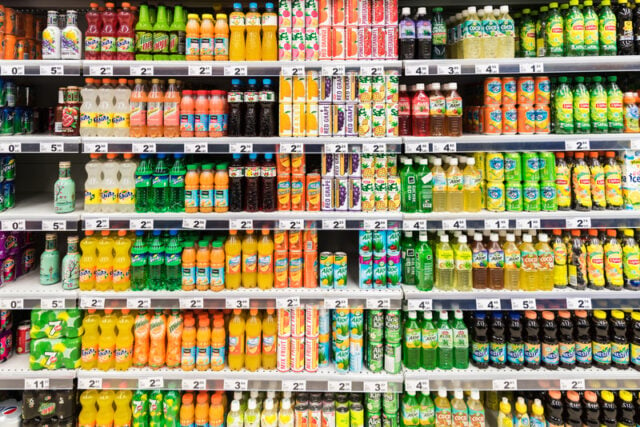
If you’ve walked down a supermarket beverage aisle lately, you might have noticed a quiet shift taking place across store shelves. According to the inaugural Power of Beverage report from FMI – The Food Industry Association, nonalcoholic drinks are now driving growth across the entire beverage category, while sales of traditional alcoholic options are experiencing a noticeable decline.
In 2025, total retail beverage sales reached $295 billion—a modest 3% increase year-over-year. However, looking closer at the category reveals a stark divide: nonalcoholic beverage sales surged by 5% to reach $221 billion, whereas alcoholic beverage sales fell by 2% to $74 billion. Overall annual market growth has slowed compared to the robust 7% rate seen between 2019 and 2024, forcing grocers to rethink how they attract and engage modern shoppers.
So, what is driving this major consumer pivot? Today’s grocery shoppers are no longer just buying beverages to quench their basic thirst; they are actively searching for functional health benefits and tailored outcomes. Influenced in part by the widespread adoption of GLP-1 weight-loss medications and a broader cultural movement toward personal wellness, people want drinks tailored to hydration, added protein, sugar reduction, digestive support, and alcohol moderation. Circana data shows energy drinks and weight-control beverages both leaped 15% year-over-year, while coffee grew 13%.
How Your Local Grocery Store is Silently Rewriting Its Playbook for the Ozempic Era

Because consumers now shop by personal health outcome rather than brand name, FMI recommends that retail grocers completely rethink how they organize their store aisles. Instead of organizing shelves by traditional product types like carbonated soft drinks, juices, or teas, grocers could group items by “need states”—such as focus, hydration, muscle recovery, or gut health. Explicit functional shelf tags like “electrolytes for hydration” or “high protein to keep you full” help shoppers quickly identify solutions. FMI notes that drinks delivering targeted health benefits are far less likely to suffer from consumer trading-down, opening lucrative growth avenues for both brand names and private labels.
Digital channels are also transforming how consumers buy their favorite drinks. Online beverage retail currently commands 3% of total sales, while social media platforms like TikTok generated $46 million in beverage sales in the final quarter of 2025 alone. To capture these evolving habits, grocers must align their physical store layout with interactive digital search filters, ensuring a seamless, health-focused experience across every touchpoint.
Sources Used
- Food Dive: Should grocers try reclassifying their beverage aisles? (Published August 6, 2026)
- FMI – The Food Industry Association: Power of Beverage Report (2026)
Disclaimer
Artificial Intelligence Disclosure & Legal Disclaimer
AI Content Policy.
To provide our readers with timely and comprehensive coverage, South Florida Reporter uses artificial intelligence (AI) to assist in producing certain articles and visual content.
Articles: AI may be used to assist in research, structural drafting, or data analysis. All AI-assisted text is reviewed and edited by our team to ensure accuracy and adherence to our editorial standards.
Images: Any imagery generated or significantly altered by AI is clearly marked with a disclaimer or watermark to distinguish it from traditional photography or editorial illustrations.
General Disclaimer
The information contained in South Florida Reporter is for general information purposes only.
South Florida Reporter assumes no responsibility for errors or omissions in the contents of the Service. In no event shall South Florida Reporter be liable for any special, direct, indirect, consequential, or incidental damages or any damages whatsoever, whether in an action of contract, negligence or other tort, arising out of or in connection with the use of the Service or the contents of the Service.
The Company reserves the right to make additions, deletions, or modifications to the contents of the Service at any time without prior notice. The Company does not warrant that the Service is free of viruses or other harmful components.