TEHRAN / WASHINGTON D.C. — January 11, 2026 — The Islamic Republic of Iran is currently gripped by its most existential crisis in decades as nationwide protests enter their third week. What began on December 28, 2025, as a localized outcry over the collapse of the Iranian rial has transformed into a sweeping, revolutionary movement challenging the very foundations of the theocratic regime. As of Sunday, human rights organizations report a staggering escalation in state violence, with hundreds confirmed dead and thousands more swept into a judicial system that has begun labeling protesters as “enemies of God.”
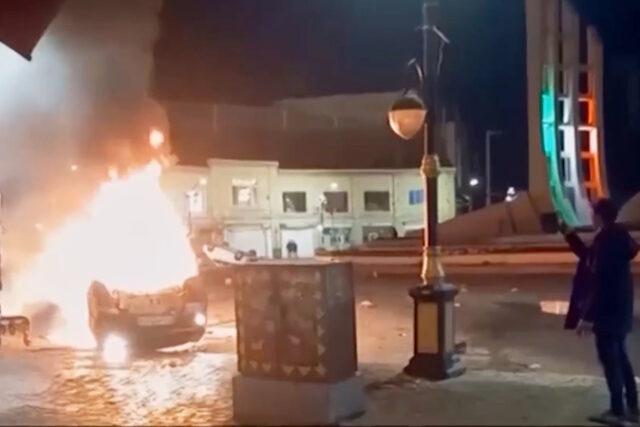
Iran decontrations video - courtesy of CBC
The Human Cost: Deaths and Detentions
According to the Human Rights Activists News Agency (HRANA) and other monitors, the death toll from the crackdown has now reached at least 538 people, including dozens of women and children. The Center for Human Rights in Iran (CHRI) has documented specific atrocities in provinces like Lorestan and Ilam, where security forces reportedly opened fire on unarmed crowds with live ammunition and metal pellets.
The scale of the arrests is equally vast. Rights groups estimate that more than 10,600 individuals have been detained. Reports from inside the country suggest that hospitals in Tehran and Mashhad are being raided by the Islamic Revolutionary Guard Corps (IRGC) to seize injured protesters directly from their beds.
The Regime’s Response: “Enemies of God”
Tehran has signaled that it has no intention of backing down. The country’s Prosecutor General, Mohammad Movahedi Azad, recently declared all participants in the unrest to be mohareb (enemies of God), a charge that carries the death penalty under Iranian law.

In a televised address on Sunday, Parliament Speaker Mohammad Baagher Qalibaf struck a defiant tone, warning that if the United States uses force to intervene, U.S. military bases and personnel in the region will be treated as “legitimate targets.” The regime continues to frame the protests as a foreign-led “terrorist” plot, comparing the demonstrators to ISIS in an attempt to justify the use of lethal military force by the Artesh (conventional army) and the IRGC.
The Trump Wildcard: “Locked and Loaded”
In Washington, President Donald Trump has broken with the traditional diplomatic caution of his predecessors, explicitly pledging his support for the “freedom-seeking” people of Iran. Over the weekend, the White House confirmed that the President has been briefed on a range of military options should the killing of protesters continue.
“Iran is looking at FREEDOM, perhaps like never before,” Trump posted on Truth Social. “The USA stands ready to help!!!”
The administration’s “red line” appears to be the mass slaughter of peaceful civilians. During a briefing at the White House, Trump warned: “We’ll be hitting them very hard where it hurts… and that doesn’t mean boots on the ground, but it means hitting them very, very hard where it hurts.”
Analysts suggest that the administration is considering several paths:
- Targeted Airstrikes: Options include strikes on IRGC command centers, police barracks, or government infrastructure used for repression.
- Cyber Operations: Utilizing U.S. cyber capabilities to dismantle the “National Information Network” and bypass the regime’s internet censorship.
- Asymmetric Pressure: Increasing maritime interdictions of Iranian oil vessels to further starve the regime of currency.
Critics and regional partners, including Qatar, have urged restraint, fearing that a U.S. military strike could unify the Iranian elite and allow the regime to wrap itself in the flag of nationalism. However, the Trump administration has already shown a willingness to use force; in June 2025, the U.S. conducted strikes on three Iranian nuclear facilities, a move that significantly heightened tensions before the current unrest began.
An Uncertain Future
As the sun sets on Tehran this Sunday, the atmosphere remains electric and precarious. The exiled Crown Prince, Reza Pahlavi, has called for a “final push” to seize government centers, while the Supreme Leader, Ayatollah Ali Khamenei, has signaled a coming “decisive confrontation.”
With the rial trading at over 1.4 million to $1 and the streets filled with a generation that feels it has nothing left to lose, the standoff between the Iranian people, their government, and the United States has reached a boiling point. Whether the Trump administration will follow through on its “locked and loaded” rhetoric remains the most consequential question for the Middle East in 2026.
Sources & Links
- The Guardian: Iran warns US against attack as protest death toll reportedly soars
- Iran Human Rights (IHRNGO): Mass Killing of Protesters in Iran: The International Community Must Stop This International Crime
- PBS News / Associated Press: Death toll in crackdown on protests in Iran spikes to at least 538, activists say
- CBS News: Trump briefed on new options for military strikes in Iran, source says
- Institute for the Study of War (ISW): Iran Update, January 10, 2026
- Amnesty International: Iran: Deaths and injuries rise amid authorities’ renewed cycle of protest bloodshed
- Center for Human Rights in Iran (CHRI): Iranian Authorities Intensify Crackdown on Protests
Disclaimer
Artificial Intelligence Disclosure & Legal Disclaimer
AI Content Policy.
To provide our readers with timely and comprehensive coverage, South Florida Reporter uses artificial intelligence (AI) to assist in producing certain articles and visual content.
Articles: AI may be used to assist in research, structural drafting, or data analysis. All AI-assisted text is reviewed and edited by our team to ensure accuracy and adherence to our editorial standards.
Images: Any imagery generated or significantly altered by AI is clearly marked with a disclaimer or watermark to distinguish it from traditional photography or editorial illustrations.
General Disclaimer
The information contained in South Florida Reporter is for general information purposes only.
South Florida Reporter assumes no responsibility for errors or omissions in the contents of the Service. In no event shall South Florida Reporter be liable for any special, direct, indirect, consequential, or incidental damages or any damages whatsoever, whether in an action of contract, negligence or other tort, arising out of or in connection with the use of the Service or the contents of the Service.
The Company reserves the right to make additions, deletions, or modifications to the contents of the Service at any time without prior notice. The Company does not warrant that the Service is free of viruses or other harmful components.