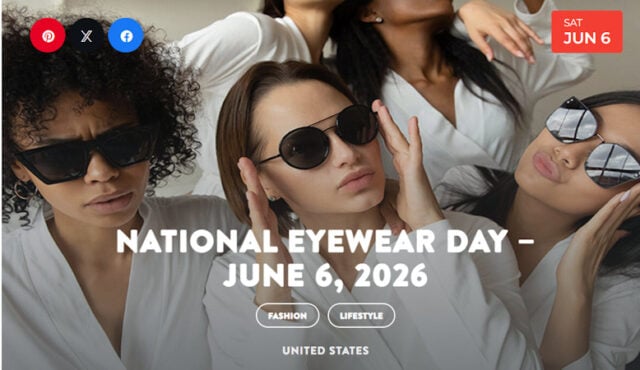
On June 6th we can see clearly and look good doing it as we celebrate National Eyewear Day.
- 1000 AD – The first vision aid was invented. It was called a reading stone – a small glass sphere that was placed on top of small letters and texts to magnify them for easy reading.
- 12th Century – Smoky quartz was used in the 12th century in China as a form of sunglasses
- 1286 – Artisans in northern Italy produce the first recognizable wearable eyeglasses, with convex lenses mounted in frames held by hand or balanced on the nose to aid farsighted monks and scholars.
- 1352 – One of the earliest pictures of someone wearing glasses dates to about 1352. It is a portrait of Cardinal Hugh de Provence reading.
- 1452 – It wasn’t until the invention of the printing press in 1452 and an increase in literacy that the demand for eyewear grew.
- 1700s – Early Spanish eyeglass manufacturers fixed ribbons to the lenses and looped the ribbons on the wearer’s ears to keep them from constantly slipping down the nose. This led to the eventual creation of modern temple arms that allowed glasses to rest comfortably on the bridge of the nose and on top of the ears without slipping in the 1700s.
- 18th Century – The first frames were made of wood, copper, leather, and bone. Spanish inventors attached ribbons to glasses simply to keep them from slipping down the nose. The modern style that enables glasses to rest on the bridge of the nose was created in the eighteenth century.
- 18th Century – Monocles were developed in the late 18th century and were worn around the neck. Interestingly, monocles were mainly worn by aristocrats.
- 1727 – Edward Scarlett designed the glasses shape that we know today in 1727, but they were not popularized until 2 centuries later.
- 1784 – Seeking relief from switching between distance and reading spectacles, Benjamin Franklin devised bifocals by combining lenses of two different powers in a single frame, an idea that spread gradually through the 19th century.
- 19th Century – Pince-nez were invented in the late 19th century. These eyeglasses were held in place by a spring clip between the lenses rather than by frames.
- 1885 – Colored lenses had existed for centuries, but by the late 19th century, manufacturers began selling smoked and tinted spectacles as practical protection from bright light, especially for outdoor workers and travelers.
- 1914 – Optometrists felt people with impaired vision should be prohibited from driving cars.
- 1929 – Sunglasses are a kind of dark eyeglasses that became popular in America around 1929. Eventually, sunglasses became an essential fashion item still in use today.
- 1930s – Ray-Ban is also known as “Aviators.” First developed for pilots in the 1930s, Ray-Ban eyeglasses are now especially popular with celebrities.
- 1936 – Polaroid sunglasses offering protection from UV rays were invented. Before then, tinted sunglasses only reduced glare from sunlight entering the eye.
- 1948 – Kevin Tuohy files a U.S. patent for a small corneal contact lens made of plastic that covers only the cornea rather than the entire eye surface, paving the way for more comfortable, mass‑produced contact lenses.
- 1953 – First appearing in 1953 and worn by countless celebrities, from James Dean to Andy Warhol to Tom Cruise, the Ray-Ban Wayfarer is reported to be the best-selling style in history.
- 1959 – The French company Essel (later part of Essilor) brings to market CR‑39 plastic lenses, which are much lighter and more impact-resistant than traditional glass, transforming everyday comfort and expanding frame design options
- 1960s – Soft contact lenses are made of soft, flexible plastics that allow oxygen to pass through to the cornea.
- 1981 – Congress expands Medicare to include coverage for certain types of optometry.
- 1990s – Advances in materials and lens design lead to thinner high‑index lenses, widespread use of progressive (no‑line bifocal) designs, and routine incorporation of UV‑blocking and anti‑reflective coatings in prescription eyewear.
- 1998 – Oklahoma became the first state to approve the use of laser technology for optometrists.
- 2012 – Researchers determined that people who wear glasses may be smarter.
- Spectacles have existed for about seven centuries, but early versions were only worn by monks and scholars.
- Singer and songwriter Sir Elton John’s love for wacky and unique glasses is no secret. His personal glasses collection boasts more than 25,000 pairs and continues to grow.
- Before Tom Cruise and Top Gun, Ray-Ban aviator sunglasses were originally designed for US military pilots to protect their eyes while flying, hence the name ‘aviator’.
- Sunglasses were “invented” 2,000 years ago. The Inuit (eskimos) created snow goggles from animal bone, leather and wood. There were small slits that allowed only the tiniest of light through. This shielded the eyes from the blinding glare of sunlight reflected off the snow.
- Italian eyeglass conglomerate Luxottica owns nearly every popular sunglasses brand sold worldwide, as well as Sunglass Hut.
- In the United States, someone loses, breaks, or sits on a pair of sunglasses every 14 minutes.
- According to studies, 25 percent of the world’s population wears prescription glasses or corrective lenses.
- In the United States of America, more women than men wear contact lenses.
- According to the Vision Council of America, about 85% of the US’s population wears sunglasses.
- Celebs & their visionary eyewear:
- Sir Elton has one of the latest glasses collections and can be seen again in the summer 2019 movie “Rocketman.”
- Karle Kloss looks extra glam in tortoiseshell glasses. Of course, being a supermodel doesn’t hurt.
- Zooey Deschanel “New Girl” Jess Day’s not-quite-perfectly-square frames have set the prime time standard for cool eyewear.
- Andy Samberg “Brooklyn Nine-Nine” star (and “SNL” standout) Andy Samberg frequently shows up wearing glasses during guest appearances on TV.
- Joseph Gordon-Levitt This actor already personifies a “smart guy” look, but the glasses push him to a whole new level.
Sources:

American Sunglasses
Disclaimer
Artificial Intelligence Disclosure & Legal Disclaimer
AI Content Policy.
To provide our readers with timely and comprehensive coverage, South Florida Reporter uses artificial intelligence (AI) to assist in producing certain articles and visual content.
Articles: AI may be used to assist in research, structural drafting, or data analysis. All AI-assisted text is reviewed and edited by our team to ensure accuracy and adherence to our editorial standards.
Images: Any imagery generated or significantly altered by AI is clearly marked with a disclaimer or watermark to distinguish it from traditional photography or editorial illustrations.
General Disclaimer
The information contained in South Florida Reporter is for general information purposes only.
South Florida Reporter assumes no responsibility for errors or omissions in the contents of the Service. In no event shall South Florida Reporter be liable for any special, direct, indirect, consequential, or incidental damages or any damages whatsoever, whether in an action of contract, negligence or other tort, arising out of or in connection with the use of the Service or the contents of the Service.
The Company reserves the right to make additions, deletions, or modifications to the contents of the Service at any time without prior notice. The Company does not warrant that the Service is free of viruses or other harmful components.