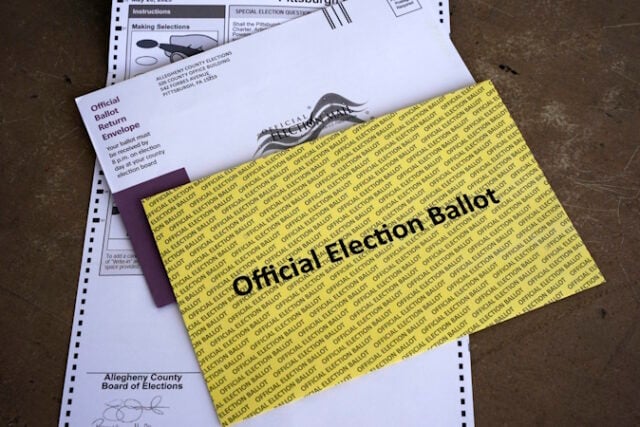
Every election season, tens of millions of voters across the United States cast their ballots without ever setting foot in a traditional polling place. Instead, they rely on a red, white, and blue mail truck to deliver their vote. What started decades ago as a niche alternative for absentee voters has transformed into a cornerstone of American democracy. However, as mail voting expands, so do questions about how the U.S. Postal Service (USPS) handles this crucial responsibility.
The Scale of Mail Voting in America
According to a report by Elena Patel for the Brookings Institution, the share of Americans voting by mail grew from just 7.8% in 1996 to 21% in 2016, spiked to 43% during the 2020 pandemic, and settled around 29% in 2024. During that election alone, the Postal Service carried roughly 99 million ballots to and from voters.
While states like Oregon and Washington see over 95% of voters submitting ballots by mail, other states rely almost entirely on in-person voting. This wide gap highlights a key reality: USPS operates as an infrastructure carrier rather than an election oversight body.
A Carrier, Not an Election Administrator
When election season arrives, many people assume the Postal Service oversees the mail-in voting process. In reality, the agency’s mandate is far more specific. Brookings highlights that “the Postal Service is a carrier, not an election administrator.”

As USPS plainly stated in a post-election summary quoted by Brookings, “The Postal Service’s role is clear: We deliver the mail.” The agency does not establish state election deadlines, design ballot envelopes, determine voter eligibility, or count votes. Those decisions rest entirely with state legislatures and roughly 8,000 local election boards across the country.
The Postmark Paradox and Network Overhauls
One of the growing challenges facing mail voting involves postmarking. In 17 states and the District of Columbia, a ballot arriving after Election Day is counted as long as it bears a timely postmark. However, ongoing USPS network restructuring has changed how mail moves. Ballots are increasingly routed to regional processing facilities, creating potential delays between when a voter drops off a ballot and when it actually gets postmarked.
Brookings notes that in late 2025, USPS updated its Domestic Mail Manual to formally acknowledge that a postmark’s date “does not inherently or necessarily align with the date on which the Postal Service first accepted possession of the mailpiece.” This disconnect places extra pressure on voters to mail their ballots well in advance of deadlines.
Navigating Operational Pressures
To ensure smooth delivery, USPS executes extraordinary operational measures during election periods. These include daily facility sweeps, Sunday processing runs, and expedited ballot transit. Yet, as financial constraints and network overhauls continue, maintaining peak efficiency requires careful coordination between local election officials and postal operations. Understanding this distinction ensures voters can navigate postmark rules and deadlines effectively.
Sources Used
- Brookings Institution — Delivering the vote: How 4 pressures are testing the Postal Service’s role in American elections
Disclaimer
Artificial Intelligence Disclosure & Legal Disclaimer
AI Content Policy.
To provide our readers with timely and comprehensive coverage, South Florida Reporter uses artificial intelligence (AI) to assist in producing certain articles and visual content.
Articles: AI may be used to assist in research, structural drafting, or data analysis. All AI-assisted text is reviewed and edited by our team to ensure accuracy and adherence to our editorial standards.
Images: Any imagery generated or significantly altered by AI is clearly marked with a disclaimer or watermark to distinguish it from traditional photography or editorial illustrations.
General Disclaimer
The information contained in South Florida Reporter is for general information purposes only.
South Florida Reporter assumes no responsibility for errors or omissions in the contents of the Service. In no event shall South Florida Reporter be liable for any special, direct, indirect, consequential, or incidental damages or any damages whatsoever, whether in an action of contract, negligence or other tort, arising out of or in connection with the use of the Service or the contents of the Service.
The Company reserves the right to make additions, deletions, or modifications to the contents of the Service at any time without prior notice. The Company does not warrant that the Service is free of viruses or other harmful components.