The management, segregation, and ultimate disposal of controlled substances in hospitals is subject to rigorous federal, state, and environmental statutory oversight. Improper disposal creates severe regulatory liability under federal law, introduces acute risks of drug diversion, and presents grave environmental hazards.
To satisfy legal mandates, hospital compliance officers, pharmacy directors, and clinical staff must maintain an unbroken chain of custody, enforce strict physical security measures, and apply distinct protocols based on whether the material constitutes unsold pharmacy inventory or patient-administered clinical wastage.
Hospital controlled-substance disposal follows a strict four-step workflow:
- Segregation: Clinical staff and pharmacy personnel immediately segregate expired, damaged, or leftover medications from active supplies to prevent accidental administration or diversion.
- Secure Holding: Unused inventory is locked in pharmacy safes or automated dispensing cabinets under dual-lock access, while partially used medication waste is held in dedicated, tamper-resistant receptacles.
- Witnessed Neutralization or Transfer: Medications are either deactivated on-site using chemical neutralization, processed via technical destruction equipment, or shipped off-site to licensed third-party reverse distributors.
- Documented Logging: Every disposal action requires dual sign-offs, detailed electronic logs, and formal regulatory filings maintained for audits.
The Safest Way to Destroy Controlled Substances in a Hospital
To execute these steps without disrupting clinical workflows or exposing staff to security threats, hospitals rely on established technical destruction methods and specialized compliance partners. Federal rules require that controlled substances undergoing on-site destruction be rendered “non-retrievable.” This means permanently altering their chemical state so they cannot be recovered or reconstituted.

Healthcare institutions meet this standard through specialized on-site drug destruction providers, such as the DEA-licensed company GAIACA, which perforates packaging, then pulverizes and chemically neutralizes the contents. Alternatively, hospitals send the drugs for high-temperature thermal incineration.
An on-site approach allows facilities to process controlled substances immediately, significantly reducing the risks associated with transporting or stockpiling high-risk medications. Throughout the process, technicians verify materials against hospital ledgers and issue transfer manifests alongside Certificates of Destruction, giving compliance teams the documentation required during federal inspections.
How Hospitals Dispose of Bedside Wastage
While pharmacy departments manage bulk inventory, clinical staff encounter controlled substances daily in the form of partial doses or leftover preparations. This is known as pharmaceutical wastage.
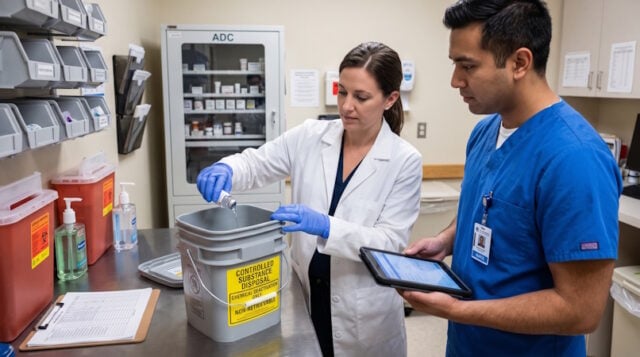
When a nurse administers a partial dose of a controlled substance (e.g., 2 mg from a 5 mg vial of morphine), the remaining amount cannot be returned to stock. The clinician must complete the bedside disposal protocol:
- Dual-Person Witnessing: A second licensed healthcare professional must physically witness the destruction of the unused portion.
- Chemical Neutralization: The waste is disposed of in dedicated, tamper-proof neutralization containers located in medication rooms. These receptacles contain active chemical agents (such as activated carbon) that denature the drug upon contact.
- Immediate Electronic Sign-off: Both clinicians log in to the hospital’s Automated Dispensing Cabinet (ADC) or electronic health record (EHR) system to record the exact volume wasted, time, and witness co-signature.
Inventory vs Wastage Classification
Federal law distinguishes sharply between unused pharmacy inventory and clinical wastage generated during patient care. Applying the incorrect regulatory workflow can lead to federal enforcement actions, civil fines, or revocation of DEA registration.
| Category | Primary Origin | Governing Regulation | Required Documentation | Destruction Pathway |
| Controlled-Substance Inventory | Unused, expired, or damaged pharmacy stock | 21 CFR Part 1317 | DEA Form 41 (On-site) or DEA Form 222 (Reverse Distribution) | Registered Reverse Distributor or Certified On-Site Non-Retrievable System |
| Pharmaceutical Wastage | Leftover IV solutions, partial vials, or cancelled patient doses | 21 CFR § 1304.22 | Real-time ADC / EHR electronic waste logs with dual signatures | Chemical neutralization receptacles in clinical units |
1. Inventory (Controlled-Substance Inventory)
Stock remaining under the primary control of the hospital pharmacy falls directly under DEA destruction protocols (21 CFR Part 1317).
- Documentation: Formal destruction requires executing DEA Form 41 (Registrant Record of Controlled Substances Destroyed).
- Schedule I and II Transfer: Transferring Schedule I or II substances outside the facility requires executing DEA Form 222 or its electronic equivalent via the DEA Controlled Substance Ordering System (CSOS).
- Audit Requirements: Inventory records must be kept separate from patient charts and reconciled continuously through physical counts and electronic ledger verification.
2. Pharmaceutical Wastage
Partially administered medications or unused portions prepared for a specific patient are classified as clinical wastage.
- Regulatory Distinction: The DEA explicitly clarifies that partially administered wastage does not require a DEA Form 41 filing.
- Execution Protocols: Under 21 CFR § 1304.22, clinical wastage is documented in internal hospital logs. This requires immediate logging in ADCs or clinical registers along with the physical co-signature of a witnessing healthcare professional.
Authorized Disposal Pathways for Bulk Inventory
Healthcare institutions managing bulk or expired controlled-substance inventory must select an authorized statutory pathway outlined under the Controlled Substance Disposal Act of 2010 and codified in 21 CFR § 1317.90.
Pathway A: On-Site Destruction (The Non-Retrievable Standard)
To destroy controlled substances on-site, a facility must utilize technology that meets the DEA’s strict “non-retrievable” standard.
Statutory Definition (21 CFR § 1300.05): “Non-retrievable means, for the purpose of destruction or disposal, the condition or state to which a controlled substance shall be rendered following the physical destruction thereof that permanently alters that controlled substance’s physical or chemical state through irreversible means and thereby renders the controlled substance unavailable and unusable for all practical purposes.”
Flushing, diluting in water, or placing whole pills into standard waste bins does not meet the non-retrievable standard. To achieve full compliance, hospitals use specialized chemical digestion systems, high-temperature thermal incineration, or mechanical pulverization combined with chemical neutralization.
- Witnessing Requirements: On-site destruction must be conducted by two authorized employees of the registrant (21 CFR § 1317.95).
- Record Retention: Execution records, including DEA Form 41 and technical Certificates of Destruction, must be securely stored for a minimum of two years and made readily available for official inspection (21 CFR § 1304.04).
Pathway B: Reverse Distribution
Transferring inventory to a DEA-registered reverse distributor (21 CFR § 1317.15) shifts the burden of physical destruction to a licensed secondary entity.
- Transfer Integrity: Transferring Schedule I and II substances requires a completed DEA Form 222 issued by the reverse distributor to the hospital. Schedule III through V substances require formal invoice records detailing drug names, dosage forms, strengths, quantities, and transfer dates.
- Statutory Destruction Window: Under 21 CFR § 1317.15(d), a DEA-registered reverse distributor must destroy, or cause the destruction of, all received controlled substances within 30 calendar days of receipt.
- In-Transit Security: Packages must be shipped via common or contract carrier using secure, tamper-evident packaging sent directly to the reverse distributor’s registered physical location (21 CFR § 1301.74).
Environmental Restrictions and EPA Mandates
Hospital disposal protocols must comply with environmental protection laws alongside drug enforcement regulations. Improper disposal of controlled substances can trigger significant legal liabilities from both the DEA and the EPA.
- EPA Sewer Ban (40 CFR Part 266 Subpart P): Federal regulations prohibit the flushing, pouring, or “sewering” of hazardous waste pharmaceuticals down drains or toilets across all healthcare facilities.
- Resource Conservation and Recovery Act (RCRA – 40 CFR Part 261): Controlled substances containing hazardous ingredients (e.g., chloral hydrate or specific preservative agents) must be managed as RCRA hazardous waste, requiring dedicated accumulation containers and licensed hazardous waste haulers.
- DEA Physical Security Standards (21 CFR § 1301.71): Placing controlled substances into standard solid municipal trash is strictly illegal due to the risk of theft, interception, and accidental exposure.
Compliant Protocols Help Hospitals Dispose of Drugs Safely
Hospital controlled-substance disposal requires institutional efficiency as well as uncompromising legal and environmental compliance. Whether managing bulk pharmacy inventory under DEA Part 1317 or handling routine bedside wastage under section 1304.22, healthcare facilities face an intricate web of statutory obligations.
Successfully fulfilling these mandates relies on clear operational distinctions, strict dual-witnessing protocols, and the deployment of authorized non-retrievable destruction technologies that eliminate opportunities for drug diversion.
Disclaimer
Artificial Intelligence Disclosure & Legal Disclaimer
AI Content Policy.
To provide our readers with timely and comprehensive coverage, South Florida Reporter uses artificial intelligence (AI) to assist in producing certain articles and visual content.
Articles: AI may be used to assist in research, structural drafting, or data analysis. All AI-assisted text is reviewed and edited by our team to ensure accuracy and adherence to our editorial standards.
Images: Any imagery generated or significantly altered by AI is clearly marked with a disclaimer or watermark to distinguish it from traditional photography or editorial illustrations.
General Disclaimer
The information contained in South Florida Reporter is for general information purposes only.
South Florida Reporter assumes no responsibility for errors or omissions in the contents of the Service. In no event shall South Florida Reporter be liable for any special, direct, indirect, consequential, or incidental damages or any damages whatsoever, whether in an action of contract, negligence or other tort, arising out of or in connection with the use of the Service or the contents of the Service.
The Company reserves the right to make additions, deletions, or modifications to the contents of the Service at any time without prior notice. The Company does not warrant that the Service is free of viruses or other harmful components.