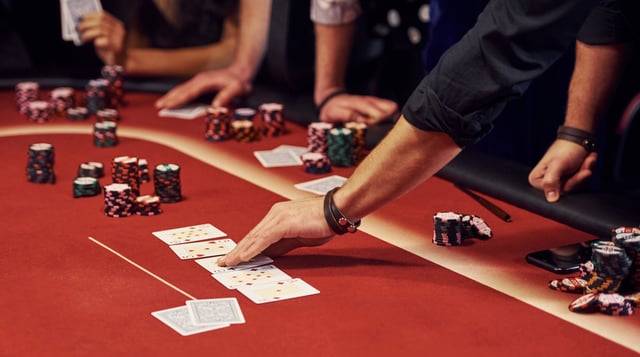
Gambling and politics have always kept close company in the American South. The riverboats that worked the Mississippi in the 1830s carried card sharps and legislators in roughly equal measure, and it was rarely clear which class did the greater damage. Two centuries on, the instruments have changed (the campaign filing has replaced the marked deck), but the arrangement itself has proved remarkably durable.
A Modest Cheque from Hallandale
On 28 February 2026, the Big Easy Casino, a racino in Hallandale Beach, Florida, sent $10,000 to the gubernatorial campaign of Tommy Tuberville. The sum was small by the standards of modern politics; the sender was not. The Big Easy belongs to Fontainebleau Development, and Fontainebleau belongs, in the sense that matters, to Jeffrey Soffer, the Florida billionaire whose name hangs over a resort on Collins Avenue and a tower on the Las Vegas Strip.
The donation was perfectly legal. It was also, according to AL.com, the first contribution from a casino owner to an Alabama campaign since 2014. A month later VGW, the Australian-founded sweepstakes operator behind Chumba Casino, added $30,000 of its own; by September it had added a further $100,000. Gambling Insider tallied the spring filings with a certain dry relish: $40,000 from gambling interests in barely two months, to a candidate who professes no particular appetite for gambling.
Tuberville, the football coach turned senator, won the Republican nomination in May and faces Doug Jones on 3 November. His position on the question is studiously agnostic. Gambling, he says, is a matter for the legislature; the voters might be consulted by referendum; he would merely inform the public. It is the stance of a man who would prefer not to be photographed holding the dice.

The Long Siege of Miami Beach
Why, one might ask, should a Florida casino owner care about Alabama’s governorship? Part of the answer lies some six hundred miles to the southeast.
Miami Beach banned casino gambling in 2017 and has defended the prohibition ever since with the zeal of a convert. Soffer has spent years probing its walls. In early 2024 a pair of bills in Tallahassee, SB 1054 and HB 1127, would have allowed the holder of a gaming permit to move it to a new site within 30 miles. The Big Easy sits roughly 20 miles from the Fontainebleau. Nobody needed a slide rule.
Entities connected to Soffer had by then given more than $300,000 to committees supporting state legislators, nine of them Miami-Dade Republicans, and Soffer himself had put $1 million into a super PAC behind Ron DeSantis’s presidential ambitions. Against him stood Ken Griffin, the hedge fund billionaire who had moved Citadel to Miami, and who declared in the Herald that casinos were a bad bet for South Florida. The city accepted the loan of a private aeroplane to fly more than a hundred officials and residents to the capital in protest. The bill vanished from a committee agenda within hours of appearing on it. The chairman allowed that the matter might return, perhaps the following year.
It has returned, though in different clothes. In February 2026 a representative from Doral attached an amendment to a land-use bill that would strip city boards of authority over variances at “large destination resorts”, hotels of more than 500 rooms, a definition that fits the Fontainebleau’s 1,504 rather snugly. The immediate subject this time was waterslides, not roulette. But the principle at stake, whether Miami Beach or Tallahassee decides what happens on Soffer’s stretch of sand, is the very one on which any future casino would turn.
Alabama’s Peculiar Abstinence
Alabama is a curious place to go looking for friends of the gaming table. It is one of five states without a lottery. Its only casinos belong to the Poarch Band of Creek Indians, who operate three under federal law and would rather the number stayed at three. In 2024 a package that would have brought a lottery, commercial gaming and tribal compacts fell a single vote short in the state Senate; later attempts fared worse. The evangelical churches remain the most dependable opponents, and they have rarely lost.
And yet the money flows in, from every point of the compass. A super PAC funded by DraftKings and FanDuel spent more than $9.3 million in this year’s Republican legislative primaries. VGW’s Alabama giving has reached roughly $351,000, split evenly across both parties. Their interests don’t align: licensed operators want their sweepstakes rivals outlawed, and sweepstakes companies want to remain the only game in a state that offers no other. What they share is a conviction that the next governor, whatever he says now, will be in the room when the matter is finally settled.
What a Wager Buys
It would be too simple to read the Big Easy cheque as a bribe, or VGW’s generosity as a conspiracy. Political giving of this kind is closer to an insurance premium: a modest sum paid against the possibility that the rules will one day be rewritten, and that one would like to be remembered when they are.
For the sweepstakes industry, the stakes are more pressing. By one count, thirteen states now prohibit the dual-currency model by statute. Players who still use online sweepstakes casinos like Titan Treasure do so on a shrinking map, and the companies behind them understand that a hostile governor in a single southern state can do more damage than a dozen lawsuits.
Soffer’s wager is longer and stranger: a Florida developer funding an Alabama campaign while fighting a Florida city over a Florida pool deck. The connective tissue is not geography but a belief, common among men who build casinos, that permission is a commodity, and that it is cheapest when bought early.
Whether Alabama ever sells it remains to be seen. Tuberville is heavily favoured in November. The churches will be watching, and so, one suspects, will the tribes. Miami Beach, meanwhile, keeps its ban and leaves its waterslides undecided. History suggests the house rarely loses. It merely waits.
Disclaimer
Artificial Intelligence Disclosure & Legal Disclaimer
AI Content Policy.
To provide our readers with timely and comprehensive coverage, South Florida Reporter uses artificial intelligence (AI) to assist in producing certain articles and visual content.
Articles: AI may be used to assist in research, structural drafting, or data analysis. All AI-assisted text is reviewed and edited by our team to ensure accuracy and adherence to our editorial standards.
Images: Any imagery generated or significantly altered by AI is clearly marked with a disclaimer or watermark to distinguish it from traditional photography or editorial illustrations.
General Disclaimer
The information contained in South Florida Reporter is for general information purposes only.
South Florida Reporter assumes no responsibility for errors or omissions in the contents of the Service. In no event shall South Florida Reporter be liable for any special, direct, indirect, consequential, or incidental damages or any damages whatsoever, whether in an action of contract, negligence or other tort, arising out of or in connection with the use of the Service or the contents of the Service.
The Company reserves the right to make additions, deletions, or modifications to the contents of the Service at any time without prior notice. The Company does not warrant that the Service is free of viruses or other harmful components.