Why Fake Shopping Carts Are Taking Over the Web
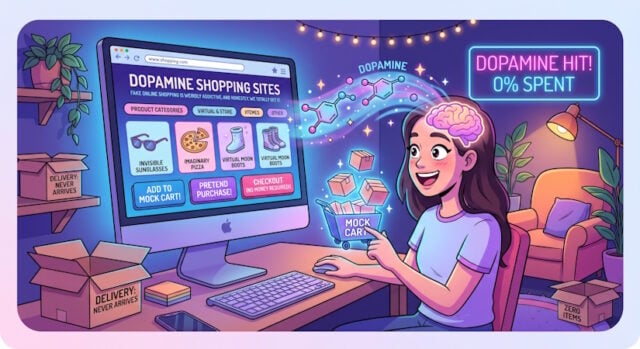
Have you ever added ten expensive items to your cart just to feel something? You are definitely not alone. A bizarre new web trend is taking the online world by storm. People everywhere are flocking to quirky platforms known as “dopamine sites.” These clever websites let you browse clothes, fill carts, and hit checkout. Here is the hilarious catch: you spend zero dollars, and nothing ever ships. It is pure retail therapy without any of the financial hangover.
The viral movement kicked off in South Korea earlier this year. A creative engineering student named Park Seohyun built a parody website called “Food Never Arrives.” Users order imaginary takeout meals and watch a fictional delivery driver navigate a digital map. Crucially, the app calculates how much money and calories users avoid spending. Park told The New York Times that people quickly shared the experiment across social media. She noted that users debated “whether it actually helped them resist ordering food.” What started as a lighthearted joke soon evolved into an international lifestyle phenomenon.
Dozens of copycat platforms popped up almost overnight worldwide. One popular clone, “FakeHaul,” mimics the frantic energy of budget shopping portals. You can pile twenty pairs of wild sunglasses into your basket without risking rent money. Meanwhile, two software developers in India launched a sister project named “Food Never Comes.” Their simulator provides actual dinner recipes alongside orders that never arrive. As The New York Times reported, their creation racked up millions of visits within months. Other creators even built simulated rooftop lounges for digital smoke breaks. Visitors watch animated cigarettes burn down while chatting harmlessly with strangers.
Why are so many sane adults obsessed with pretend shopping? Brain science offers a fascinating explanation. Our nervous system releases dopamine during the anticipation of a reward, not during actual ownership. The New York Times quoted Ravi Dhar, a consumer insights expert at Yale University. Dhar pointed out that the “element of looking forward brings a lot of the pleasure.” He explained that shoppers often crash emotionally right after swiping their credit cards. Dopamine sites capture that initial thrill while completely bypassing post-purchase remorse. You enjoy the exciting hunt without draining your hard-earned bank balance.

Still, behavioral economists urge caution before making fake checkouts a daily habit. Simulated habits might not cure runaway impulse shopping for everyone. Researcher Lingguo Xu warned in The New York Times that simulated habits could trigger “stronger cravings.” If your brain expects tangible deliveries, clicking pretend buttons could leave you feeling empty. Yet for younger generations squeezed by rising living costs, these games feel oddly therapeutic. They turn stressful budgeting blues into playful digital comedy.
Next time midnight boredom strikes, step away from your actual shopping apps. Try loading up a pretend cart with luxury watches or extra-large pizzas instead. Your brain will still enjoy the fun chemical rush. Best of all, your checking balance will stay completely safe until morning. In an economy filled with stubborn inflation, that feels like a massive win. You get to play the shopping game on your own terms.
Sources Used
- The New York Times: https://www.nytimes.com/2026/09/11/world/asia/dopamine-sites-popularity.html
- Futurism: https://futurism.com/future-society/bizarre-websites-dopamine-brain
- Mashable: https://mashable.com/life/south-korea-dopamine-sites-fake-shopping
Disclaimer
Artificial Intelligence Disclosure & Legal Disclaimer
AI Content Policy.
To provide our readers with timely and comprehensive coverage, South Florida Reporter uses artificial intelligence (AI) to assist in producing certain articles and visual content.
Articles: AI may be used to assist in research, structural drafting, or data analysis. All AI-assisted text is reviewed and edited by our team to ensure accuracy and adherence to our editorial standards.
Images: Any imagery generated or significantly altered by AI is clearly marked with a disclaimer or watermark to distinguish it from traditional photography or editorial illustrations.
General Disclaimer
The information contained in South Florida Reporter is for general information purposes only.
South Florida Reporter assumes no responsibility for errors or omissions in the contents of the Service. In no event shall South Florida Reporter be liable for any special, direct, indirect, consequential, or incidental damages or any damages whatsoever, whether in an action of contract, negligence or other tort, arising out of or in connection with the use of the Service or the contents of the Service.
The Company reserves the right to make additions, deletions, or modifications to the contents of the Service at any time without prior notice. The Company does not warrant that the Service is free of viruses or other harmful components.